







Introduction:Panama’s Geisha coffee from Hacienda La Esmeralda is world-renowned, but the differences between its Red Label, Green Label, Blue Label (Geisha 1500), and Black Label can often be confusing. This article delves into the grading logic behind the various Geisha products from Hacienda La Esmeralda, including origin, altitude, processing methods, and flavor profiles. It also explains why the once-popular Blue Label Geisha 1500 has been discontinued. By reading this, you’ll clearly understand the distinctions between each label and be able to choose the Geisha coffee that best suits you.
Hacienda La Esmeralda is one of the key players that helped bring the Geisha variety onto the international stage. By participating in the Best of Panama (BOP) competition, it successfully propelled this once-obscure variety to the pinnacle of specialty coffee. Today, the Geisha series produced by the estate — such as the Red Label, Green Label, Blue Label (commonly known as Geisha 1500), and the newer Black Label — are all highly sought after by coffee enthusiasts. However, over time, certain labels like the Blue Label Geisha 1500 have gradually exited the market, prompting many to wonder about their differences and the reasons behind it.
Hacienda La Esmeralda has four main growing areas: Jaramillo, Canas Verdes, El Velo, and the relatively lower-altitude Palmira farm. The first three primarily cultivate the Geisha variety and are further subdivided into multiple small plots based on altitude and microclimate. Among them, Jaramillo and Canas Verdes are located at altitudes between 1600 and 1800 meters, serving as the core regions for producing high-quality Geisha.
Based on origin, altitude, processing methods, and cupping performance, the estate has established a multi-tiered grading system and introduced several product lines, including Red Label, Green Label, Diamond Mountain, and Black Label. Among these, the Red Label Geisha (Esmeralda Special) is considered the flagship offering. Its cupping scores must reach 91 or above, and it is sourced exclusively from individual, independent small plots, concentrated in Jaramillo and Canas Verdes at altitudes of approximately 1600 to 1800 meters. Each batch of Red Label Geisha can be traced back to a specific plot, with highly consistent and unique flavor profiles. Additionally, some experimental batches, specially processed lots, or beans grown at extremely high altitudes within the Red Label are further categorized as ‘Black Label’. These usually command higher prices and are the top choice for collectors and connoisseurs.
The Green Label Geisha (Private Collection) also comes from the three estates of Jaramillo, Canas Verdes, and El Velo. However, unlike the Red Label, Green Label beans are a blend from multiple plots, so they can only be traced back to the estate level, not to specific small plots. Despite this, Green Label Geisha still maintains high-altitude cultivation conditions of 1600 to 1800 meters, offering a rich and layered flavor profile. It is a relatively more affordable option in terms of value. The Green Label is also the entry-level choice for many coffee enthusiasts trying Hacienda La Esmeralda’s Geisha for the first time.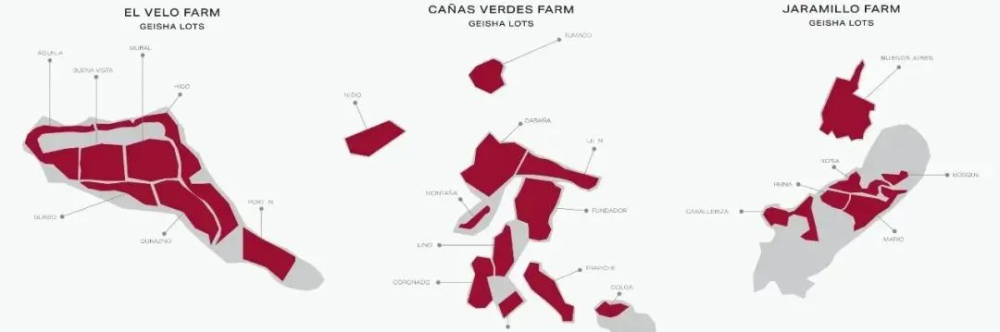
As for the once widely popular Blue Label Geisha (Geisha 1500), it was actually an early, high-value-for-money Geisha product launched by Hacienda La Esmeralda. It earned its name because it mainly came from plots at around 1500 meters altitude across the three main sub-estates. While the Blue Label Geisha still retained the distinctive characteristics of Geisha in terms of flavor, its slightly lower altitude meant its overall performance was not as outstanding as the Red and Green Labels. It was also more affordable, making it a top choice for many consumers. However, starting in 2021, Hacienda La Esmeralda decided to discontinue the production of Blue Label Geisha, leading to its gradual exit from the market and becoming a nostalgic memory for many coffee aficionados.
In addition, Hacienda La Esmeralda also includes the El Velo sub-estate. In addition to Geisha, this area also cultivates a variety of other cultivars such as SL34, Pacamara, and Laurina. As a result, the estate has also launched a ‘Varietals Collection’ to offer more choices for consumers who enjoy exploring new flavors. For those who prefer coffee with slightly lower altitude but still of good quality, the Diamond Mountain series is also a great option. It mainly uses the Catuai variety grown at Jaramillo and Canas Verdes, planted at altitudes between 1400 and 1600 meters, making it suitable for coffee lovers looking for different flavor profiles.
In summary, Hacienda La Esmeralda’s Geisha grading system reflects its rigorous commitment to quality. From the single-plot selection of the Red Label, to the blended premium selection of the Green Label, to the entry-level positioned Blue Label (Geisha 1500), each label has its own unique market positioning and flavor expression. Understanding this grading logic and origin background will help you choose the most suitable Geisha coffee based on your personal taste and budget, allowing you to experience the refined flavors of Panama’s highlands.
The above content is compiled by CoffeeHunters, a coffee news website.


