








Introduction:The Ethiopian central bank has recently introduced a new regulation on foreign exchange trading spreads, reducing the bid-ask spread to 2%, thereby easing the currency conversion pressure on coffee exporters. This article delves into the policy details, market reactions, as well as the actual benefits and challenges this adjustment brings to the coffee industry chain, helping readers grasp the latest changes in the trade environment.
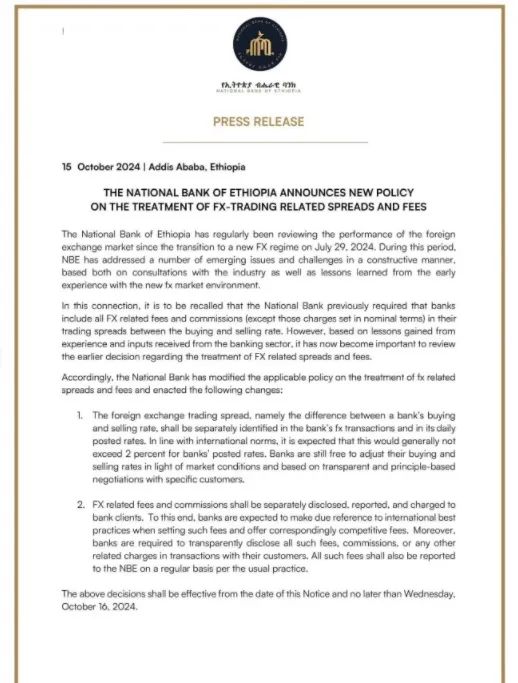
The National Bank of Ethiopia announced the new regulation on October 15, strictly limiting the bid-ask spread for foreign exchange transactions, with the cap set at2%, and the measure officially took effect the following day. This is another significant adjustment to the foreign exchange market following the implementation of a market-based exchange rate system in July this year, aiming to stabilize the economic environment and support export-oriented industries.
According to the new regulation, banks are not allowed to have a bid-ask spread exceeding 2% when conducting foreign exchange transactions, and they must clearly disclose all related fees and commissions to customers to ensure transaction transparency. Although banks can still negotiate interest rates based on market conditions and customer needs, they must adhere to the principle of openness. This policy is expected to significantly reduce foreign exchange losses for exporting companies, particularly benefiting major export commodities such as coffee.

Looking back to the end of July this year, Ethiopia moved toward a market-oriented foreign exchange system reform, with the goal of narrowing the gap between the official exchange rate and the black market rate, and addressing long-standing economic distortions. However, after the new system came into effect, the birr exchange rate experienced significant volatility. In early October, the selling rate of the US dollar by commercial banks once soared to1 USD to 125 birr, with the bid-ask spread widening to over 10 birr, placing a heavy burden on exporters.
After the announcement of the new policy, the market responded quickly. Multiple banks immediately adjusted their quotes, lowering the buying rate to113 birrand the selling rate to115 birr, with the spread subsequently shrinking to 2.26 birr, close to the policy limit. Prior to this, exporting companies had to exchange dollars at the higher rate of 123 birr to cover costs such as transportation, but when receiving payments, banks would only convert at the 112 birr rate, severely eroding profit margins.
Exchange rate fluctuations and wide spreads not only affect corporate earnings, but also led some exporters to raise their product prices, with the minimum price of coffee beans also being increased as a result2%. The new policy, by limiting the spread, effectively prevents banks from profiteering, ensures trading fairness, enhances market transparency, and creates a more stable business environment for exporters.
For Ethiopia’s coffee industry, this adjustment is of great significance. In the past, due to unstable exchange rates and black market interference, rising cultivation costs and living expenses forced exporters to rely on price hikes to maintain profits. Now, the 2% spread limit helps stabilize export revenues while also reducing the cost of imported raw materials, bringing a positive cycle to the entire industry chain.
Despite the benefits of the policy, Ethiopia still faces multiple challenges. Recent serious conflicts in the Amhara region in the north-central part of the country have escalated, with fighting between government forces and rebel militias intensifying and even involving heavy weapons, impacting the local economy and people's livelihoods. In addition, the Red Sea region has been affected by the blockade actions of the Houthi militants, leading to disruptions in international shipping and affecting Ethiopia’s import and export efficiency. The port dispute with neighboring Somalia remains unresolved, and logistical bottlenecks continue to be a pressing challenge.
The above content is compiled by CoffeeHunters, a coffee news website.


