







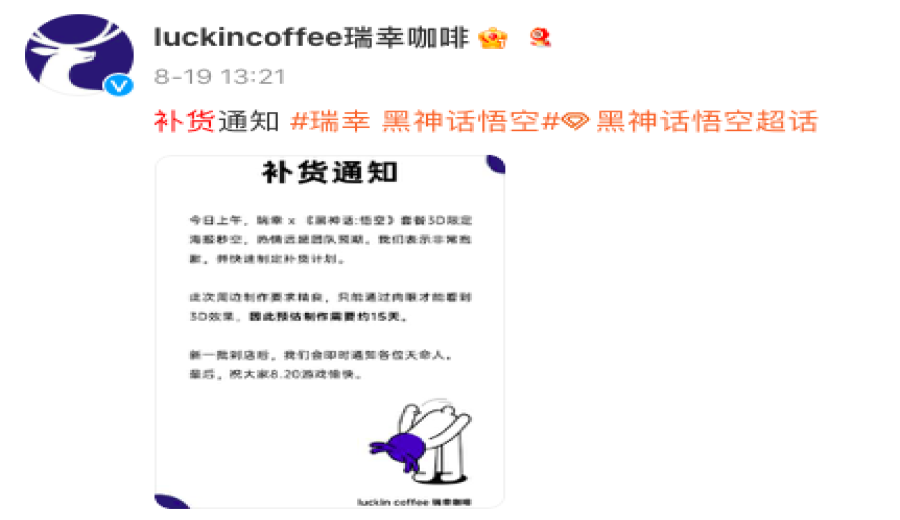
Introduction:Luckin Coffee’s collaboration with the hit game Black Myth: Wukong saw its lenticular card posters sell out almost instantly. After the brand promised a 15-day restocking period, some customers noticed that the production dates on the newly arrived items were the same as those from the first batch, raising suspicions that the company was passing off old stock as new. This article delves into the supply chain management issues behind the incident, explains how consumers can identify authentic merchandise, and offers practical advice to avoid being misled by scarcity marketing.
The collaboration between Luckin and the popular game Black Myth: Wukong sparked a shopping frenzy, with lenticular card posters at physical stores selling out within just a few hours of launch, triggering widespread dissatisfaction among customers. To appease the public, the brand announced it would restock within 15 days and promised to notify customers via official channels once the new stock arrived at stores.
However, when the promised restocking deadline arrived, the first customers to receive the new posters were surprised to find that the production dates on the packaging were clearly marked as July 15 — exactly the same as those from the first batch that had sold out.This discovery quickly caused an uproar on social media platforms.Many customers questioned whether Luckin had actually redistributed unsold old stock to stores rather than producing new items.
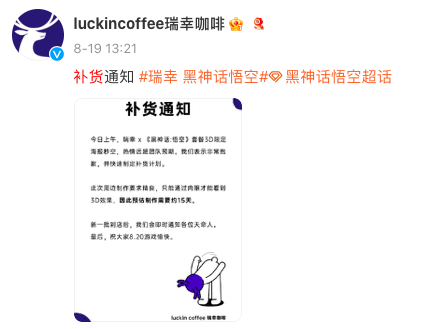
According to reports from customers in multiple cities, some stores in Beijing, Shanghai, Guangzhou, and other locations did receive the so-called “restocked” items within the expected timeframe, but upon closer inspection, they found that the production dates were identical to those of the items that had sold out two weeks earlier.Cities close to the production bases, such as Guangzhou and Shenzhen,received their new stock earlier over the weekend of the event due to shorter transportation distances, while other regions experienced varied arrival times due to differences in logistics schedules.
Notably, in addition to the lenticular card posters, other limited-edition merchandise such as exclusive cup sleeves and paper bags also began to be restocked and distributed to stores nationwide. However, upon inspecting the packaging, customers noticed that the production dates matched those of the first batch exactly, leading many to doubt whether the brand had truly produced new stock as promised.
Some customers compared the new and old batches of posters in detail and found no significant differences in print quality, paper thickness, or the placement of anti-counterfeiting labels, further fueling suspicions of “old stock passed off as new.” Even more confusingly, some stores apparently did not receive any restocked items at all and continued to provide customers with leftover stock from the first batch.
Industry experts pointed out that supply chain management for collaborative merchandise often involves complex production scheduling and inventory allocation. In popular IP collaborations, brands typically produce a certain quantity of goods based on estimated sales, but when actual demand far exceeds expectations, supply chain disruptions can easily occur.Luckin’s incident exposed two key issues:one being the huge gap between estimated sales and actual demand, and the other being the discrepancy between the restocking promise and its actual execution.
For consumers, this incident offers several important lessons: when participating in popular collaborations, it’s advisable to carefully check the production dates on product packaging; if restocked items show suspicious dates, customers can verify with official customer service; most importantly, avoid impulsive purchases of limited-edition items and rationally assess their actual value.
Experts suggest that when taking part in similar collaborations in the future, consumers should pay attention to the following:First, check whether the production date on the product packaging and the delivery date are reasonable;second, observe whether there are subtle differences in the product details; and finally, keep purchase receipts for potential rights protection. These practical tips can help consumers avoid potential marketing traps and make smarter purchasing decisions.
The above content is compiled by CoffeeHunters, a coffee news website.


