








Introduction:Yirgacheffe is one of Ethiopia’s most iconic coffee regions, renowned for its delicate floral aromas and bright citrus notes. It is often the first choice for many coffee enthusiasts exploring specialty coffee. This article delves into the geographical environment and climate conditions of Yirgacheffe, interprets Ethiopia’s defect-based green bean grading system, and explores how the washed processing method influences flavor — giving you a comprehensive understanding of the essence of this classic African bean.
Ethiopia is hailed as the birthplace of coffee, not only boasting the world’s richest coffee gene pool but also being Africa’s largest producer of Arabica beans. Among its many regions, Yirgacheffe stands out with its unique floral, citrus, and bright acidity profiles, making it a star region highly regarded in the specialty coffee world.
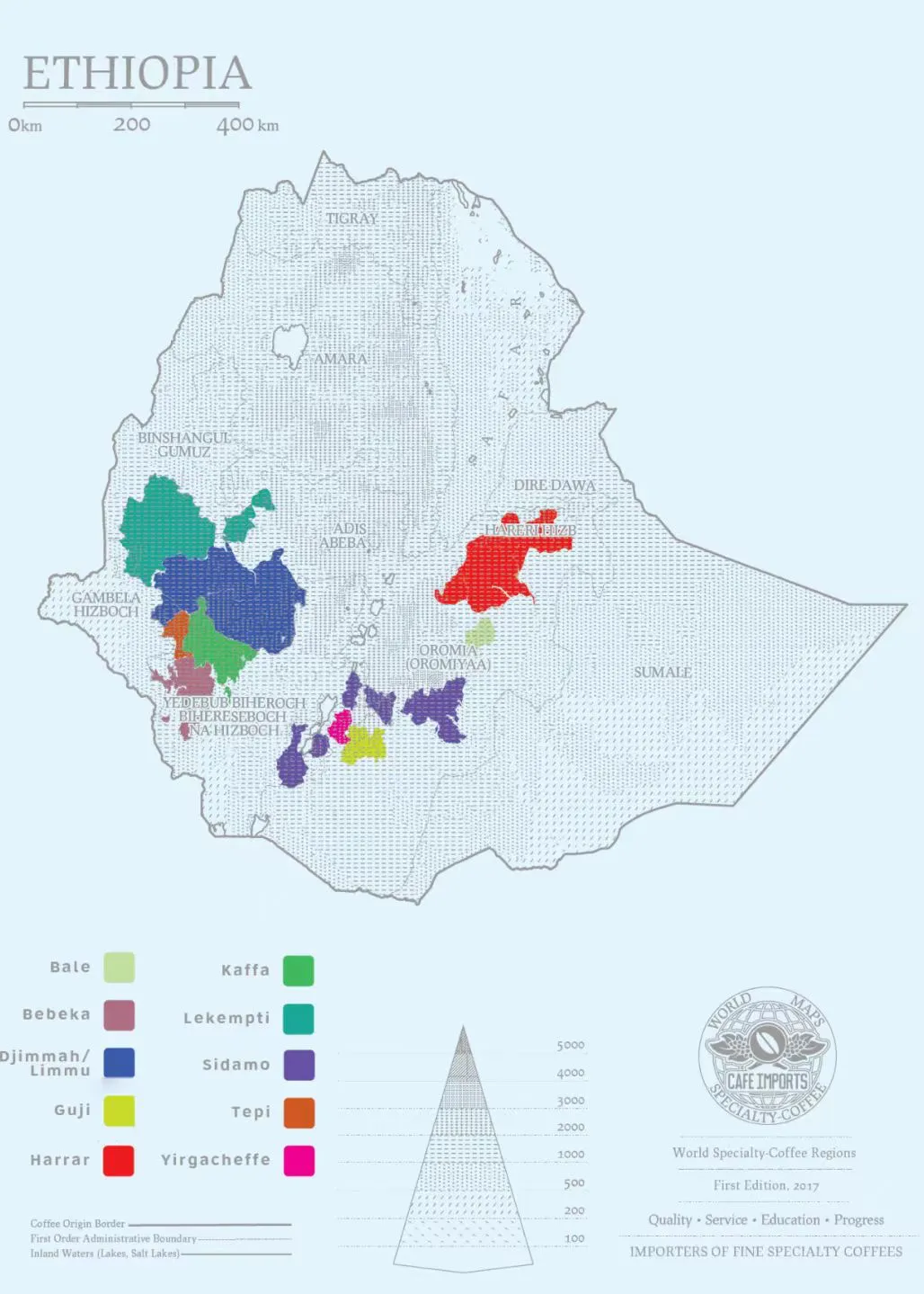
Located in central-southern Ethiopia near the East African Rift Valley, Yirgacheffe sits at high altitudes, with average planting elevations ranging between 1750 and 2200 meters. The region enjoys a cool climate with significant day-to-night temperature variations, along with mineral-rich volcanic soils that provide an ideal growing environment for coffee trees. The coffee from this area not only possesses distinct regional characteristics but is also often regarded as representative of African coffee flavors.

Ethiopia’s terrain is predominantly plateau and mountainous, with an average elevation exceeding 750 meters. Its climate is mainly tropical savanna and subtropical forest, but due to altitude effects, actual temperatures are relatively mild, averaging around 16°C throughout the year, and divided into distinct dry and rainy seasons. Such an environment is not only conducive to coffee cultivation but also endows the beans with rich and complex flavor layers.
In addition to its exceptional natural conditions, Ethiopia is home to an incredibly diverse range of coffee varieties. It is estimated that there are between 10,000 to 15,000 coffee varieties within the country, though most have yet to undergo complete genetic identification. This contributes to the wide variety of flavors found in Ethiopian coffee, often bringing unexpected surprises.
Although Yirgacheffe is often regarded as a single region, it actually encompasses several adjacent sub-regions, such as Wenago in the north, and Kochere and Gedeb in the south. These areas together form what we know as the “Yirgacheffe flavor circle.” Though these smaller regions are individually distinct, they share similar coffee characteristics due to comparable altitudes, microclimates, and processing methods.
In terms of green bean grading, Ethiopia primarily manages the system through the Ethiopia Commodity Exchange (ECX), using the ratio of defective beans as the main grading criterion. Based on defect rates and cupping results, coffee beans are divided into three major categories: Specialty, Commercial, and Local/Domestic grades for the domestic market. Only Specialty and Commercial grades are used for international export.
Specifically, all export coffee is initially categorized by processing method — either natural (sun-dried) or washed — and then evaluated based on the number of defects found in a 300g sample, followed by cupping to assess basic flavor quality. Subsequently, beans graded G1 to G3 are further cupped and scored according to SCAA (Specialty Coffee Association of America) standards: G1 and G2 beans scoring above 85 points are classified as Q1 Specialty grade; G1, G2, and G3 beans scoring between 80 and 85 points are classified as Q2 Specialty grade; and those scoring below 80 points are rated as G3 grade. Q1 and Q2 are collectively referred to as Specialty grades, mainly supplied to the international specialty coffee market. In contrast, G4 to G9 maintain their original grading and are collectively classified as Commercial Grade.
Regarding washed processing, Yirgacheffe coffee beans are typically refined using the washed method. This process effectively reduces impurities and off-flavors, while highlighting the coffee’s bright acidity and clear fruity notes. Yirgacheffe coffee processed via the washed method often exhibits pronounced floral aromas, citrus fruit notes (such as lemon and orange), and subtle berry flavors. It has a clean and vibrant acidity, a refreshing mouthfeel, and is a favorite among many pour over coffee enthusiasts.
Considering Yirgacheffe’s regional characteristics, grading logic, and processing techniques, it is easy to understand why it has become an important player in the global specialty coffee market. Whether as a daily drinking choice or as a starting point for exploring African coffee flavors, Yirgacheffe offers a rich and distinctive taste experience.
The above content is compiled by CoffeeHunters, a coffee news website.


