







Introduction:Kenyan coffee is renowned worldwide for its vibrant acidity and juicy fruitiness, all of which stem from its unique geographical and climatic conditions. This article delves into Kenya’s three major coffee-growing regions, with a special focus on the delicate terroir of the western foothills of Mount Elgon, exploring how this area produces specialty coffees with bright acidity and prominent citrus notes. We’ll also analyze the critical influence of altitude, soil, and processing methods on flavor.
Kenyan coffee has long been celebrated for its layered complexity and vibrant fruit aromas, making it a favorite among many specialty coffee enthusiasts. This East African country, with its high-altitude mountainous regions, fertile volcanic soils, and stable tropical monsoon climate, provides an ideal environment for cultivating high-quality Arabica coffee. The nation’s coffee-growing areas can be broadly divided into three geographical zones: the central core region, the East African Rift Valley, and the promising western highlands. Among these, the areas around Mount Elgon—specifically Elgeyo-Marakwet, Trans-Nzoia, and Bungoma—are particularly notable for producing coffees with bright acidity and pronounced citrus aromas.
Overall, the African continent, with its predominantly plateau terrain and the equator running through it, boasts diverse climates and is densely populated with mountains and volcanoes—conditions highly suitable for growing coffee, a crop that thrives in specific microclimates. Over 60% of Kenya’s land lies at elevations exceeding 1,500 meters above sea level. This not only results in cool and moderate day-night temperature variations but also provides ample sunlight and moderate rainfall, creating optimal growing conditions for coffee. These factors have established Kenya’s coffee as truly distinctive in the international market.
Looking back at history, the rise of Kenya’s coffee industry is closely tied to the plantation structures of the colonial era. After gaining independence, the government significantly improved coffee quality and farmers’ incomes through land reforms, the establishment of an auction system, and the implementation of rigorous grading standards. Today, Kenyan coffee cultivation is primarily concentrated in three key geographical regions, each yielding distinct cup profiles due to differences in terrain, climate, and processing methods.
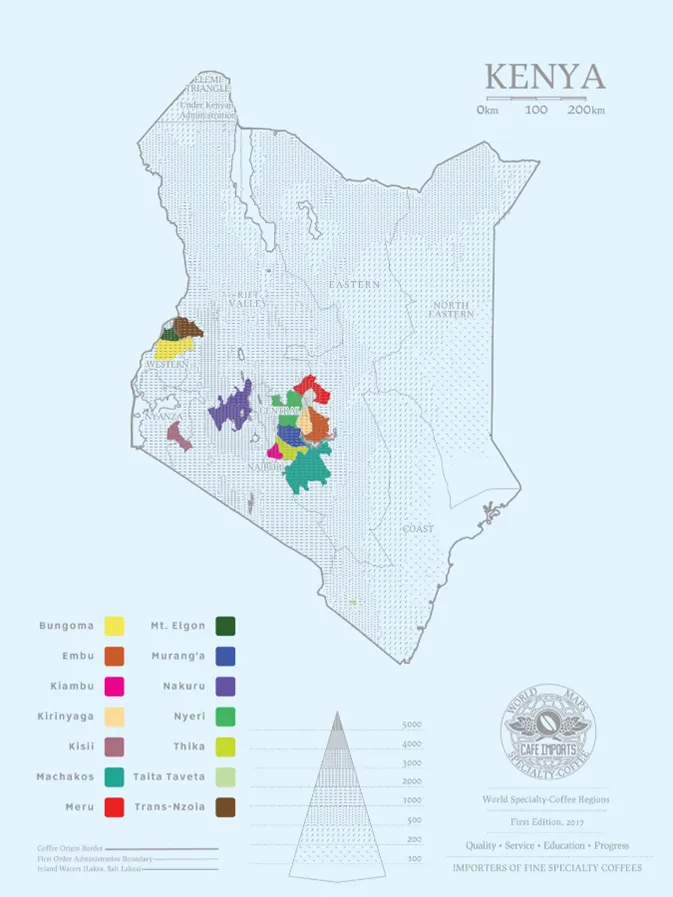
The central region is undoubtedly the heartland of Kenyan coffee, producing about 60% of the country’s output. Notable growing areas here include Nyeri, Kirinyaga, Kiambu, Murang’a, and Thika. These regions are mostly located on the slopes of Mount Kenya and the Aberdare Mountains, at altitudes ranging from 1,200 to 2,300 meters. In addition to mineral-rich red volcanic soils, their proximity to the capital, Nairobi, ensures relatively well-developed logistics and technical support. Coffee in this area is mostly grown by smallholder farmers organized into cooperatives, utilizing professional wet-processing mills to ensure consistent quality. For instance, the Assaliya factory in the Thika region often produces coffees with pronounced flavors of cherry tomato and dark plum, featuring lively acidity along with both sweetness and juiciness—a top recommendation for many baristas as an entry-level choice.
 The East African Rift Valley region is another noteworthy cluster of producing areas. This massive geological fissure, which runs across the African continent, includes a section in Kenya that encompasses growing areas such as Nakuru and Kisii. Historically dominated by agriculture and livestock farming, this region has gradually shifted toward specialty coffee cultivation in recent years. Nakuru, in particular, benefits from the nurturing environment of Menengai Volcano and Lake Nakuru, with coffee grown at elevations between 1,850 and 2,200 meters—considered relatively high. Coffees from this area typically exhibit gentle acidity, rich fruitiness, and an enticing chocolatey aftertaste, making them especially popular among fans of medium roast profiles.
As for the western region, it is the main focus of this article. This area primarily consists of three major producing zones at the foothills of Mount Elgon: Elgeyo-Marakwet, Trans-Nzoia, and Bungoma. Coffee farming is concentrated on hillsides and slopes at altitudes of 1,500 to 1,950 meters. The terrain here is rugged, crisscrossed with streams and waterfalls, complemented by fertile soils, lush vegetation, and a humid climate with annual rainfall reaching up to 1,279 millimeters—creating an exceptionally ideal environment for coffee cultivation. Coffees produced in this region generally boast exceptionally bright acidity, coupled with refreshing citrus fruit notes such as lemon and orange. They also deliver a full-bodied mouthfeel and complex layers, making them an unmissable choice for those seeking distinctive flavor profiles.
 In summary, the diversity of Kenyan coffee arises not only from its rigorous grading and auction systems but also from the unique geographical conditions of each producing area. Whether you’re a beginner coffee enthusiast or a roaster in pursuit of distinctive flavors, gaining a deeper understanding of the terroir characteristics of these regions can help you make more precise selections and brewing decisions—allowing you to fully enjoy the pure essence of Africa’s highlands in every sip.
The above content is compiled by CoffeeHunters, a coffee news website.


