








Introduction:The 2024 Best of Panama (BOP) competition awarded the “Producer of the Year” title for the first time, which went to the historic Lamastus family. This article takes an in-depth look at three of the family’s top estates located in the Boquete region—Elida, El Burro, and Luito—exploring their altitude, varieties, microclimates, and processing methods to uncover the sources of their exceptional coffee flavors. It also offers practical brewing suggestions to help you better appreciate the essence of top-tier Panamanian coffee.
Panamanian coffee has secured a place in the global specialty market, not only thanks to the renowned Geisha variety but also due to the long-term efforts of the Specialty Coffee Association of Panama (SCAP) in promoting quality improvement and market connectivity. Among these efforts, the BOP (Best of Panama) competition, held annually since 1996, attracts numerous top producers each year. It not only helps premium coffees reach international markets through auctions but also continuously boosts Panama’s coffee reputation. After Geisha stood out with its extraordinary flavor profile in 2005, it became the dream variety sought after by coffee lovers worldwide.
Panama’s geographical environment is uniquely favorable, featuring mountainous terrain, widespread volcanic landforms, and a tropical maritime climate with significant day-night temperature variations. The average annual temperature ranges between 23°C and 27°C, with abundant rainfall of about 1,500 to 2,500 millimeters per year. Coupled with the diverse microclimates created by the complex terrain, it provides nearly perfect growing conditions for coffee trees. Major producing regions include Boquete, Volcán-Candela, and Río Sereno, among which Boquete is the most renowned.
In the 2024 BOP competition, the “Producer of the Year” award was introduced for the first time, and it was ultimately won by the Lamastus family, who have been deeply rooted in Boquete for many years. The family’s three major estates—Elida Estate, El Burro Estate, and Luito Estate—are all located in this region. Each boasts unique terroir and cultivation stories, serving as cradles for cultivating exceptional coffees.
Elida Estate is a key asset of the Lamastus family, with a history dating back to 1918 when it was founded by Robert Louis Lamastus. The estate is named in honor of his wife, Elida. It is now managed by the second-generation family member, Wilford Lamastus. Covering an area of 65 hectares, over half of which lies within the boundaries of the Barú Volcano National Park, about 30 hectares are planted with coffee, while the rest remains pristine forest. Coffee is cultivated at elevations between 1,670 and 1,850 meters, making it one of the highest-altitude estates in Panama, which contributes to the production of coffee with delicate and complex flavors. The estate mainly grows classic varieties such as Geisha, Typica, and Caturra. In the 2024 BOP competition, its Geisha natural processed lot won the championship with an impressive score of 95.13.
El Burro Estate has a story of family perseverance. Originally established by Amado Boutet, the maternal grandfather of the Lamastus family, the estate was once considered for sale during a downturn in the coffee market. However, Wilford Lamastus and his brother Patrick were determined to preserve the family legacy and took over its management. Interestingly, the estate was originally a livestock farm, hence the name “El Burro” (The Donkey). Located at the southern end of the producing region, El Burro Estate sits at an elevation between 1,550 and 1,800 meters, covering a total area of about 50 hectares. Of this, 20 hectares are dedicated to growing Geisha and Catuai, another 10 hectares are reserved for future expansion, and the remaining areas fall within the protected zone of the Barú Volcano National Park, preserving the intact ecosystem.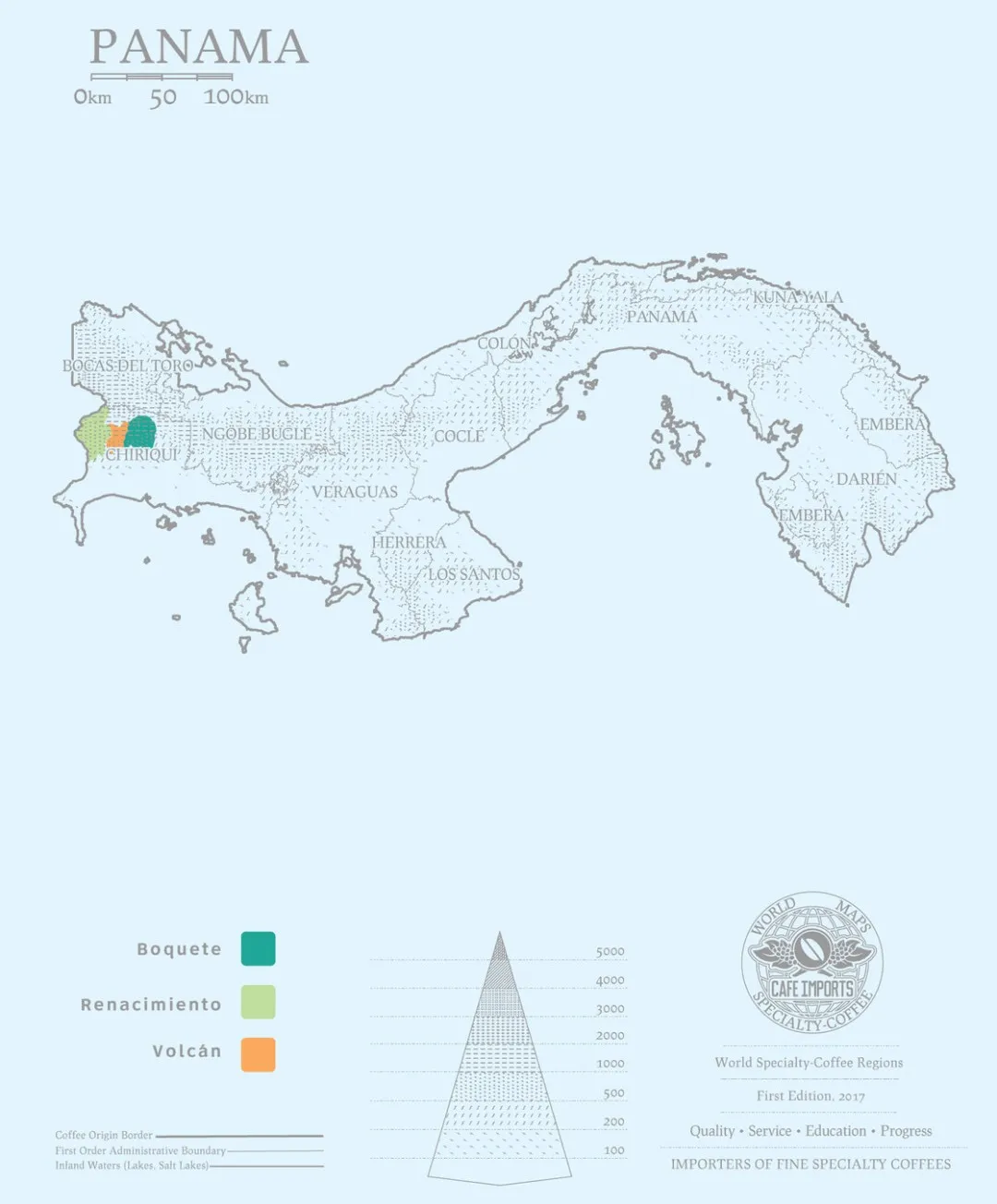
Finally, Luito Estate is managed by Wilford Lamastus’s elder brother, Luito Lamastus. It is located in the northernmost part of Boquete, close to the mountains, with some sections even situated within the Parque Internacional de la Amistad (La Amistad International Park). This small-scale estate spans just 5 hectares, at an elevation between 1,600 and 1,750 meters, and focuses solely on cultivating the Geisha variety. Due to its unique geographical location, the area has a different rainfall pattern compared to most parts of Boquete, maintaining stable precipitation even during the traditional dry season. This results in a distinct coffee tree growth cycle compared to neighboring estates and contributes to its unique flavor profile.
To experience the flavor charm of Lamastus family coffees, you might want to try the Caturra variety from Elida Estate. Introduced by a well-known coffee brand, this bean is sun-dried, medium-light roasted, and grown at an altitude of 1,850 meters. It is recommended to use a V60 dripper, with a 1:15 coffee-to-water ratio and water temperature around 92°C for pour over. After brewing, you can enjoy sweet notes of peach, raisin, orange, and caramel, with a subtle green tea aroma in the aftertaste. The overall mouthfeel is smooth and clean, making it an excellent choice for everyday premium pour over.
The above content is compiled by CoffeeHunters, a coffee news website.


