








Introduction:Brazil is the global leader in both coffee production and exports, and within this kingdom, Minas Gerais stands out as the crown jewel, accounting for 30% of the nation’s total output on its own. Moreover, the state boasts a wealth of microclimates and renowned sub-regions, including Cerrado, known for its chocolatey and nutty flavor profiles, and Sul de Minas, the heartland of the coffee industry. This article will delve into the geographical advantages, historical background, and representative farms of this coffee powerhouse, uncovering the quality secrets behind its high production.
As the world’s leading producer and exporter of coffee, Brazil accounts for nearly one-third of global coffee exports, firmly holding the top spot. Among the country’s 26 states, 17 are involved in coffee cultivation, with Paraná, São Paulo, Minas Gerais, and Espírito Santo together contributing over 80% of the total output. Notably, located in southeastern Brazil, Minas Gerais not only takes the crown for production with about 30% of the national share but also maintains a high standard in terms of flavor and quality.
Minas Gerais enjoys uniquely favorable geographical conditions, home to some of Brazil’s highest peaks. These natural barriers effectively weaken the intrusion of Atlantic sea winds, providing a stable growing environment for coffee plants. Beyond its macro-level terrain advantages, the state is further divided into multiple representative coffee sub-regions, such as Cerrado, famous for its honey processing method, and Sul de Minas, hailed as the “heart of Brazil’s coffee industry.”

Coffee from the Cerrado region often employs the honey processing method, featuring a clear flavor profile commonly characterized by rich chocolate and nutty notes. It has a smooth mouthfeel and distinct layers, making it an excellent choice for beginners looking to explore specialty coffee. Sul de Minas, on the other hand, is dominated by mid-to-high altitude mountainous terrain ranging from 700 to 1200 meters. The area is mostly hilly, making mechanized harvesting difficult, thus relying more on traditional manual methods, which also contributes to a higher pursuit of quality. This region not only has a deep coffee culture but also hosts numerous prestigious farms, including Fazenda Esperança (Hope Estate), Fazenda Ipanema (Ipanema Estate), and Fazenda Santa Inês (Santa Inês Estate).
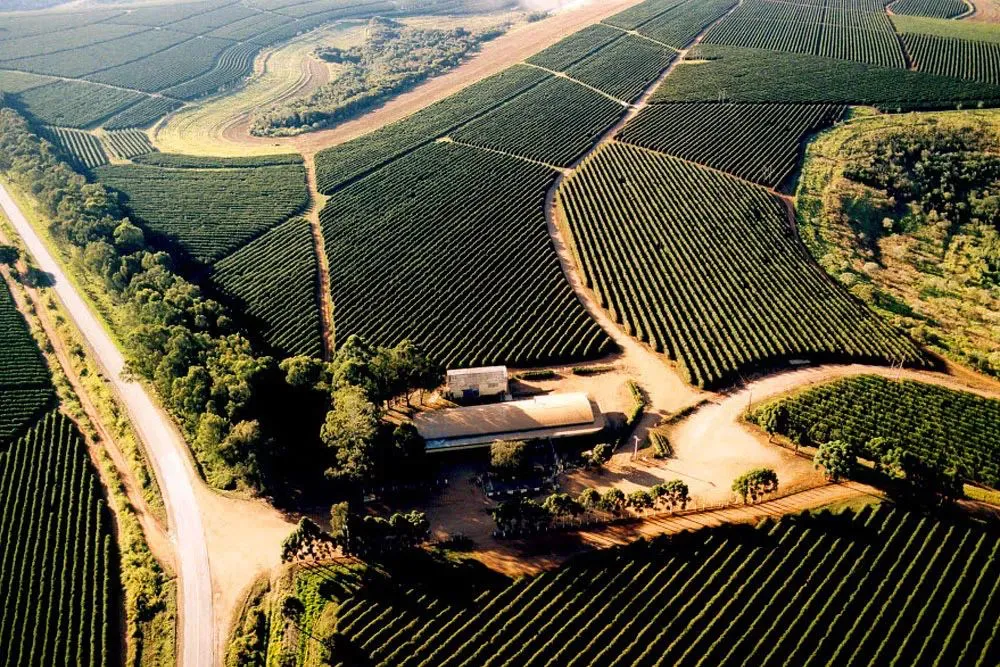
Among them, Fazenda Ipanema (Ipanema Estate), established in 1969, is one of the founding members of the Brazilian Specialty Coffee Association (BSCA). It manages over 5,500 hectares of vast land and approximately 14 million coffee trees. The estate includes three main farms, among which Fazenda Rio Verde (Rio Verde Farm) is the most representative. Located at the heart of the Mantiqueira Mountains in Sul de Minas, this farm has existed since 1887 and was only incorporated into Fazenda Ipanema in 2002, covering a total area of 1,500 hectares.
Rio Verde Farm not only boasts magnificent natural scenery, surrounded by dense woodlands, waterfalls, and natural hot springs, but also benefits from the regulated climate of the Mantiqueira Mountains, ensuring stable and suitable rainfall and temperature conditions. Its coffee planting areas are mainly concentrated at high altitudes between 1,000 and 1,310 meters. This elevation not only facilitates the slow ripening of coffee cherries but also aids in the accumulation of flavor compounds. The farm also adheres to a diversified crop co-cultivation model, growing other economic crops alongside coffee, which helps maintain soil health and ecological balance.
More notably, Rio Verde Farm is equipped with a complete team of professional technicians, with strict quality control standards and technical support across all stages from green bean processing, pre-roasting treatment, to storage. This end-to-end oversight from cultivation to post-harvest processing is also key to its repeated international acclaim. In the 2023 Brazil Cup of Excellence (COE) competition, the farm even claimed the top spot with an impressive score of 92.15, showcasing its exceptional quality.
In summary, Minas Gerais has become a Brazilian representative that excels in both coffee production and quality, not only due to its geographical advantages but also thanks to its diverse microclimates, rigorous cultivation management, and renowned farms like Ipanema and Rio Verde that strive for excellence. If you wish to explore the diverse profiles of Brazilian coffee, you might start with the honey-processed beans from Cerrado, then further savor the complex layers nurtured by the highlands of Sul de Minas, experiencing the profound heritage of this coffee kingdom.
The above content is compiled by CoffeeHunters, a coffee news website.


