








Introduction:The One-Pour Dragon Tornado Pour Over combines the traditional One-Pour technique with cyclonic pouring to extract richer and more full-bodied coffee flavors through high water temperature, fine grind size, and a unique vortex creation method. This article details the steps, key parameter settings, compares it with the standard One-Pour technique, and analyzes suitable and unsuitable coffee bean types to help you master this advanced pour over skill.
In the world of pour over coffee, innovative methods are emerging one after another, and the “One-Pour Dragon Tornado Pour Over” is an advanced technique that fuses the traditional One-Pour method with cyclonic pouring. This approach divides the total water volume into two non-interrupted phases—bloom and main extraction—and uses rapid circular pouring combined with focused high-flow pouring to create a vortex, enhancing extraction efficiency and delivering a richer mouthfeel. However, this technique demands high-level control over water flow and precise parameter matching, and is not suitable for all coffee beans. The following will delve into its operational procedure, parameter adjustments, comparison with the regular One-Pour, and recommended coffee bean types.
What is the One-Pour Dragon Tornado Pour Over?
The term “One-Pour” refers to dividing the total water volume into two phases: the first for blooming and the second for main extraction, with no pause between them, typically resulting in a bright acidity and clean aftertaste. The “One-Pour Dragon Tornado” builds on this foundation by adding a cyclonic pouring technique, creating a more dynamic extraction method. The “Dragon Tornado” refers to generating a vortex effect in the filter by using rapid circular movements and focused high-flow pouring, thereby improving the agitation and uniformity of extraction across the coffee grounds.
Three Stages of the Dragon Tornado Pour Over
Generally, the One-Pour Dragon Tornado Pour Over can be divided into three main stages: first is the bloom phase for releasing CO₂, followed by the initial watering done via rapid circular pouring, and finally the vortex creation in the filter using focused high-flow pouring. Since the One-Pour only uses a single stage of pouring after the bloom, compared to multi-stage extraction, the overall brewing time is shorter. Coupled with the fact that the cyclonic method can cause more disturbance in water level, it is recommended to use a finer grind size and higher water temperature to ensure sufficient extraction.
Practical Comparison: Standard One-Pour vs. One-Pour Dragon Tornado
To better understand the effects of the One-Pour Dragon Tornado, we conducted practical tests using Ethiopian Natural Yirgacheffe G1 coffee beans, employing both the standard One-Pour and the One-Pour Dragon Tornado techniques. The parameters for the standard One-Pour group were as follows: 16g coffee dose, 1:15 brew ratio, 91°C water temperature, 20-mesh sieve passing rate of 80% (equivalent to EK43s setting 10), using a Hario V60 resin filter. The operation involved pouring 30–35g of hot water in small streams from the center outward in a circular motion for a 30-second bloom, then continuing with the remaining water poured in a mosquito-coil-like even circular motion. The total brew time was about 1 minute and 46 seconds, and the resulting flavors included mango, lemon, grape, and green tea aromas, with bright acidity but a relatively thin mouthfeel.
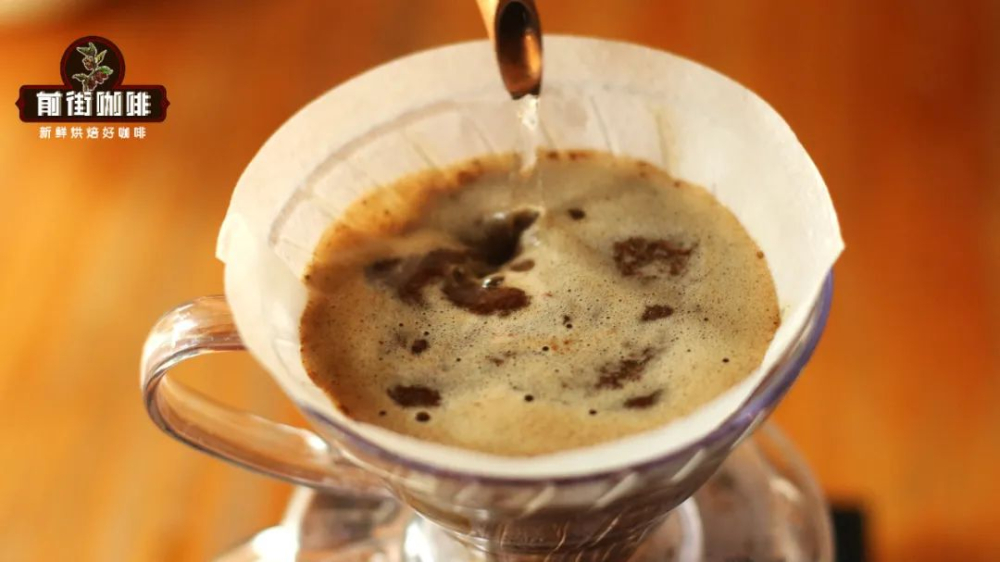
For the One-Pour Dragon Tornado group, the water temperature was adjusted to 94°C, and the grind size was increased to a 20-mesh sieve passing rate of 85% (EK43s setting 7). During the operation, the bloom also used 30–35g of hot water for 30 seconds, after which the second stage of pouring began. At this point, the pouring height was increased and the circular speed was accelerated to enhance agitation of the coffee bed. When the liquid level rose to about four-fifths full in the filter (around 40–45 seconds), the pouring point was moved to one side of the filter, the kettle spout was lowered close to the liquid surface, and a large-focused stream was poured at a fixed point until the total weight reached 240g, stopping at around 1 minute and 20–30 seconds. The results showed a deeper coffee bed crater and thinner coffee walls without clogging, and the flavors exhibited more fermented notes such as dried fruit, peach, cherry, guava, and blueberry. The cup was fuller-bodied with a more substantial mouthfeel.
Analysis of Suitable and Unsuitable Coffee Bean Types
To further verify the applicability of this technique, we also tried using a medium-light roasted Tanzanian washed Kilimanjaro and a dark roasted Indonesian Mandheling (with a Kono filter). The results showed that the Tanzanian beans mainly exhibited citrus fruit acidity, but the aroma was thin and lacked complexity, with a slightly woody aftertaste, suggesting partial over-extraction and partial under-extraction. The Mandheling, on the other hand, due to the high water temperature and fine grind, presented an overly strong smoky character, with its positive aromas not fully expressed. This indicates that the One-Pour Dragon Tornado technique is more suitable for medium-roasted beans, where balanced acidity, sweetness, and body can complement this aggressive method.
How to Successfully Create the “Dragon Tornado” Effect?
The key to creating the vortex lies in the final step of focused high-flow pouring. In principle, it involves controlling the size, angle, and height of the water stream to drive the coffee particles in the filter to move rapidly, forming a swirling vortex. In practice, it’s important to observe the direction of the coffee particles’ movement and adjust in real-time according to the liquid level. Experience shows that keeping the kettle spout close to the liquid surface, directing the flow toward the edge of the filter, and increasing the water flow intensity can help form a stable vortex more quickly. While this technique is visually impressive and helps maintain a deep and even coffee bed crater, it demands a high level of control over water flow and circular pouring skills, and is recommended for those with some pour over experience.
In summary, the One-Pour Dragon Tornado Pour Over is an advanced pour over method that combines skill and creativity. Through specific parameters and a unique pouring technique, it can extract coffee flavors with more layers and a fuller body. However, it has a relatively high operational threshold and requires careful selection of suitable coffee beans. It is recommended that coffee enthusiasts who enjoy a challenge master the basic One-Pour technique first before attempting this method to fully realize its potential.
Image descriptions:

The above content is compiled by CoffeeHunters, a coffee news website.


