








Introduction:The results of the 2024 Nicaragua Cup of Excellence (COE) have been announced, with the Geisha variety once again securing multiple high rankings. Meanwhile, Parainema, making its debut, impressively claimed second place with a score of 89.85, drawing significant market attention. What makes this disease-resistant variety, which once won the Honduras COE, so exceptional? This article delves into its varietal background, breeding history, cupping performance, and explores the shifting status of disease-resistant varieties in the specialty coffee industry.
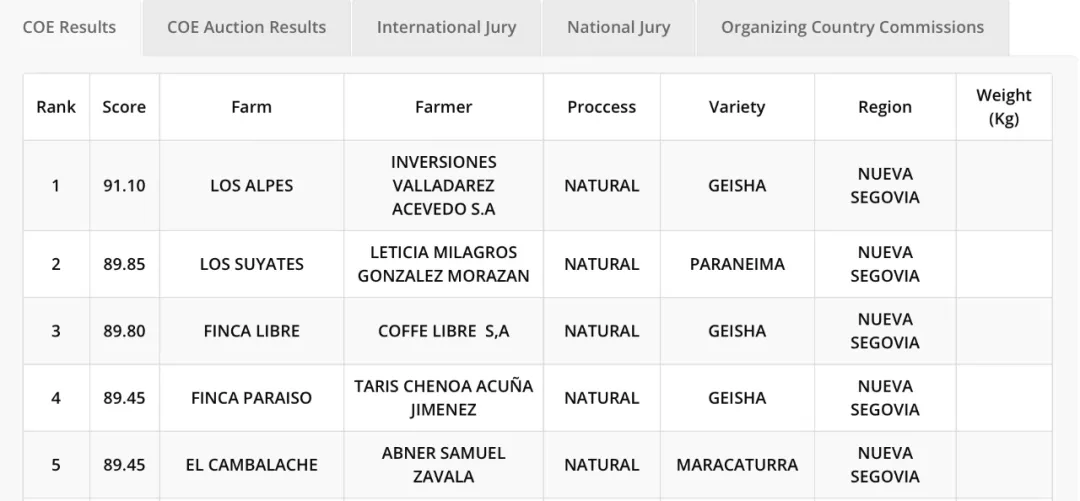
The results of the 2024 Nicaragua Cup of Excellence (COE) competition have recently been officially released, with several high-quality coffee beans standing out under the global buyers’ spotlight. Among them, the well-known Geisha variety continued its popularity and stable performance, taking the first, third, and fourth places in the competition. Notably, a naturally processed Geisha scored an astonishing 91.10 points to claim the championship.
However, the most talked-about highlight of this year’s competition was undoubtedly the appearance of the Parainema variety in Nicaragua for the first time. This relatively rare variety,with a remarkable score of89.85 points,

secured second place, not only showcasing extraordinary flavor potential but also prompting a reevaluation of whether disease-resistant coffee varieties can achieve a balance between quality and practicality.
The Cup of Excellence (COE) is an international coffee evaluation competition first launched in Brazil in 1999 by the non-profit organization Alliance for Coffee Excellence (ACE). It is also the world’s first competition to publicly auction winning coffees via an online bidding platform. Participating countries can host their own COE events, with entries sourced from various regions within the country. The beans are rigorously blind-tasted and scored, and the winning coffees are then auctioned internationally. This not only brings prestige to the farms but also generates substantial economic returns.
The 2024 Nicaragua COE featured a diverse range of competing varieties. In addition to the champion Geisha, there were also Maracaturra, Pacamara, and Parainema, demonstrating the diversity and innovation in Nicaraguan coffee cultivation.
Out of the top ten overall, the Geisha variety dominated by claiming first, third, and fourth places. Among them, the naturally processed Geisha impressed judges with its complex floral notes, citrus tones, and long-lasting sweetness, earning unanimous praise and ultimately topping the charts with a score of 91.10.In contrast, Parainema, which took second place, may not be as famous as Geisha, but itsscore of 89.85was equally impressive. Notably, this variety had previously won the Honduras COE in 2017 with astunning score of 91.81,
demonstrating its exceptional potential. However, in the 2023 Honduras competition, its performance was relatively modest and it ranked lower. It wasn’t until this year’s debut in Nicaragua that it regained attention from both the market and judges.
Parainema actually has a strong breeding background. Its lineage can be traced back to T5296 Sarchimor, a new variety selected by the Honduran Coffee Institute (IHCAFÉ) from the T5296 line.
The origin of T5296 goes back to the 1978 “PROMECAFE” Central American Regional Alliance Program, jointly funded by the USAID’s Regional Office for Central America and Panama (ROCAP) and the Brazilian Agricultural Research Corporation (IAC). The primary goal of this program was to combat the increasingly severe issue of coffee leaf rust at the time.
In this context, Portugal’s renowned coffee research institution CIFC (Centro de Investigação das Ferrugens do Café) imported a large number of Timor variety seeds (a natural hybrid of Arabica and Robusta) from Timor Island, and from these, selected two plants with extremely high resistance to leaf rust for breeding research. One of these, named HDT CIFC 832/2, was crossed with the dwarf variety Villa Sarchi, resulting in H361 — later known as Sarchimor.
Subsequently, under the PROMECAFE program, H361 was sent to the Tropical Agricultural Research and Higher Education Center (CATIE) in Costa Rica for further breeding selection and was renamed T5296 (with T representing Turrialba, where CATIE is located). T5296 was then distributed to several countries in the Americas for trial planting and improvement.
In Honduras, IHCAFÉ carried out localized selection and breeding work on T5296, eventually naming it Parainema. This variety, in addition to having high resistance to leaf rust and nematodes, features green-tipped young leaves and a relatively small plant size, making it highly suitable for high-density planting. Moreover, Parainema coffee beans are larger and more slender, offering good processing flexibility.However, for a long time, many coffee buyers held biases against such disease-resistant varieties, believing they often underperformed in cupping evaluations compared to traditional high-quality varieties, with simpler flavor profiles. Theimpressive score of 89.85
achieved by Parainema in the Nicaragua COE undoubtedly provides such varieties with an opportunity to shine, prompting the industry to reconsider the possibility of combining disease resistance with outstanding flavor.
The above content is compiled by CoffeeHunters, a coffee news website.


