







Introduction:Recently, multiple Starbucks outlets have trended on social media due to incidents where non-paying customers were asked to leave, sparking widespread discussion about whether commercial premises can be considered public spaces. Where does Starbucks’ “purchase-to-sit” policy come from? How should the rights of businesses and customers be balanced? This article delves into the real challenges behind the controversy and explores reasonable solutions.
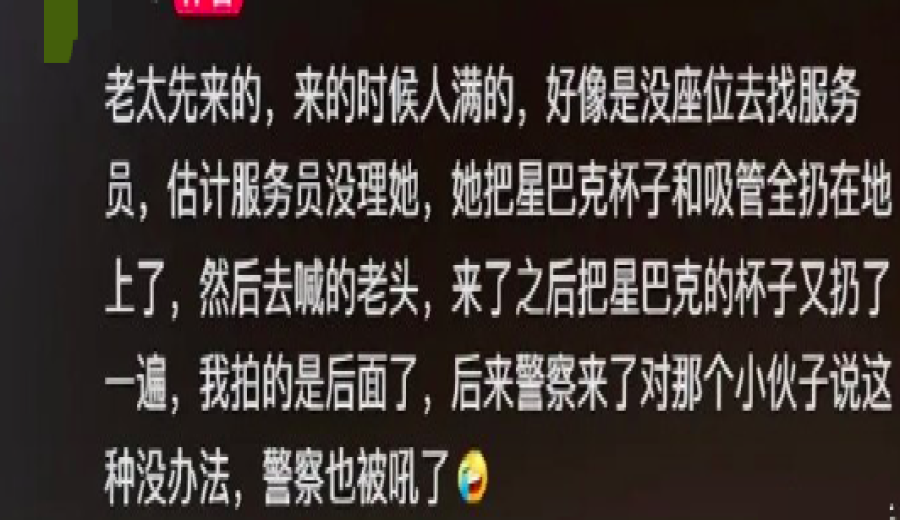
Recently, several videos have circulated on social media platforms showing disputes between Starbucks staff and non-paying customers. In these clips, both sides sticking to their own stories quickly became a hot topic. In one incident, an elderly customer, citing limited seating and a noisy environment inside the store, asked the staff if they could rest for a while. However, the request was politely declined because the customer had not made a purchase. The elderly individual, visibly upset, raised their voice and questioned, “Just because I’m old, I can’t come in and sit?” They even threw their belongings on the floor, escalating the argument to the point where police had to be called to mediate. Although some bystanders tried to calm the situation, the elderly person remained agitated, and even the responding officers became targets of criticism.
Similarly, a Starbucks outlet in Xi’an was caught on camera handling a comparable situation—staff members were seen asking multiple non-paying individuals taking temporary rest to leave within a short period. According to the person who recorded the incident, one male customer was approached by staff less than a minute after sitting down and was asked whether he had made a purchase. After confirming he hadn’t, he was asked to leave. Notably, there were still available seats in the public area outside the store, but as long as customers chose to sit inside, staff would check their purchase status, and most non-paying individuals were asked to leave.
In response to the series of controversies, Starbucks’ official customer service stated that stores do have a basic “purchase-to-sit” policy, primarily aimed at maintaining reasonable use of the store environment. However, the customer service emphasized that enforcement is generally conducted through polite persuasion, rather than strictly requiring every customer to make a purchase. This explanation aligns with the recollections of some store employees—some revealed that Starbucks had never had an explicit rule stating “you must buy a drink to sit,” and due to the comfortable store ambiance, many passersby often came in to rest.
However, the original intention of “open seating” has over time led to numerous management challenges. According to feedback from multiple stores, uncivilized seat usage has become increasingly frequent in recent years. This includes customers bringing their own food to eat inside, individuals occupying multiple tables alone, or even people conducting commercial photo shoots, applying makeup, or getting eyebrow tattoos inside the store. These behaviors not only affect the experience of other paying customers but also increase the cleaning and order-maintenance burden on staff. One employee admitted that the original goodwill of providing resting space has gradually been offset by certain “seat-squatting” behaviors, making it difficult for customers who genuinely want to buy drinks or enjoy the coffee atmosphere to find suitable seating.
Faced with these challenges, more and more stores have started to enforce the “purchase-to-sit” rule more discreetly. Most staff members gently remind non-paying customers, using phrases such as “Currently, there is high demand for seating, so we recommend sitting if you plan to make a purchase.” However, some members of the public believe that posting clear usage guidelines in visible areas of the store (such as “This store’s seating is primarily for paying customers, thank you for your cooperation”) could reduce misunderstandings and allow customers to understand the basic rules before entering, thereby avoiding unnecessary conflicts.
Based on online comments, public opinion on Starbucks’ policy is divided: supporters argue that coffee shops are inherently commercial spaces aimed at profit, unlike public areas such as park benches or train station waiting rooms. Businesses have the right to set reasonable usage conditions. Requiring customers to make a purchase can ensure operational sustainability and protect the rights of those who genuinely need the service. Opponents, however, point out that even if a customer hasn’t made a purchase, as long as they are not causing significant disruption (such as occupying excessive space or being loud), the store should maintain some flexibility. After all, “letting people sit and rest” has traditionally been part of the public perception of cafes.
Industry insiders analyze that this controversy highlights the blurred boundaries of “usage rights in commercial premises.” When businesses create comfortable environments to attract foot traffic, balancing “an open atmosphere” with “actual operational needs” requires clearer communication and management strategies. For consumers, it is advisable to observe in-store notices or ask staff about seating rules before entering a café. For businesses, in addition to enforcing basic policies, they might consider designating “purchase zones” and “resting zones” (if space allows), or offering flexible options such as “short-term stays for customers who make a beverage purchase,” to accommodate the needs of different groups.
The above content is compiled by CoffeeHunters, a coffee news website.


