







Introduction:The March export report from the Colombian Coffee Growers Federation (FNC) shows that both production and exports declined month-on-month, primarily due to the impact of drought. Although there was year-on-year growth, the industry faces numerous challenges, and whether the government should take over the FNC has sparked widespread discussion. This article provides an in-depth analysis of the latest data, the impact of climate change on production, and the ongoing policy debate, while also recommending Colombian coffee beans suitable for pour over brewing to help readers stay informed about market trends and bean selection.
The latest March export report released by the Colombian Coffee Growers Federation (FNC) indicates that although coffee production and exports for the month were higher than the same period last year, both saw a significant month-on-month decline, mainly due to the ongoing impact of drought. Meanwhile, the Colombian president’s proposal for the national government to take over the FNC continues to generate discussion, but no concrete action has been taken by the government so far, sparking widespread debate within the industry.
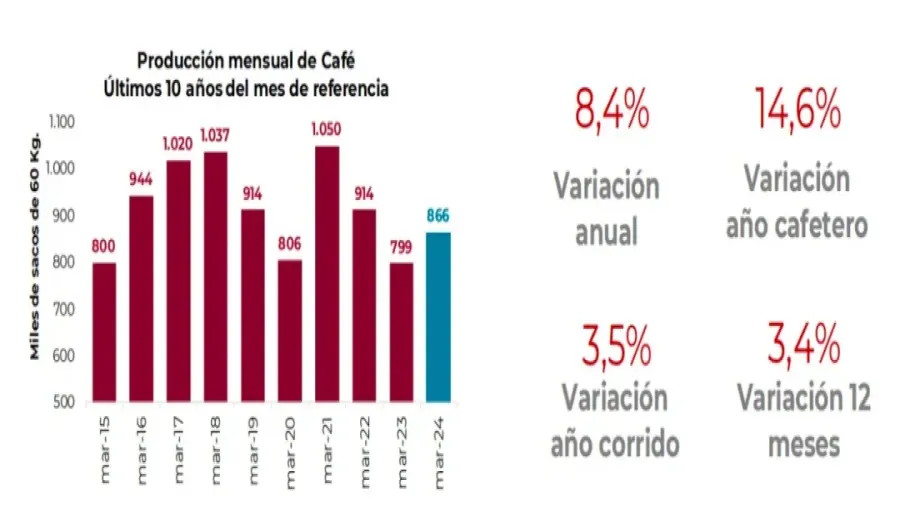
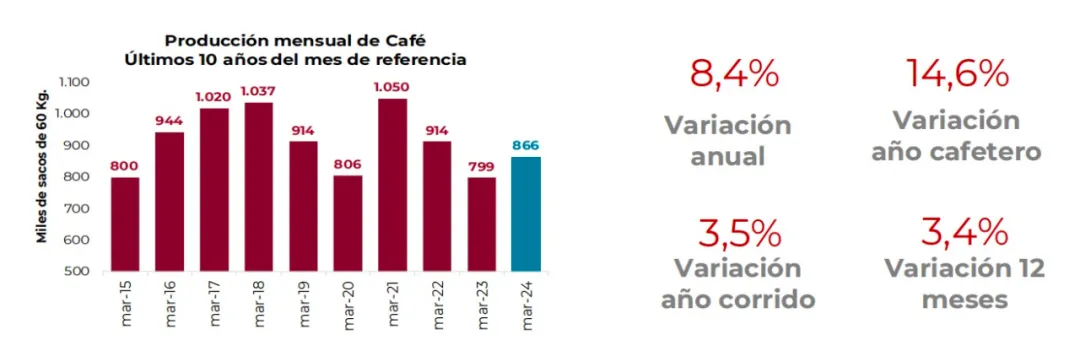
According to FNC statistics, Colombia’s coffee production in March 2024 was866,000 bags(each bag weighing 60 kilograms), which is an increase of8.4%compared to the 800,000 bags produced during the same period last year, but a decrease of9%compared to February’s 961,000 bags. This decline is largely due to the recent nationwide drought, which has severely affected the growth and harvest of coffee cherries.
In terms of exports, Colombia exported1 million bags(60-kilogram bags) of coffee in March, an increase of10.9%year-on-year, but a decrease of3.8%month-on-month compared to February. The total value of coffee exports for the month reached$281 million, an increase of4.5%compared to March 2023, with the rise in revenue mainly driven by higher global coffee prices.
Overall, although March’s production and export volumes were higher than the same period last year—primarily because 2023 saw a significant drop in Colombian coffee output due to the El Niño phenomenon—early 2024 initially saw a short-term rebound in production, which was later hampered by abnormal weather conditions, leading to the month-on-month decline in March data.
Colombia’s Ministry of Environment and the Institute of Hydrology, Meteorology and Environmental Studies (IDEAM) pointed out that since the beginning of this year, the average water levels in many reservoirs across the country have been30%below normal, prompting water rationing measures in many areas. However, moderate to heavy rainfall is expected in May, with some regions possibly experiencing torrential or even extremely heavy rain. While rainfall may help alleviate the drought, intense precipitation and excessive cumulative rainfall could also lead to flooding in small and medium-sized rivers, flash floods, and landslides, posing potential threats to coffee-growing regions.
Beyond weather factors, government policy is also a major variable affecting the industry. Earlier at a national conference of major coffee producers in Colombia, President Gustavo Petro stated that the state should take over the FNC to effectively manage public resources and drive the industrialization of the coffee sector, thereby improving the overall quality of exported products. However, no concrete measures have been introduced by the government to date, leaving the industry uncertain.
In response, the coffee growers' committees from 15 provinces across Colombia jointly issued a statement emphasizing that this is a time for the industry to unite in facing challenges, rather than encouraging division or restructuring institutions. They called on the government not to escalate tensions, but to provide necessary support to the FNC—a national coffee growers’ union—for the next 100 years, in order to jointly maintain the stability and sustainable development of the industry.
Overall, Colombia’s coffee industry is facing dual challenges from climate and policy. For coffee enthusiasts, choosing beans from stable growing regions is even more important. Currently,HUILA region coffee from Colombiaremains an excellent value option for pour over brewing. Processed using the washed method, it offers a balanced flavor profile with prominent caramel and nutty notes, making it well-suited for drinkers who prefer medium to dark roasts. It performs consistently whether brewed via pour over or espresso.
The above content is compiled by CoffeeHunters, a coffee news website.


