







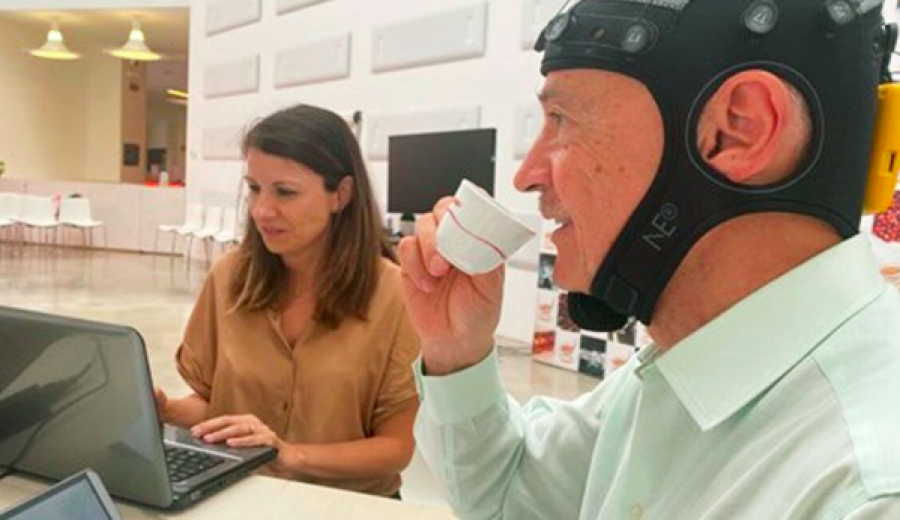
Introduction:In coffee evaluations, subjective feelings often influence judgment. An Italian research team has developed a wearable tasting helmet that uses physiological signals such as electrocardiograms, galvanic skin response, and electroencephalograms to translate emotions like pleasure or disgust experienced while tasting coffee into concrete data. This helps reduce evaluation bias and brings new possibilities for sensory analysis in specialty coffee.
After the conclusion of the 2024 World Brewers Cup (WBrC), in addition to the competition results and impressive techniques, the inner feelings of judges while tasting coffees from various countries have sparked much discussion. What exactly do judges feel when sipping each cup—pleasure, balance, or dullness, sharpness? These abstract sensations could previously only be described subjectively, but now a team from the Italian National Research Council has proposed an innovative solution: a tasting helmet capable of "objectively quantifying" the sensory emotions of coffee.
This helmet combines multiple wearable sensors, including electrocardiogram (ECG), galvanic skin response (GSR), and electroencephalogram (EEG), which can instantly capture subtle signals such as myocardial contractions, changes in skin resistance, and brain neural activity as the taster drinks coffee. By analyzing these biomedical data, researchers transform emotions that are otherwise hard to describe—such as pleasure, disgust, calmness—into quantifiable indicators, further interpreting the taster's true reaction to coffee flavors.
In the past, coffee evaluation relied on the experience and subjective judgment of judges. Even with cupping standards set by the Specialty Coffee Association (SCA), it was still difficult to completely avoid the influence of personal preferences or momentary states on the results. To address this, the SCA has continuously optimized its evaluation system over the past three years, including the updated cupping form in 2023, aiming to enhance fairness through more scientific and consistent standards. However, even with tool improvements, human factors still remain, which is precisely the original intention behind the Italian team’s development of the tasting helmet—to provide an auxiliary tool that makes coffee sensory analysis more objective.
In reality, the operating principle of this helmet is not complicated, but the technology integration is quite precise. When the taster wears the helmet and takes a sip of coffee, the ECG sensor records heart rate changes, reflecting the body’s level of excitement or relaxation; the GSR detects skin resistance, capturing subtle sweat changes caused by emotional fluctuations; the EEG further monitors the activity of different brain regions, analyzing attention, emotional responses, and cognitive processing. These signals, once integrated via algorithms, can map out the taster’s physiological and emotional profile in response to a specific coffee.
The research team points out that this technology not only helps judges describe their feelings more accurately during competitions, but could also be applied in the future for coffee roasters to adjust recipes, baristas to optimize brewing processes, or even to help consumers understand their own reactions to different flavor profiles. Especially for the specialty coffee industry, being able to substantiate sensory evaluations with data will significantly improve product development and market communication efficiency.
Currently, this tasting helmet is still in the prototype stage. Researchers emphasize that they will next collaborate with professional coffee evaluators, roasters, and sensory science experts to further validate the accuracy and practicality of the data. Lucia Billeci, a researcher at the Institute of Clinical Physiology of the Italian National Research Council, stated that this study opens up a new perspective for the sensory analysis of coffee tasting. In the future, judges or researchers may not only fill out questionnaires but also wear such minimally invasive devices to directly monitor emotional changes triggered by physiological responses, making coffee evaluation no longer just a matter of "going by feeling."
For coffee enthusiasts, although this helmet is not yet widely available, the trend it represents—combining technology and sensory science to reduce subjective bias and improve evaluation consistency—is likely to become an important tool in the specialty coffee industry in the future. If successfully applied, it will not only help professionals make more accurate judgments, but also enable consumers to better understand their preferred coffee flavor characteristics, further enriching the tasting experience.
The above content is compiled by CoffeeHunters, a coffee news website.


