







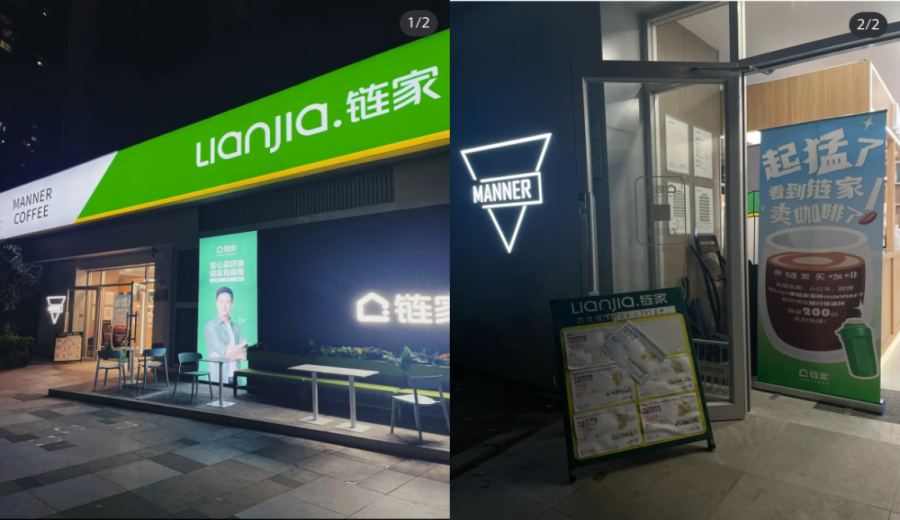
Introduction:A Manner coffee kiosk has surprisingly appeared at a Lianjia branch in Shanghai, marking the first-ever attempt by two major brands to share retail space. This cross-industry collaboration has sparked widespread discussion in the market. What’s the business logic behind it? Is the real estate agency seeking new revenue streams, or is the coffee brand testing the community market? This article delves into the details of the Manner and Lianjia shared store partnership, exploring its potential impact and insights for the industry.
Recently, netizens in Shanghai discovered a Manner coffee kiosk inside the Lianjia branch located at No. 184, Lane 100, Zhongtan Road. The store’s signage blends the brand colors of both parties—half white and half green—with Manner’s iconic inverted triangle logo and Lianjia’s property listings displayed side by side indoors, creating an unmistakably cross-industry atmosphere from the moment you walk in.
This branch is a “shared store” jointly created by Manner and Lianjia Shanghai, officially opening to the public on April 7. In the past, Manner typically chose locations in urban core business districts and office building clusters—such as corners of shopping malls or downstairs from office buildings—primarily serving office workers. This time, however, it has ventured into a residential community and shared a storefront with a real estate agency, breaking away from its previous business model and taking on an experimental nature.
In fact, Manner is a popular affordable premium coffee brand beloved by urban white-collar workers, with most drinks priced between 15 and 25 RMB, making it a daily pick-me-up for many. Lianjia, on the other hand, is a leading real estate agency brand in China, with branches spread across major cities nationwide. Whether for renting or buying, consumers can easily find this “green store” to meet their housing needs.
This collaboration has triggered extensive discussion, with netizens holding varying opinions. Some are optimistic about this innovative model, believing it can drive foot traffic for both parties—especially since the store is located at the entrance of a residential community, where there is a steady stream of daily passersby. Even if it’s not as bustling as a busy commercial district, it still has a stable customer base. However, many others question whether the significant differences in target demographics and consumption scenarios between the two brands can truly result in synergy, leaving the outcome uncertain.
Interestingly, netizens have gotten creative, poking fun at the collaboration with humorous comments like “Can I get a 50,000 RMB discount on a house if I bring my own cup?” or “Buy a house while sipping a coffee?” These remarks show the public’s curiosity and imagination about such an unconventional pairing. Although most comments are meant as jokes, they also reflect surprise and interest in the combination of these two distinct life scenarios.
Currently, this shared store is a one-off, representing an initial trial phase. Industry insiders believe this move may be Manner’s attempt to explore the community consumption market—by reducing rental costs and increasing exposure points, it aims to reach different consumer groups. For Lianjia, it could also be an exploration of diversified revenue streams, using shared space to improve per-square-meter efficiency and attract more young customers.
From an industry perspective, while such cross-industry shared stores are not common, under the current business environment, companies are facing increasing pressure to seek innovative operating models, control costs, and expand their customer base. Similar collaborations may become more prevalent in the future. However, how to balance the differing brand atmospheres and service objectives remains a key challenge for such hybrid stores.
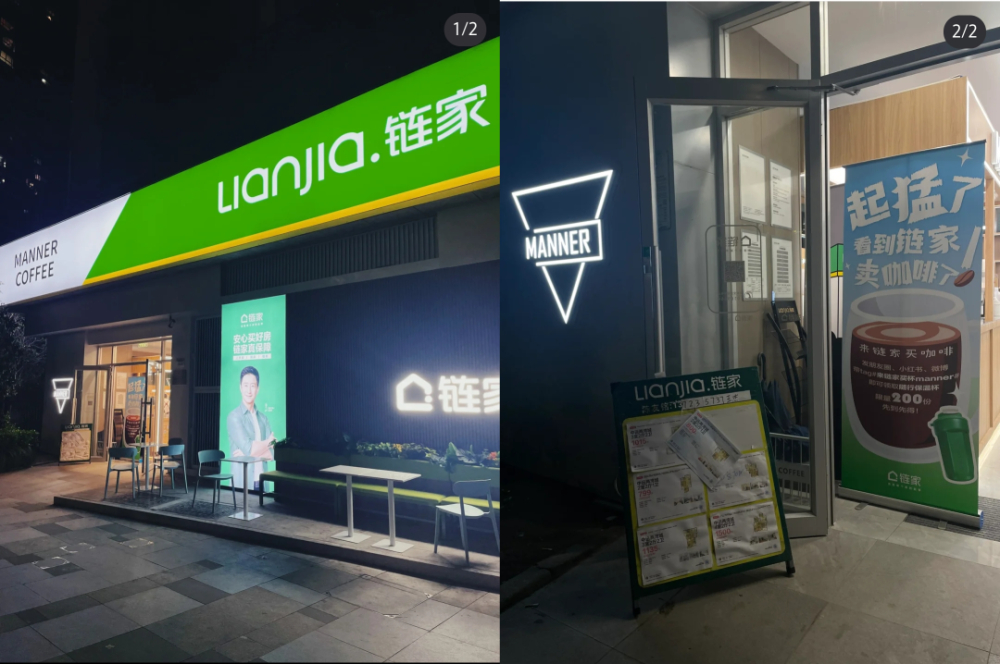
Overall, the Manner and Lianjia shared store is a bold experiment. Regardless of its ultimate success, it has already introduced new directions for market thinking. For consumers, being able to enjoy a high-quality cup of coffee while browsing property listings undoubtedly adds a little joy to daily life. For the industry, such cross-industry collaborations may well be a glimpse into the future of business models.
The above content is compiled by CoffeeHunters, a coffee news website.


