







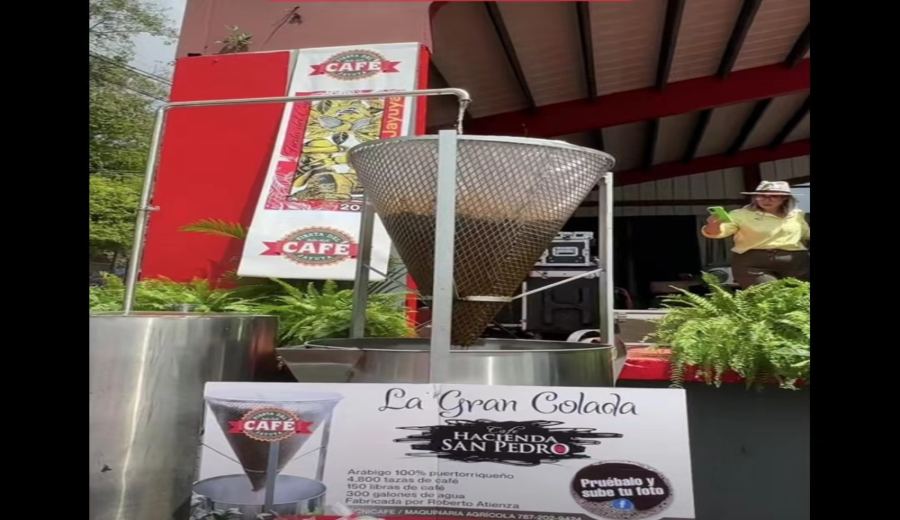
Introduction:At the 7th Coffee Festival held in Jayuya, Puerto Rico, an innovative giant pour over coffee device became the center of attention. This device was capable of producing approximately 4,800 cups of coffee in a single operation, meeting the beverage needs of a large number of visitors. This article will delve into the design principles, operational process, and real-world performance of this device, taking you behind the scenes to explore the technical details and interesting stories behind its efficient extraction.
Modern coffee festivals are growing in popularity, but for on-site baristas, the influx of crowds often poses a challenge. Even just a few dozen people in line can be overwhelming. However, at the 7th Coffee Festival in Jayuya, Puerto Rico, an innovative solution completely changed the game.
The star of the show this time wasn’t a top-tier barista, but an unprecedentedly large pour over coffee device. It was able to provide freshly brewed coffee to thousands of visitors in a single run, reportedly extracting enough for around 4,800 cups at once, greatly enhancing supply efficiency.
The device mainly consists of three parts: a water storage tank, a giant filter cone, and a container to collect the brewed coffee. Its overall appearance resembles an oversized version of a pour over setup, with a simple yet ingenious concept. According to the organizers, they used 150 pounds of locally sourced Arabica coffee beans, which were ground appropriately, placed into a specially made filter cloth, and then set up in the huge filter cone.
During operation, hot water is pumped from the water storage tank through dedicated pipes into the filter cone, with a total water volume of about 300 gallons. This hot water evenly saturates the coffee grounds at the bottom, after which the brewed coffee gradually drips down into the collection container below, forming a large vat of freshly brewed coffee.
Based on on-site estimates, this large volume of brewed coffee can be portioned into 4,800 cups, meaning that just one extraction process is enough to meet the needs of thousands of coffee enthusiasts. This method of large-scale extraction is quite rare at coffee festivals.
As seen in footage from the event, hot water is steadily injected into the filter cone from a pipe on one side of the device, gradually saturating the coffee grounds in the filter cloth. As the water level rises, the brewed coffee begins to naturally drip from the bottom of the filter cone. For curious attendees, all they need to do is open the tap on the collection container to draw out a steaming cup of coffee, much like tapping a keg.
This design not only saves a significant amount of labor but also greatly improves supply efficiency. Staff only need to manage the taps nearby to serve visitors freshly brewed coffee, eliminating the usual bustling scene of manual brewing at typical coffee stands.
However, some observers have pointed out that although the device looks similar to a pour over setup, its actual operation is more akin to that of a drip coffee machine. This is because the water is not poured in a circular motion by hand, nor is there precise control over the flow rate. Instead, it is simply injected from one side, allowing the water to naturally seep through the coffee grounds and drip down. Therefore, its extraction method differs significantly from traditional pour over techniques.
As a result, this device is more like an oversized drip coffee machine, and the flavor profile of the coffee it produces is closer to that of standard drip coffee. Some attendees even added sugar to their coffee after pouring, possibly to balance out any perceived flavor shortcomings.
Although this giant device may not produce astonishingly flavorful coffee, it does serve as an excellent example of how innovative equipment can achieve efficient supply in response to high crowd demand. In high-traffic settings like coffee festivals, being able to meet the coffee needs of thousands of people at once is undoubtedly a perfect blend of technology and practicality.
The above content is compiled by CoffeeHunters, a coffee news website.


