







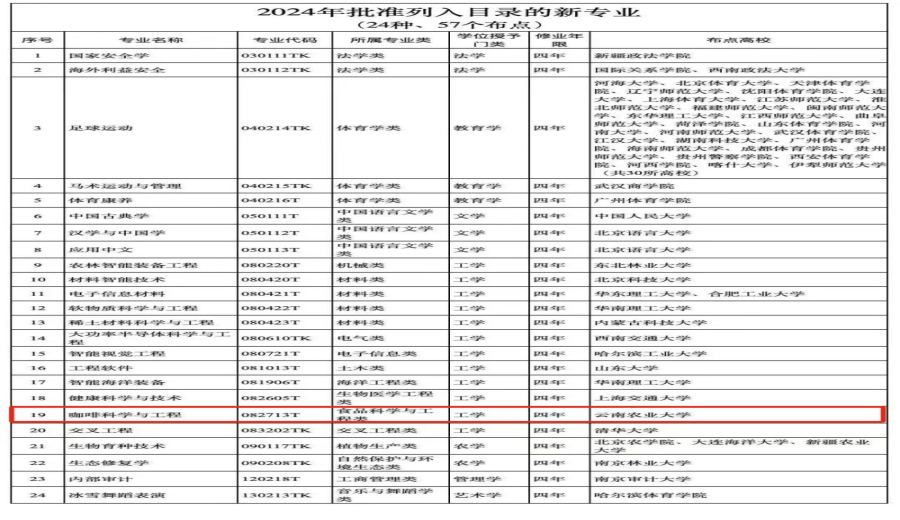
Introduction:The Ministry of Education has recently approved Yunnan Agricultural University’s establishment of an undergraduate major in “Coffee Science and Engineering,” making it the world’s first higher education program dedicated to the coffee industry. This new curriculum integrates theory and practice to cultivate well-rounded professionals skilled in cultivation, roasting, and blending, aiming to meet the surging demand of China’s coffee market, which is growing by hundreds of billions annually. This article delves into the highlights of the program, the pain points in the industry, and why skilled baristas and technical experts are in such high demand.
Attention, coffee enthusiasts: A recent move by the Ministry of Education has sent shockwaves through the industry — the “Coffee Science and Engineering” major proposed by Yunnan Agricultural University has been officially approved in the 2024 list of undergraduate programs, marking the birth of the world’s first tertiary-level coffee-focused academic discipline. This is not only an academic milestone but also a targeted response to the talent gap emerging from the rapid expansion of China’s coffee sector.
This unique undergraduate program falls under the national initiative for cultivating distinctive talent. Its goal is clear: to develop versatile experts capable of developing new products, optimizing production processes, and designing production lines. According to information, the curriculum spans foundational theory to hands-on training, including three core subjects: “Coffee Processing Science,” “Coffee Blending Science,” and “Coffee Roasting and Cupping Science,” along with an online course introducing local coffee culture titled “The Enchanting Coffee of Yunnan.” Students will not only learn about the chemical properties of coffee beans and the differences in processing methods, but they will also operate roasting equipment firsthand and understand how various extraction parameters affect flavor.
The demand for such professionals is not unfounded. Data shows that China’s coffee market surpassed 600 billion RMB in size last year, and experts predict it will hit the 1 trillion RMB mark by 2025. With the growing popularity of specialty coffee, the need for knowledgeable baristas, roasters, and quality control personnel has surged — from chain brands to independent cafés. Yet the reality is that many positions remain unfilled for long periods, especially those requiring expertise in various green bean processing methods and the ability to consistently control roasting profiles.
Industry insiders point out that although Yunnan, as China’s main coffee-growing region, has relatively stable manpower in planting and agricultural management, there is a clear shortage of skilled professionals in the downstream processing chain — such as advanced washing techniques, honey processing, and other key methods that enhance flavor, as well as bean grading and cupping. These roles not only require extensive experience but also a solid understanding of coffee chemistry and sensory science — areas that current educational systems seldom cover.
The newly established undergraduate coffee program aims to bridge this gap. The curriculum goes beyond brewing techniques or shop management, diving deep into every stage from farm to cup. Students will learn how to adjust roast levels based on the characteristics of beans from different regions, analyze subtle differences on the flavor wheel, and even participate in the development of new product formulations. This comprehensive training is precisely what the evolving coffee industry needs for its transformation and upgrade.
Experts analyze that as consumer expectations for coffee quality continue to rise, future market competition will hinge on “professionalism.” Whether it’s chain enterprises or specialty coffee estates, there is a growing need for technical backbone staff who can ensure flavor consistency and optimize production efficiency. Yunnan Agricultural University’s move not only injects academic energy into the local industry but may also serve as a reference model for global coffee education.
The above content is compiled by CoffeeHunters, a coffee news website.


