








Introduction:Beginners in pour over coffee often encounter over-extraction, resulting in coffee that is overly strong and bitter. Many people’s first instinct is to dilute it with water — a technique in the coffee professional field known as ‘By pass,’ or bypass water dilution. But when should you use it, how much should you add, and how should you control the water temperature to avoid affecting the flavor? This article delves into the principles and practical techniques of By pass, and highlights situations where adding water is ineffective, helping you adjust coffee strength more wisely.
Many who are new to pour over coffee have accidentally brewed it too strong, ending up with a bitter and astringent taste that can be quite harsh. Some may pour it out, but others, unwilling to waste it, choose to dilute it with water. This method, known in the coffee community as ‘By pass,’ is actually a technique that adjusts coffee strength by adding water through a bypass.
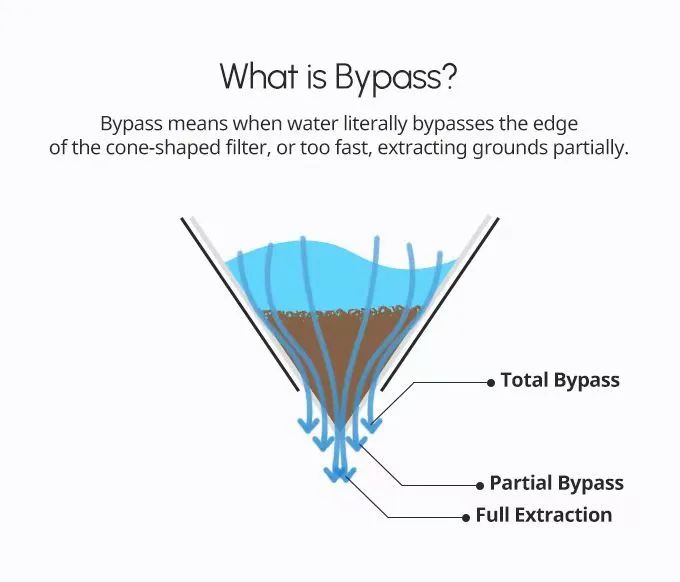
As the name suggests, By pass means allowing some hot water to ‘bypass’ the coffee grounds — not participating in the extraction process — and instead flowing directly into the server or drinking cup. This water that does not come into contact with the coffee grounds is called ‘bypass water.’ Taking the common V60 filter as an example, if water flows down the spiral groove on the side wall of the filter and into the server without passing through the coffee bed, it also falls under the category of bypass water.

For example, when making iced pour over, we often replace part of the hot water with ice cubes — which is essentially a form of By pass. In one brand’s practical experience, they typically use a 1:15 coffee-to-water ratio when brewing hot pour over with 15 grams of coffee, but for the iced version, they switch to a 1:10 ratio and replace 75 grams of the intended hot water with ice cubes placed in the server in advance. This not only helps control the brewing temperature but also naturally dilutes the coffee strength, achieving a more balanced flavor.

Another real-world example: a brand once used 15 grams of coffee and a 1:15 ratio to brew a Juliet Geisha from Panama’s 90+ Estate. However, because the grind size was accidentally set finer by half a notch (EK43s at setting 9), although the coffee still exhibited pronounced fermented wine notes and deep cocoa layers, it lacked the expected bright fruity acidity, tasting dull and heavy with indistinct layers. To adjust, they added about 10 grams of water at around 80°C, gently shook it, and tasted again — finding the fruit acidity became clearer, accompanied by a sweet note reminiscent of dried fruit, and the overall mouthfeel noticeably lighter.

According to one brand’s shared experience, when brewing light-roast coffee, if the grind is too fine combined with the characteristics of high-hardness beans, it can easily lead to channeling in the later stages of stirring, extending the immersion time of the coffee grounds and increasing the risk of over-extraction. Especially when the total brew time exceeds 2 minutes and 10 seconds and the coffee still hasn’t fully dripped through, it is recommended to first remove the filter, discard the last bit of coffee liquid, and then evaluate whether to adjust the concentration by adding small amounts of bypass water in increments (suggested 5–10 grams at a time) until reaching your preferred taste.
However, it must be noted that bypass water does not participate in the extraction process of the coffee grounds. Therefore, adding it indiscriminately without strategy may not only dilute the originally good flavors but also make the coffee taste flat and insipid, like plain water. One brand recommends shaking well and tasting again after each addition of bypass water to determine if further adjustment is needed, avoiding adding too much at once which could lead to irreversible flavor loss.
Additionally, there are cases where the coffee’s strength may appear normal, but the aroma is poor, accompanied by noticeable bitterness, astringency, or throat discomfort — negative flavors that likely indicate the coffee has been over-extracted, and in a state that cannot be salvaged by subsequent water addition. Common causes include uneven coffee grind size, poor grinder performance leading to excessive fines, or unstable pouring technique. In such situations, even adding bypass water will only make the coffee taste like ‘coffee-flavored plain water,’ completely failing to improve the original flaws.

In summary, although By pass is a common technique for adjusting coffee, it has no fixed standard reference values and relies more on the brewer’s practical experience and sensory judgment. For beginners, it’s advised not to rely too heavily on adding water as a ‘quick fix’ for coffee. Instead, revisit the entire brewing process — examining factors like grind size, coffee-to-water ratio, water temperature, and pouring technique — to identify the root of the problem. Only then can you truly improve your brewing skills, rather than constantly relying on ‘adding water to save the brew.’
The above content is compiled by CoffeeHunters, a coffee news website.


