







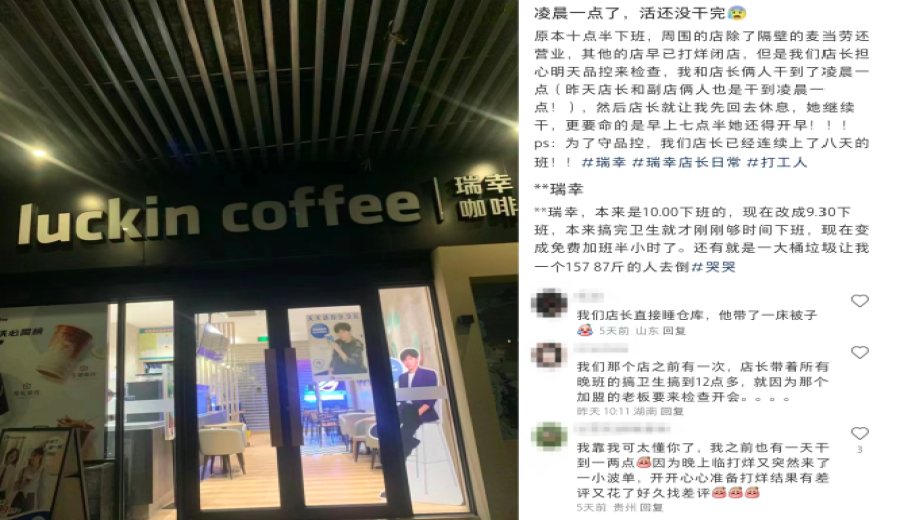
Introduction:The standardization of operations in coffee chain outlets has brought executional pressure to quality control inspections. Some Luckin employees have reported that they often have to work overtime without pay for deep cleaning before surprise end-of-month inspections. The closure tasks have intensified, and the monitoring system misjudges break periods, resulting in compressed actual meal and rest times. Understanding the operational logic and employee challenges behind these phenomena helps to gain deeper insight into the real state of back-end management in the coffee industry.
In the daily operations of coffee chain stores, standardized management of outlets is often key to ensuring service quality, but it also brings executional pressure. Especially on the eve of quality control inspections, evening shift employees at some Luckin stores frequently face additional workloads. To prepare for surprise inspections by the quality control department, they have to stay after their regular shifts to perform deep cleaning, ensuring every corner of the store is spotless.
Such cleaning processes often extend into the late night, sometimes even until one in the morning, with the store still brightly lit. Store managers and employees, in order to avoid poor quality control scores affecting overall store performance, are willing to sacrifice their personal rest time. However, if the quality control team does not show up the next day, the previous night’s cleaning efforts become futile, and employees have to do it all over again, creating a frustrating cycle.
Since the so-called “March 1 Incident,” some stores have experienced staff reductions. Tasks that were originally shared by two people, such as closing duties, now fall on a single employee. These tasks include organizing shelves, cleaning equipment, and taking inventory, all of which need to be completed within limited operating hours, forcing employees to work unpaid overtime to ensure all processes are smoothly concluded.
What adds to employees’ distress is that the system continuously sends clock-out reminders during off-duty hours. While this design is intended to ensure employees leave on time, in a high-pressure work environment, it instead intensifies their anxiety. When employees are busy completing their shifts and closing tasks, the system’s repeated reminders make them feel even more restless and uneasy.
Additionally, according to Luckin’s regulations, employees should be entitled to certain break times during their shifts. But in practice, once an employee leaves the counter to go to the stockroom for inventory checks, receiving goods, or organizing items, the monitoring system—if it doesn’t detect the employee—will assume they are on a break. This mechanism leads to situations where employees who actually need to eat or rest find their allocated break time already taken up, leaving them unable to get the rest they deserve.
To cope with these challenges, some employees choose to close earlier or skip certain non-essential tasks. For example, when closing time approaches, if a customer places an order and the equipment needed to make the drink has just been cleaned, employees might persuade the customer to cancel the order to avoid going through the tedious cleaning process again. However, such practices undoubtedly affect the customer service experience and reflect the employees’ helpless choices under the imbalance of working hours and compensation.
Overtime is already the least desirable situation for many workers, and Luckin employees are no exception. Some employees say that if they could receive overtime pay as stipulated, they would not completely reject working extra hours. But when the time and effort invested do not translate into fair compensation, it severely dampens work motivation and can even leave people feeling utterly frustrated and helpless.
The above content is compiled by CoffeeHunters, a coffee news website.


