








Introduction:The Devil’s Brew Method is an extraction technique refined by World Brewers Cup Champion Tetsu Kasuya based on the classic 4:6 method. It combines drip and immersion brewing by controlling water temperature in stages to enhance the layered complexity of the coffee. This article delves into the core principles of the method, providing a complete step-by-step guide, grind size and temperature settings, and teaching you how to fine-tune the balance between acidity, sweetness, and body through water distribution. Even beginners can easily master it and brew professional-grade coffee using a clever dripper.
Building on the foundation of the 4:6 method, Tetsu Kasuya developed what is hailed as the “Devil’s Brew Method”—a clever dripper extraction technique. This approach skillfully blends drip and immersion phases, using high temperatures initially to intensify flavor release and then switching to lower temperatures during immersion to boost body. The overall process is straightforward yet significantly optimizes the coffee’s performance, making it particularly well-suited for use with Hario V60 clever drippers equipped with valve controls.
The reason this brewing method is called the “Devil’s” stems from a humorous exchange between Tetsu Kasuya and his assistant in a teaching video. Despite its dramatic name, the technique is grounded in scientifically sound extraction logic. Practical results show that it consistently delivers clear fruit acidity layers and a rich body, making it especially suitable for medium to light roasted specialty coffee beans.

The prototype of the Devil’s Brew Method originates from Tetsu Kasuya’s proposed 4:6 method, which divides the total brew water into a 40% front stage (dominating sweetness and acidity balance) and a 60% back stage (shaping mouthfeel and concentration). The Devil’s version retains this proportional structure but consolidates the last three water additions into a single immersion phase, while reducing the back-stage water temperature from 92°C to 70°C to avoid over-extraction. This adjustment simplifies the steps while precisely managing the flavor release rhythm through temperature control.
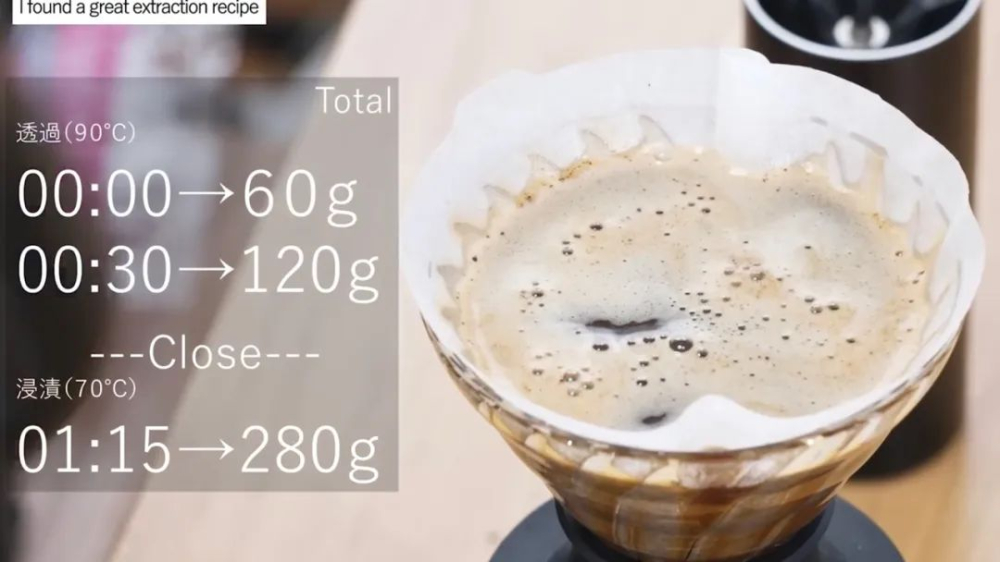
Suggested practical parameters: Use 20 grams of medium-fine ground coffee (approximately 9 on the Ek43 grinder, equivalent to 85% passing rate through a #20 sieve), paired with a total of 300 ml of water (a 1:15 coffee-to-water ratio). The first stage involves blooming with 92°C hot water—start by pouring 60 ml in a circular motion to saturate the coffee bed, including the pouring time, bloom for 30 seconds. Then add a second 60 ml pour of water at the same temperature. When the total time reaches 1 minute and 15 seconds, close the clever dripper valve and adjust the brewing water temperature to 70°C.
The most critical third stage is the immersion extraction. Slowly pour the remaining 180 ml of 70°C water directly into the center of the coffee bed to ensure even water penetration. Allow it to steep until 1 minute and 45 seconds, then open the clever dripper valve to begin dripping. The entire process should be completed within 3 minutes. If the dripping is too slow and causes an overrun, it’s recommended to remove the dripper early to stop extraction. Finally, gently shake the server to homogenize the coffee liquid before enjoying a well-balanced cup.
Water distribution strategy can be flexibly adjusted to influence flavor expression: For a more pronounced sweetness, divide the first 40% of water into 50 ml and 70 ml (a 4:6 ratio), enhancing caramelized compound extraction by increasing the second pour volume. To emphasize bright acidity, reverse the ratio to 70 ml and 50 ml (a 6:4 ratio). This modulation relies on the extraction efficiency differences during the blooming phase—slightly reducing the initial water volume helps preserve more volatile acidic aromatic compounds.
It’s worth noting that this technique is applicable to all valve-controlled dripper systems, including other brands such as the Hero Cake Dripper. However, it’s necessary to first confirm whether the dripper capacity can accommodate the instantaneous water volume required for 20 grams of coffee. If needed, reduce the grind amount to ensure smooth operation. Tetsu Kasuya himself has described this method as a “practical evolution beyond the 4:6 method,” especially recommending it for coffee enthusiasts who value both convenience and flavor.
The above content is compiled by CoffeeHunters, a coffee news website.


