








Introduction:In 2023, China's coffee industry experienced another wave of explosive growth, with the market size surpassing 180 billion yuan and nearly 60,000 new registered enterprises established throughout the year. Against the backdrop of aggressive brand expansion and intensified price wars, regional distribution patterns and market opportunities have gradually become clear. This article will delve into the latest trends, key data, and which regions have become hotspots for coffee businesses, helping you grasp the pulse of the market.
Coffee consumption in China is rapidly transitioning from a niche lifestyle to a mainstream daily habit. An increasing number of office workers and Gen Z individuals view coffee as a necessity for staying alert and as part of their lifestyle, with phrases like "I can't function without coffee" becoming commonplace. Against this backdrop, the overall market size surpassed 180 billion yuan in 2023 and has maintained rapid growth for three consecutive years.
Observing market dynamics, well-known chain brands such as Starbucks, Luckin Coffee, and Cotti Coffee all adopted low-price strategies in 2023, with single cup prices even dropping to as low as 8.8 to 9.9 yuan, while simultaneously accelerating store expansion. This "price + scale" dual-driven model has pushed competition to an unprecedentedly intense level, quietly initiating a market reshuffle.
According to market research data, the size of China's coffee industry reached 180.6 billion yuan in 2023, with an average annual compound growth rate of 23.5% over the past three years—far exceeding the global average of 2%. Such immense market potential has not only attracted traditional coffee brands but also enticed cross-industry players eager to venture into the sector.

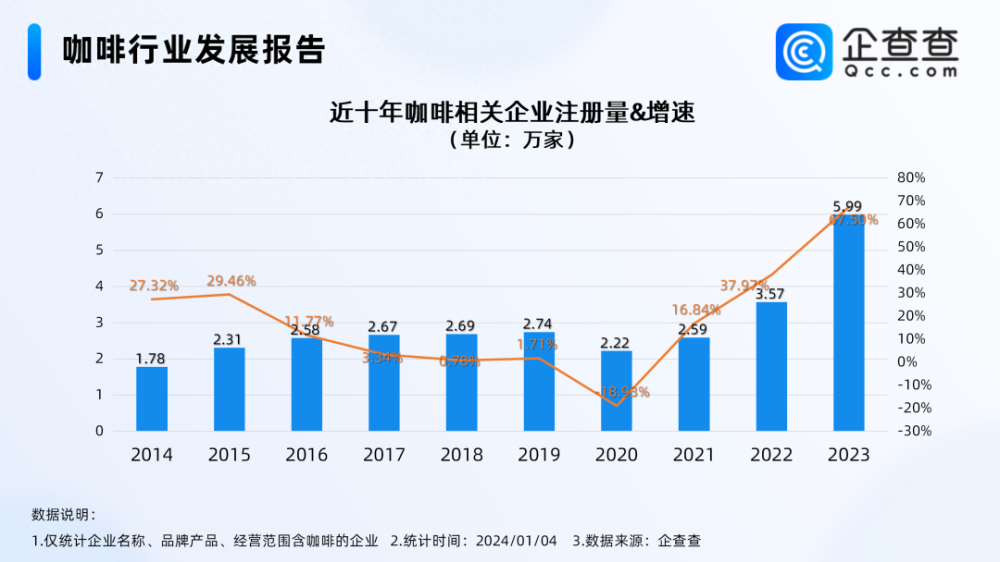
With the surge in market demand, more entrepreneurs and capital are flooding into the coffee industry. Data shows that the current number of coffee-related enterprises nationwide has reached 213,400. The number of newly registered enterprises has continued to soar over the past three years, standing at 25,900, 35,700, and an astonishing 59,900 respectively, with year-on-year growth rates of 16.84%, 37.97%, and 67.50%—clear signs that market enthusiasm remains undiminished.
So, where are these rapidly growing coffee enterprises primarily concentrated? Data indicates that Guangdong Province leads the nation with 37,000 coffee-related enterprises, making it the undisputed hotspot for coffee businesses. It is followed by Yunnan and Jiangsu, with 24,000 and 14,600 enterprises respectively, securing second and third places. Zhejiang, Sichuan, and Shandong also performed notably, with steadily rising numbers of enterprises.
In terms of city distribution, Shenzhen ranks first with 9,600 existing coffee-related enterprises, followed by Pu'er City and Guangzhou, with 9,300 and 9,100 respectively. Although Shanghai is an international metropolis, it only ranks fifth in this sector, with 5,200 existing enterprises, while Chengdu holds fourth place with 5,300. Notably, Shenzhen, Pu'er, and Guangzhou have significantly larger enterprise stocks than other cities, forming a distinct "stratified" distribution pattern.

Despite the booming market, not all brands have been able to expand smoothly. Behind the seemingly vigorous growth, some once high-profile specialty coffee brands faced a wave of store closures by the end of 2023, sparking widespread industry discussion and reflection. In an environment of economic uncertainty and increasingly cautious consumer behavior, how to operate steadily and position accurately has become a critical challenge for every brand.
Additionally, regional differences are also a significant factor influencing the survival and development of coffee enterprises. For example, coffee-producing regions like Yunnan not only possess raw material advantages but have also gradually developed a full industrial ecosystem from green beans to branding, attracting a large number of enterprises. Meanwhile, Guangdong and Jiangsu, with their massive consumer markets and convenient logistics, have become key bases for brand expansion.
Looking ahead to 2024, what lies ahead for China's coffee industry? How can brands stand out amid fierce price competition? What flavors and experiences will consumers favor? These questions will undoubtedly shape the future trajectory of the market. As more niche markets and innovative business models emerge, only those brands that truly understand market trends and consumer needs will be able to hold their ground in this wave.
The above content is compiled by CoffeeHunters, a coffee news website.


