







Introduction:Vietnamese coffee prices have recently seen a significant correction, gradually pulling back from their recent highs. Behind this trend lies not only improved supply from producing regions, but also a confluence of factors including Brazilian weather conditions, futures market dynamics, and the US dollar exchange rate. This article delves into the fluctuations in coffee pricing from Vietnam’s Central Highlands, highlights from the 2023 export data, and how global markets interact to influence coffee prices—helping readers grasp the latest market trends and procurement insights.
The Vietnamese coffee market has reached a turning point. Prices, which had been climbing due to tight supply, have recently begun to ease. According to observations by the Vietnam Coffee - Cocoa Association (Vicofa), coffee prices in the major producing areas of the Central Highlands have generally declined. Meanwhile, the international market has also been affected by a combination of factors such as improved weather in Brazil, the expiration of futures contracts, and a stronger US dollar, all of which have contributed to downward pressure on global coffee prices. Although Vietnam’s coffee exports in 2023 decreased compared to the previous year, the export value hit a historical record, demonstrating strong momentum driven by rising prices.
Looking back to the early part of last season, the market faced pressure from supply shortages. The Vietnam Coffee - Cocoa Association had previously estimated that coffee prices might continue to climb in 2024, primarily due to insufficient production. In fact, Vietnam’s coffee season typically runs from November each year to March of the following year. When the 2023/24 season first kicked off in November 2023, coffee prices had already surged to VND 60,000 per kilogram—the highest level since the start of the season—and even briefly spiked to a peak of VND 70,000 per kilogram.
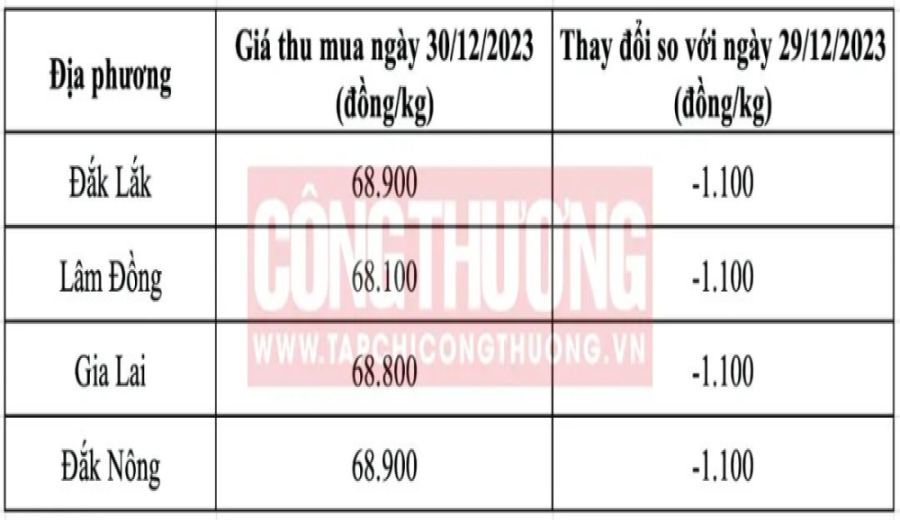
However, the latest surveys show that as supply has gradually stabilized, coffee prices have begun to adjust. The Vietnam Coffee - Cocoa Association noted that the average price in the Central Highlands region has dropped by approximately VND 1,100 per kilogram, currently fluctuating between VND 68,100 and VND 68,900 per kilogram. Specifically, the Lam Dong region reported the lowest price at VND 68,100 per kilogram; the Gia Lai region was slightly higher at VND 68,800 per kilogram; while the Dak Lak and Dak Nong regions maintained prices at VND 68,900 per kilogram, representing the relatively higher end within the surveyed areas.
In terms of export performance, Vietnam’s coffee exports in December 2023 saw a significant rebound, reaching 190,000 tonnes—marking the highest level in the past nine months and a substantial 53.9% increase compared to November of the same year. However, when compared to the same period in 2022, the figure still showed a slight decline of 3.5%. Export revenue, on the other hand, performed strongly, amounting to USD 538 million—a 51% rise from November and a 26.4% increase compared to the same period in 2022. Looking at the full year, Vietnam’s total coffee exports in 2023 are estimated at 1.61 million tonnes, down 9.6% from 2022. However, thanks to a significant rise in the average export price to USD 2,604 per tonne (a 14.1% increase from 2022), the overall export turnover still grew against the trend by 3.1%, reaching a historic high of USD 4.18 billion.
In addition to improvements in Vietnam’s supply side, multiple factors in the international market have also contributed to the price correction. First, the weather conditions in Brazil’s major coffee-growing regions have improved, easing market concerns about production impacts from drought and pointing to expectations of stable output going forward. Additionally, the expiration of coffee futures contracts and a stronger US dollar have also exerted some downward pressure on prices. Data from the ICE Futures Europe shows that the price of Robusta coffee for delivery in March 2024 fell by USD 95 per tonne to USD 2,481 per tonne, while the price for May 2024 delivery dropped by USD 92 per tonne to USD 2,757 per tonne. As for the ICE Futures US market, the price of Arabica coffee for March 2024 delivery fell by 9.7 cents per pound to 188.3 cents per pound, and the price for May 2024 delivery also declined by 9.55 cents to 186.2 cents per pound.
Notably, as of December 28, 2023, the inventory of standard Arabica coffee held by ICE Futures US increased significantly by 11,458 bags (each bag weighing 60 kilograms), bringing the total inventory back up to 258,399 bags. Although this has not yet breached the lowest inventory level recorded in the past 24 years, this upward trend is seen as a positive signal for a more stable supply outlook in the future, further influencing market expectations regarding coffee prices.
The above content is compiled by CoffeeHunters, a coffee news website.


