







Introduction:Kenyan coffee is renowned for its bright acidity and complex layers, with its unique bean grading system and premium varieties making it a classic in the specialty coffee world. This article delves into the distribution of Kenya’s 14 major coffee-growing regions, the AA+ to T bean grading standards, and highlights the legendary SL28 and SL34 varieties originating from the Scott Laboratories. It also explores the essence of Kenya’s washed processing method, as well as the pour over performance of AA TOP beans from the Thika region, offering a comprehensive understanding from origin to cup flavor.
Located in East Africa, Kenya is crossed by the equator and traversed by the East African Rift Valley from north to south. Though neighboring Ethiopia, it has developed a distinctly different coffee industry path. From the introduction of coffee seeds by French missionaries from Réunion Island in 1893, to large-scale plantation cultivation during the British colonial period, and the establishment of a grading and auction system centered on bean size and quality in the 1930s, Kenyan coffee gradually formed a unique industrial character. The country is divided into 14 coffee-growing regions, among which Nyeri, Kirinyaga, Murang’a, Kiambu, and Thika, with their high altitudes and superior terroir, produce numerous specialty-grade coffees.
Kenya’s terrain is mostly plateau, with an average elevation of about 1,500 meters, and features volcanic landforms, including Mount Kenya, a 5,199-meter extinct volcano in the central highlands. Although neighboring the birthplace of coffee, Ethiopia, Kenya’s coffee industry started relatively late, with seeds introduced only in 1893 by French missionaries. During the British colonial period, coffee was mostly grown on large plantations, with all products exported to London. After the Coffee Ordinance was passed in 1933, the Kenya Coffee Board was established, the auction system was launched in 1934 and continues to this day, and the coffee quality grading system was officially formulated in 1935. By the 1950s, the "Swynnerton Plan" agricultural act promoted land reform, granting farmers land ownership and further boosting production enthusiasm and quality control.
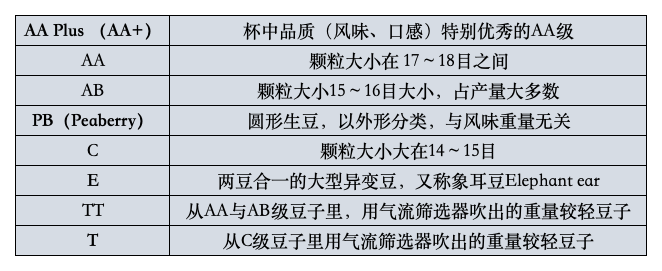
Kenya’s coffee grading standards are unique, primarily based on bean size and quality, with clear regulations and high market recognition. The main grades include AA+, AA, AB, PB, C, E, TT, and T, among which AA, AB, and PB are the most common high-quality grades on the market. AA-grade beans are relatively large and are generally regarded as top-tier representatives; AB-grade beans are slightly smaller but still offer excellent flavor; PB (Peaberry) are rare round beans, found in small proportions and often possessing intense flavors. This grading system applies to both domestic and export markets, ensuring consistent quality.
Kenya has a total of 14 coffee-growing regions: Bungoma, Embu, Kiambu, Kirinyaga, Kisii, Machakos, Meru, Mt. Elgon, Murang’a, Nakuru, Nyeri, Thika, Taita Taveta, and Trans-Nzoia. Among them, Nyeri, Kirinyaga, Murang’a, Kiambu, and Thika are acclaimed in both domestic and international markets for their coffee’s bright acidity and rich layers, thanks to their moderate altitudes and favorable microclimates.
When discussing Kenyan coffee, one cannot overlook the two iconic varieties: SL28 and SL34. Born in the 1930s, they were systematically selected from 42 coffee trees by the Scott Laboratories and later became the soul of Kenya’s specialty coffee. Between 1935 and 1939, the laboratory numbered these 42 trees with the prefix SL and conducted in-depth research on yield, quality, drought resistance, and disease resistance. SL28 originated from a single plant selected in 1935 from a drought-resistant population called Tanganyika, with genetic analysis showing kinship to the Bourbon variety; SL34 came from a tree at the Loresho Estate in Kabete, Kenya, with genetic testing indicating its relation to the Typica variety. These two varieties are suited to medium-to-high altitude environments, exhibit good drought resistance, but are more susceptible to diseases, requiring reliable management techniques.
The Scott Laboratories were established by the British colonial government in Kenya in the 1930s (note: originally misstated as 1992, actually early 1930s), under the Ministry of Agriculture, responsible for agricultural research and technology promotion, and later renamed the Kenya National Agricultural Research Laboratories (NARL). To this day, many areas still grow SL28 coffee trees aged 60 to 80 years, which continue to maintain stable yields and excellent flavor profiles.
Taking an actual pour over experience as an example, a well-known coffee brand once released a washed AA TOP bean from the Thika region, using the SL28 variety and Kenya’s distinctive meticulous 72-hour washed process (K72). This processing method enhances cleanliness and flavor complexity through prolonged fermentation and multiple washes. Recommended pour over parameters are: use 15 grams of coffee beans, a 1:15 coffee-to-water ratio, and water temperature controlled at around 92°C. After blooming with fine grind, pour hot water in stages, with a total extraction time recommended between 2 minutes 30 seconds and 3 minutes. The brewed coffee delivers a distinct fruity aroma of cherry tomatoes and dark plums, with bright yet non-aggressive acidity, a clean and refreshing mouthfeel, and a finish that carries a soft brown sugar sweetness and a silky texture reminiscent of green tea. Overall, it presents a balanced and layered profile, making it a classic choice for experiencing the flavors of high-altitude Kenyan coffee.
The above content is compiled by CoffeeHunters, a coffee news website.


