








Introduction:The Fujian Provincial Consumer Council recently conducted spot checks on 59 varieties of freshly prepared coffee from 20 brands in Fuzhou. The results showed that all samples contained trace amounts of acrylamide, a Group 2A carcinogen. This article provides an in-depth analysis of the testing background, the mechanism of acrylamide formation, and actual intake levels to help readers rationally assess the risks and understand the safety boundaries of daily coffee consumption.
Recently, the Fujian Consumer Rights Protection Committee released a comparative test report on freshly prepared and sold coffee. The research team collected 59 samples of freshly made coffee from 20 well-known coffee brands in the Fuzhou area through online and offline channels. These included mainstream choices such as Luckin, Starbucks, Xingyunc, Tims, KFC, and McDonald’s. The sample types covered Americano, latte, and flavored lattes. The testing focused on eight key indicators: energy, carbohydrates, protein, fat, trans fatty acids, total sugar, caffeine, and acrylamide.
Notably, the testing report specifically pointed out that all 59 samples were found to contain low levels of acrylamide, a Group 2A carcinogen. Although China has not yet established restrictive or prohibitive regulations for acrylamide in coffee, the results quickly drew consumer attention after being reposted by media outlets, with many people beginning to worry about potential food safety hazards in their daily coffee consumption.
In fact, the detection of acrylamide in coffee is not new. As early as 2018, media reports indicated that coffee products from brands such as Nestlé, Luckin, and Starbucks contained this substance. This time, the testing covered a wider range of commonly seen market brands, which led to broader discussion. Many consumers have started to question whether the coffee they usually order has similar issues, and some have even become wary of chain coffee brands.

So, what exactly is acrylamide? And why does it appear in coffee? Acrylamide is an organic compound known to damage the human nervous system. According to the World Health Organization's classification, it is considered a Group 2A carcinogen, meaning that its carcinogenicity has been clearly demonstrated in animal experiments, but the evidence in human studies is still insufficient. Some epidemiological studies suggest that acrylamide may be associated with kidney cancer, endometrial cancer, and head and neck tumors, but these conclusions are still in the "suspected" stage.
The key point is that coffee beans do not inherently contain acrylamide, nor is it added artificially afterward. This substance is naturally produced during the coffee bean roasting process. When foods—especially those rich in carbohydrates and proteins—are subjected to frying, baking, or roasting at high temperatures (above 120°C), acrylamide is generated through the Maillard reaction. The roasting temperature of coffee beans typically reaches over 200 degrees Celsius, so a certain amount of acrylamide is inevitably formed. The higher the roasting temperature and the longer the roasting time, the more acrylamide is usually produced.
According to the 2005 paper published by the Joint Expert Committee on Food Additives (JECFA) of the United Nations Food and Agriculture Organization and the World Health Organization, titled “Acrylamide in Food: Toxicology and Risk Assessment,” acrylamide is commonly found in a variety of high-temperature processed foods. In addition to coffee, common foods such as French fries, cookies, and grilled meat have also tested positive for this substance.
As for the actual carcinogenic risk of acrylamide, we can refer to specific data for estimation. A 2010 study in the journal Food and Chemical Toxicology indicated that the carcinogenic dose of acrylamide is 2.6 to 16 micrograms (μg) per kilogram of body weight per day. By this measure, an adult weighing around 50 kilograms would need to ingest at least 130 micrograms of acrylamide per day to potentially reach the threshold for carcinogenic risk.
According to the Fujian Provincial Consumer Council’s test results, the acrylamide content in a cup of coffee ranges from 3.39 μg to 10.2 μg. Taking the highest detected value of 10.2 μg, a 50 kg adult would need to drink approximately 12.74 cups of coffee per day to ingest an amount of acrylamide that could reach the carcinogenic dose. Clearly, for the vast majority of consumers, drinking such a high quantity of coffee daily is unrealistic.
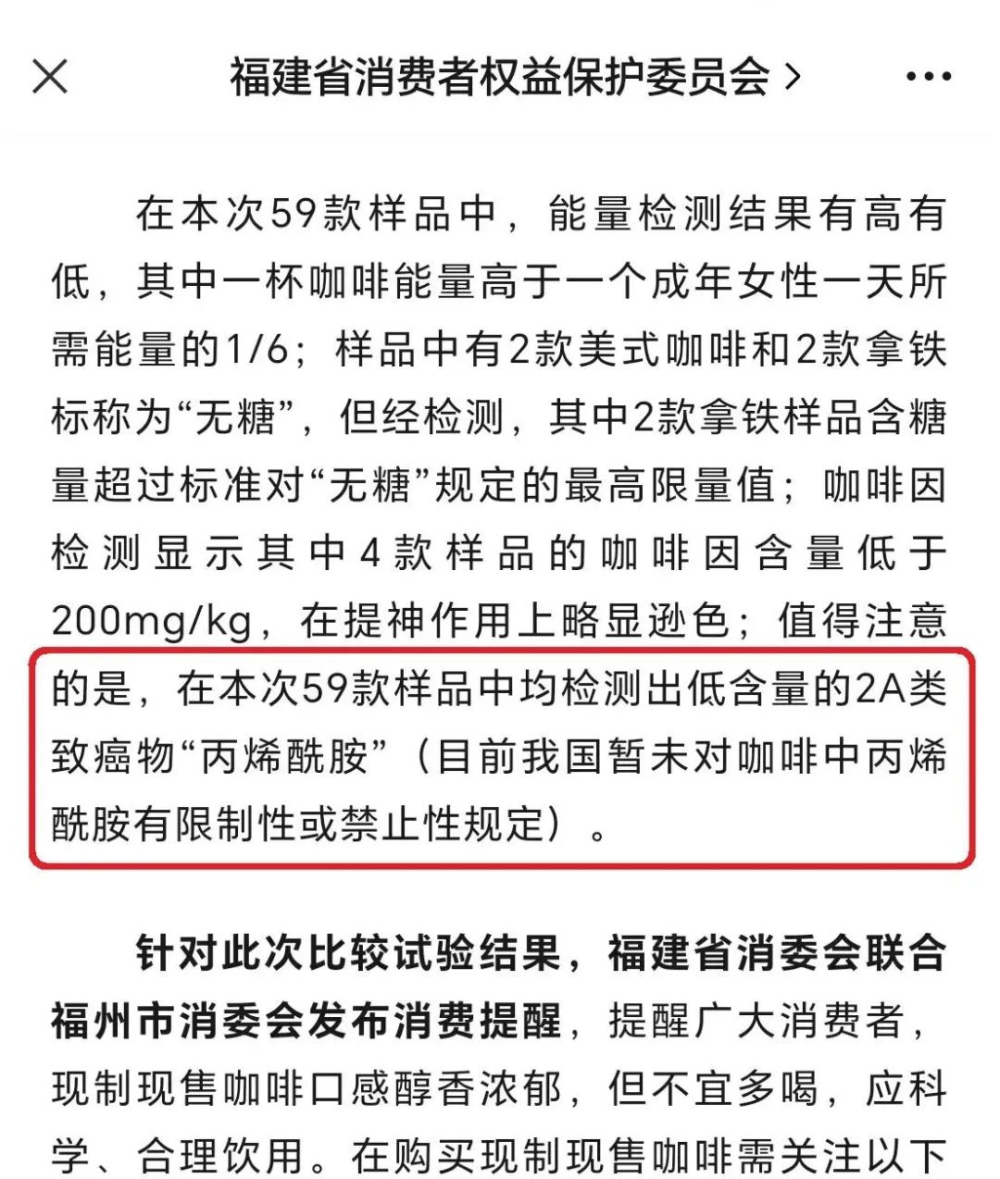
Additionally, the Consumer Council specifically noted in the report that “China currently has no restrictive or prohibitive regulations regarding acrylamide in coffee.” This statement indirectly reflects the overall scientific assessment of the risks posed by acrylamide in coffee—under normal consumption levels, the risk is extremely low. If there were a significant safety threat, relevant authorities would typically take measures such as product recalls or removal from shelves. Therefore, consumers need not panic excessively due to sensational headlines; a rational view of the testing data and actual intake levels is key.
In summary, although all 59 samples of freshly prepared coffee were found to contain trace amounts of acrylamide, based on current scientific data and dosage assessments, the carcinogenic risk of normal coffee consumption is extremely low. Understanding the mechanisms of acrylamide formation and actual intake levels can help consumers make more informed choices, allowing them to enjoy coffee while also considering health factors.
The above content is compiled by CoffeeHunters, a coffee news website.


