








Introduction:To brew a well-balanced cup of coffee with harmonious acidity, sweetness, and bitterness, extraction time plays a crucial role. Only about 30% of a coffee bean consists of soluble flavor compounds, and the release rates of acidity, sweetness, and bitterness vary. Poor timing can easily result in thin, sour flavors or an overly bitter cup. This article delves into the flavor-release characteristics at different stages of extraction, helping you identify the optimal brewing times for both pour over and espresso methods—while avoiding common extraction pitfalls.
Did you know? Only around 30% of a coffee bean is made up of soluble flavor compounds—the source of the acidity, sweetness, and bitterness we taste. However, these three flavor categories are not released simultaneously; their dissolution rates and peak release periods differ. If the extraction time is too short, sweetness and bitterness haven’t had a chance to fully develop, often resulting in a thin and overly acidic cup. Conversely, if brewed too long, bitterness can overpower other flavors, leading to an imbalanced taste overall. Therefore, mastering the right extraction time is key to achieving a balanced acidity-sweetness-bitterness profile.
In a cup of coffee, only about 30% of the bean’s weight consists of extractable flavor components—the rest, 70%, is insoluble woody fiber. In other words, once the soluble portion has been fully extracted, what remains is akin to the residue of chewing gum, offering virtually no flavor. However, we don’t need to extract all 30%; the ideal extraction yield typically falls between 18% and 22%. This range helps deliver the best possible flavor complexity.
The soluble flavors in coffee can be broadly divided into three main categories: acidity, sweetness, and bitterness. Their dissolution speeds vary, so their peak release periods occur at different stages during extraction. This is one of the reasons why many people misunderstand how coffee flavors are released.
Acidic compounds are the fastest to dissolve, usually peaking early in the extraction process and quickly imparting a bright, fresh acidity to the coffee. Next come the sweet compounds, which dissolve slightly more slowly than acids. As a result, while acids are being heavily released, sweetness is still gradually accumulating. It isn’t until the mid-stage of extraction that sweetness reaches its own release peak. Bitter compounds dissolve the slowest; they show little change early on, only gradually increasing after the peaks of acidity and sweetness have passed, with a clearly rising release curve. Overall, the longer the extraction time, the richer the accumulation of flavor compounds, and the more pronounced the layers of flavor in the coffee.
So why is it especially important to pay attention to extraction time? The answer lies in controlling the release of these flavor compounds to ensure a balance among acidity, sweetness, and bitterness. Insufficient extraction time means sweetness and bitterness haven’t been fully released yet, often leaving the coffee tasting thin and overly sour due to lack of supporting flavors—this is known as “under-extraction.” On the flip side, extending extraction into the stage where bitterness is heavily released can make the entire cup taste harsh and bitter—a problem referred to as “over-extraction.”
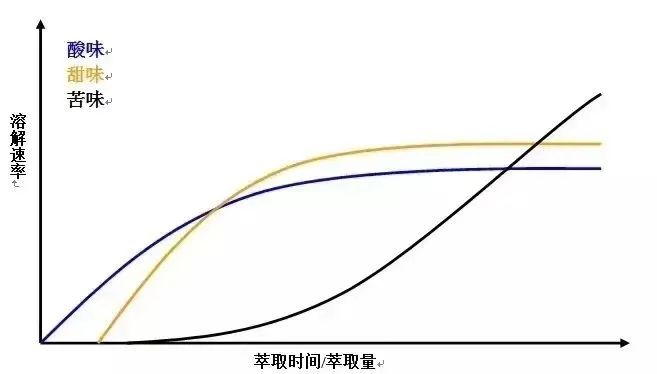
Therefore, the ideal scenario is to end the extraction process just after the sweetness peaks but before bitterness begins to dominate. This approach preserves the coffee’s bright acidity and sweet layers, while preventing bitterness from taking over the overall taste. In practice, this can be achieved by controlling extraction time. For example, when using 15 grams of coffee beans in a pour over, under standard parameters, aiming for an extraction time between 1 minute 50 seconds and 2 minutes 25 seconds often yields a well-balanced cup with ideal acidity, sweetness, and bitterness.
However, there’s a common misconception about the order in which acidity, sweetness, and bitterness are released—that they appear sequentially. In fact, all three flavor compounds begin releasing at the same time; it’s simply their different dissolution rates that cause their peaks to occur at staggered intervals, creating the illusion of sequential release.

For instance, when you taste a cup of coffee made from lightly roasted beans, the bitterness may not be obvious—but bitter compounds are indeed present. Their release level is just relatively low, masked by the brighter notes of acidity and sweetness. Understanding this can help you make more precise adjustments to grind size, water temperature, and extraction time, thereby further enhancing the overall flavor quality of your coffee.
The above content is compiled by CoffeeHunters, a coffee news website.


