








Introduction:In 2023, Vietnamese coffee prices surged to multi-year highs, reaching up to 70,000 Vietnamese dong per kilogram (approximately 207 RMB). With production forecasted to decline by 10%, the market imbalance between supply and demand in 2024 may worsen. This article delves into the reasons behind the shifts in Vietnam’s coffee supply chain, explores the market performance of Robusta and Arabica varieties, and provides insights on future price trends and purchasing advice to help consumers and traders stay attuned to market movements.
According to statistics from the Vietnam Coffee - Cocoa Association (Vicofa), domestic coffee prices in Vietnam soared to 70,000 Vietnamese dong per kilogram in 2023, equivalent to about 207 RMB, marking a rare high in recent years. Despite a slight decline in coffee export volume during the same period, overall export earnings still reached a record high.
Between October 2022 and September 2023, Vietnam’s total coffee exports amounted to 1.662 million tons (approximately 27.7 million bags, calculated at 60 kilograms per bag), a decrease of 4.5% compared to the previous year. However, driven by rising prices, overall export revenue still grew by 3.4%, reaching 4.08 billion US dollars, setting a new historical record.
Analyzing the reasons for the price increase, they can mainly be attributed to two factors: a global supply shortage in the market, and the gradual improvement in the quality of locally grown Vietnamese coffee, enabling products to be traded at higher price levels. Particularly in the export structure, Vietnam still primarily exports green coffee beans, with Robusta varieties accounting for the highest proportion, while the proportion of specialty coffee remains relatively low.
Breaking down variety performance, in 2023, the sales volume and export value of Arabica coffee in Vietnam both declined by approximately 30.7% and 34.9% respectively, indicating a weakening in market demand. In contrast, although the export volume of Robusta coffee only saw a marginal increase of 0.7%, its export value rose by approximately 10.8%, demonstrating an enhanced competitiveness and bargaining power in the international market.
Notably, some coffee-growing regions in Vietnam have begun adjusting their crop structures, with many farmers turning to growing durian and other high-economic-value fruits. This shift is mainly due to the long-term low coffee prices in recent years, where smallholder farmers (excluding large companies and cooperatives) lack the incentive to invest, coupled with the intensifying impacts of climate change, particularly the persistent drought caused by the El Niño phenomenon, which has significantly affected Robusta varieties.
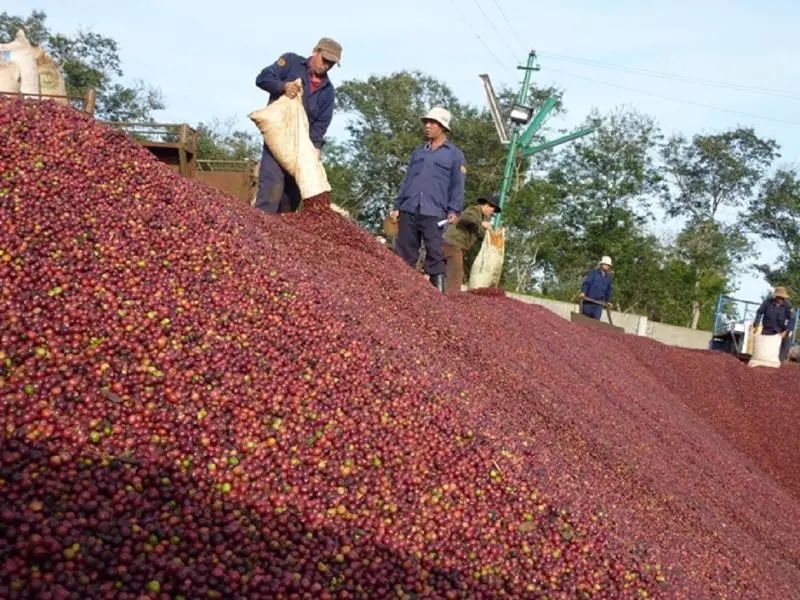
Since August 2023, Vietnam’s coffee export volume has notably decreased. Statistics show that in the first 10 months of 2023, the total export volume was close to 1.3 million tons, with a total value of about 3.3 billion US dollars, but compared to the same period last year, the export quantity dropped by nearly 11%, and the export value also slightly declined by 1.2%.
Vicofa predicts that the 2023–2024 coffee harvest will be delayed, and production may decline by 10%. The main reasons include the ongoing impacts of climate change, as well as farmers redirecting funds to invest in higher short-term-yield economic crops such as durian. Additionally, due to downward pressure on coffee market prices, harvesting methods in some regions have shifted to green harvesting, which has had a certain impact on the quality of early-harvested coffee beans.
Market expert Nguyen Quang Binh pointed out that coffee prices for the 2023–2024 season will remain high. If major global economies further cut interest rates before June 2024, it is expected to stimulate roasters to stock up in advance, further driving up market demand, especially for Arabica varieties.
Currently, the international quotation for Arabica coffee has risen from 140 US cents per pound (approximately 70,000 Vietnamese dong per kilogram) to 175 US cents (approximately 92,000 Vietnamese dong per kilogram), and there is still room for further increases. Although Robusta coffee prices have slightly pulled back due to initial supply pressures, overall, from now until the end of the year, Arabica coffee prices are expected to remain stable until the monetary policies of Europe and the United States become clear by June 2024.
In terms of export structure details, in 2023, Vietnam’s main export items included: approximately 1.5 million tons of Robusta green beans, generating 3.2 billion US dollars in foreign exchange; about 41,500 tons of Arabica green beans, generating 169 million US dollars; around 36,000 tons of decaffeinated green beans, generating 136 million US dollars; as well as a combined 90,000 tons of roasted and instant coffee, generating 510 million US dollars. These figures reflect Vietnam’s important position in the global coffee supply chain, as well as the differing market demands for various coffee varieties.
The above content is compiled by CoffeeHunters, a coffee news website.


