








Introduction:McDonald's premium coffee brand, McCafé, has rapidly expanded in the Chinese market, with its number of outlets surpassing 3,200. It focuses on a specialty route featuring semi-automatic coffee machines and dedicated baristas. However, recently some consumers have reported operational issues at certain outlets, such as unweighed coffee grounds, lack of tamping, and inadequate cleaning of steam wands, sparking discussions about quality control standards. This article will delve into the standard procedures of McCafé and the gaps in actual operations, helping readers understand key aspects of coffee preparation and common pitfalls.
Since announcing a three-year, 2.5 billion yuan investment to expand in the Chinese market, McDonald’s coffee brand McCafé (麦咖啡) aims to cover over 4,000 outlets with the goal of “where there’s a McDonald’s, there’s a McCafé.” Currently, it has over 3,200 outlets, with nearly every McDonald’s location featuring a dedicated McCafé section in a “store-within-a-store” model. These sections are equipped with semi-automatic “Bumblebee” coffee machines and matching grinders, operated by dedicated baristas, gradually replacing the previously offered affordable freshly ground coffee.
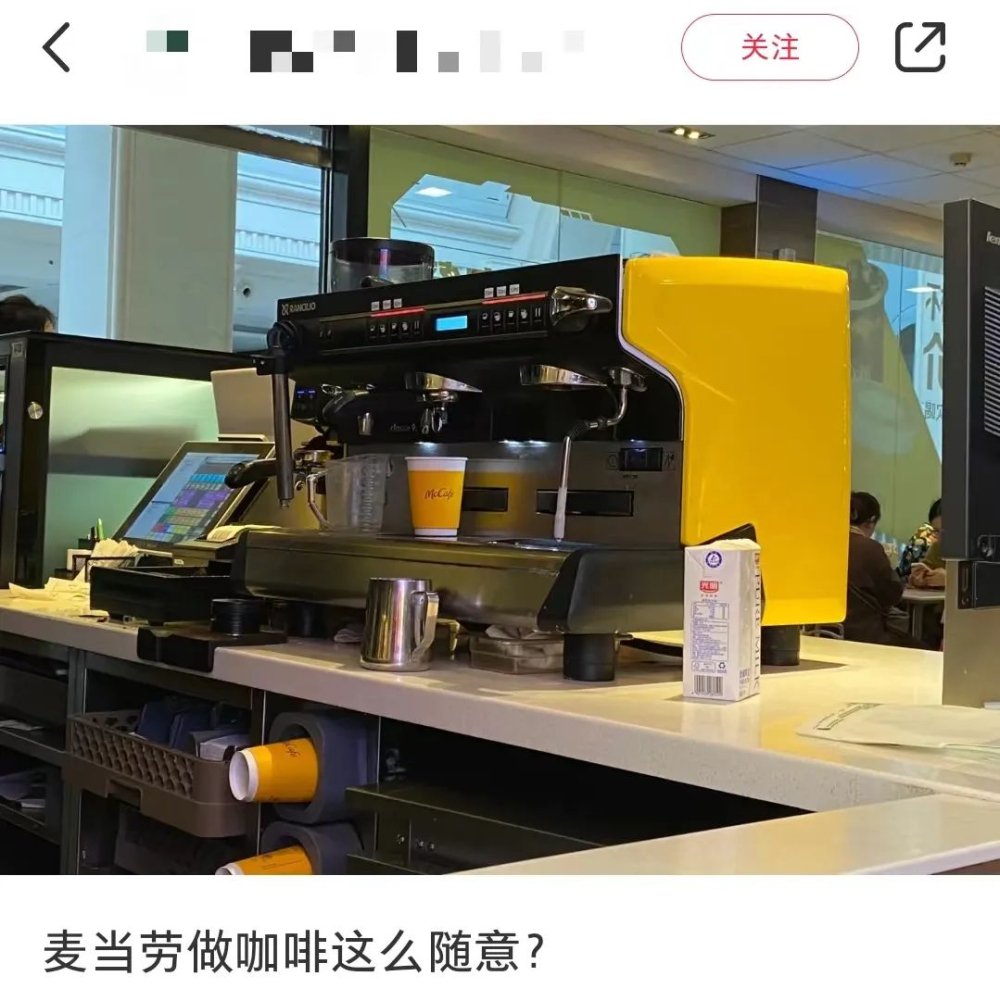
However, recently a netizen shared observations from a McCafé outlet at a high-speed railway station on social media, pointing out several operational issues by the barista during coffee preparation, which triggered widespread discussion about McCafé’s quality control. According to the netizen’s description, the barista did not weigh the coffee grounds during preparation—the portafilter was even pre-loaded with coffee—and this led to inaccurate dosing during extraction. Moreover, the tamping step was completely skipped, both of which can affect the uniformity of extraction and the flavor profile of the coffee.
Even more concerning is that the steam wand was used directly without prior cleaning during milk frothing, and was also not wiped down afterward, resulting in noticeable milk residue (The photo shows clear buildup of milk residue on the steam wand). Additionally, the wet coffee grounds left after extraction were not thoroughly cleaned, and the residual grounds were said to potentially mix into the next cup of coffee, causing issues of re-extraction that further impact the coffee’s purity and taste.

Although the prices of these coffees are not low—for example, a drip coffee is priced at 19 yuan and a latte at 21 yuan—consumers have raised doubts about the quality of the output. In response, some netizens suggest this may be an issue with individual outlets or staff, and not representative of overall standards. Other netizens who claim to be McCafé baristas pointed out that the brand does indeed have standard operating procedures, such as recommending the use of 22 grams of coffee grounds, and that the grinder’s output and grind size are usually pre-adjusted. However, considering service efficiency and real-world conditions, not every cup is individually weighed to avoid delaying customer wait times.
From a brand strategy perspective, McCafé initially emphasized in its promotions that it differs from regular convenience coffee by having dedicated baristas rather than part-time staff during peak hours. Each barista is required to undergo 100 hours of training and adhere to strict quality control standards to meet current market expectations for “specialty coffee.” However, in actual operations, some outlets experience staffing shortages or training gaps, leading to situations where less experienced staff are temporarily put on duty, resulting in discrepancies between operational procedures and standards.
Industry insiders point out that key steps in coffee preparation include accurate weighing of coffee, even distribution in the portafilter, and proper tamping—all of which directly affect the stability of extraction and the release of flavors. In addition, the cleanliness of the steam wand and the technique of milk frothing are also critical factors influencing the quality of milk-based drinks like lattes and cappuccinos. If these fundamental steps are neglected, even the use of high-quality coffee beans and equipment will make it difficult to achieve the desired coffee flavor.
For consumers, when choosing coffee, in addition to paying attention to the brand and price, one can also observe the details of the preparation process—such as whether weighing tools are used, whether tamping is performed, and whether the steam wand is clean—as these are important indicators of coffee quality. As a chain brand, how McCafé maintains consistent quality control and staff training standards while rapidly expanding will be a key challenge for its future development.
The above content is compiled by CoffeeHunters, a coffee news website.


