







Introduction:Amid abnormal climate conditions and pest infestations, coffee production in Indonesia continues to decline. The 2023/24 export volume is projected to drop sharply by 32%. In response to these challenges, local research institutions have developed a new Arabica variety named Komasti, which is resistant to leaf rust and high-yielding. Its performance is being validated through demonstration plots. This article delves into the development background, real-world performance, and current promotion status of this variety to explore whether it could be a key solution for regional transformation.
In recent years, Indonesia’s coffee industry has faced dual threats from climate change and pests. The U.S. Department of Agriculture’s Foreign Agricultural Service predicts that coffee exports in the 2023/24 season will decline significantly by 32% compared to the previous year. Excessive rainfall earlier disrupted the normal development of coffee cherries, leading to a sharp drop in output. More recently, high temperatures and drought have exacerbated pest and disease outbreaks, hampering coffee tree growth and worsening supply shortages.
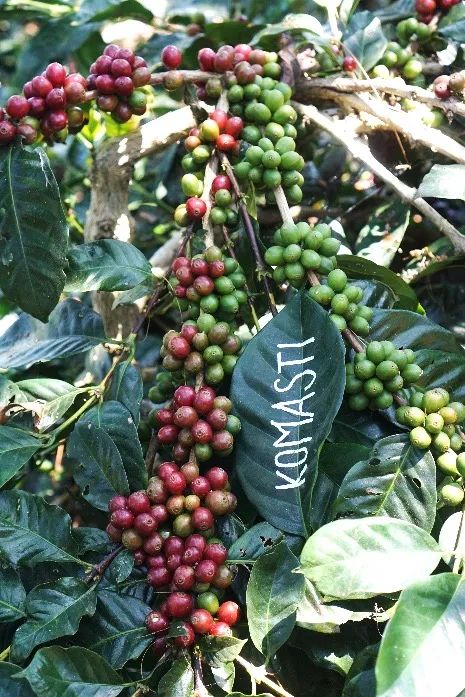
To address these challenges, the Indonesian Coffee and Cocoa Research Institute (ICCRI) has long been engaged in agricultural research, with the Komasti Arabica variety emerging as a focal point. This hybrid variety boasts strong disease resistance, particularly a high level of tolerance to common coffee leaf rust, while maintaining stable and high yields, offering a potential solution for the region.
Although officially released in 2013, Komasti initially saw low awareness and acceptance among farmers due to limited promotion efforts, testing phase restrictions, and difficulties in obtaining seedlings, resulting in modest actual planting rates.
In 2022, ICCRI partnered with the World Coffee Research (WCR) to establish a demonstration plot project in West Java, Indonesia. This initiative aims to showcase the superior performance of Komasti through actual cultivation, accelerating recognition and adoption by farmers in the region. Two major WCR industry partners, Frinsa Agrolestari and PT Sucafina Indonesia, jointly supported the setup of the demonstration zones and took charge of local management and progress monitoring starting in 2023.
It is understood that the first harvest from the demonstration plots is expected between May and July 2025. Nuzul Qudri, WCR’s Asia Regional Project Manager, stated that although the Komasti trees have not yet yielded their first crop, surrounding coffee farmers have shown strong interest, particularly noting the variety’s more vigorous early growth compared to the currently dominant local varieties.
The Komasti variety features rapid fruiting onset and high fruit set density, and under appropriate cultivation and management conditions, it has the potential to achieve yields of approximately ±2.1 tonnes per hectare (calculated based on 2,000 trees per hectare). Currently, the variety is gradually being trialed and promoted in various regions across North Sumatra and South Sulawesi in Indonesia, demonstrating regional adaptability.
Taking a single producing region as an example, some coffee plantations in South Sulawesi have introduced Komasti to observe its long-term performance and flavor characteristics. ICCRI emphasizes that the establishment of the demonstration plots will visually demonstrate Komasti’s yield advantage over Indonesia’s currently dominant varieties, helping farmers understand the importance of choosing high-quality, disease-resistant varieties to cope with ongoing climate change impacts and further advancing sustainable regional transformation.
The above content is compiled by CoffeeHunters, a coffee news website.


