







Introduction:Self-service coffee shops have gradually emerged in China in recent years, attracting many consumers eager to try something new with a business model similar to craft beer bars. Real-life examples from Wuhan and Guangzhou show that while this model—offering unlimited cups at low prices—has clear advantages in cost and efficiency, it also faces challenges related to quality control, location selection, and ambiance. This article provides an in-depth analysis of the feasibility and future direction of the self-service coffee model through on-site observations and industry insights.
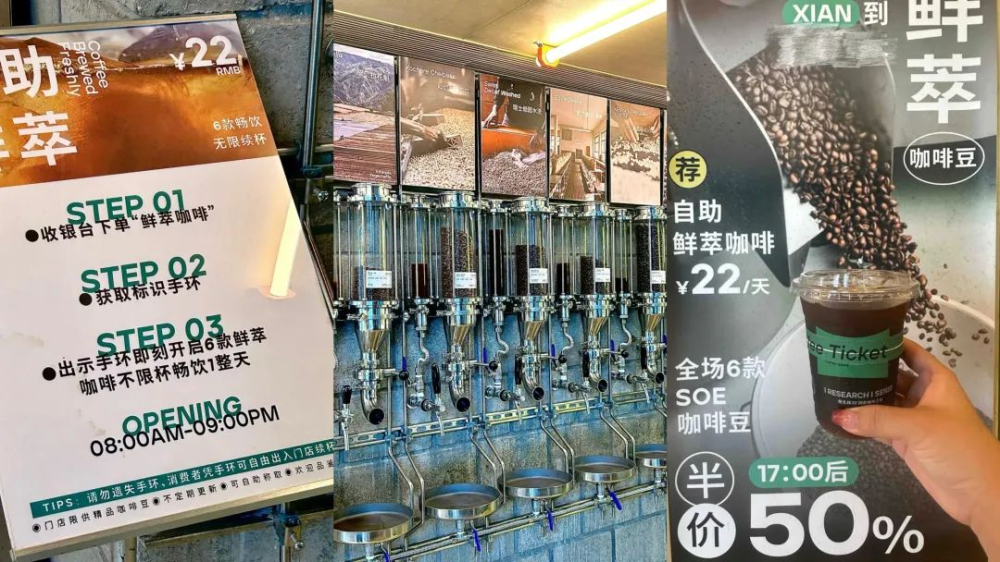
In recent years, a new business format has appeared in China’s coffee market—the self-service coffee shop. This model allows customers to pay a set fee and then enjoy unlimited cups of various freshly brewed coffees, drawing inspiration from the concept of craft beer bars. For instance, Wuhan’s first self-service coffee shop launched with a 22-yuan wristband that offered unlimited access to six types of fresh-brewed coffee for the day, along with a half-price discount after 5 p.m., quickly becoming a hot topic on social media. Guangzhou also saw a self-service café that only offered two types of coffee—black and white—where the counter featured eight thermoses, and customers could press a button to dispense the coffee.
This model emphasizes speed, low cost, and a diverse flavor experience. For busy office workers, the appeal is clear: enjoying coffee at an affordable price anytime. However, in practice, self-service coffee shops have also revealed several notable challenges, including heavy reliance on high-foot-traffic locations, inconsistent product quality, and the lack of the social atmosphere and personalized service typical of traditional cafés.
Take the Wuhan case as an example: the launch of this self-service coffee shop immediately caught the attention of many office workers. Many netizens shared how not only did they visit frequently themselves, but they also encouraged colleagues to join, even visiting the shop multiple days in a row. However, some consumers noted that although the pricing was attractive, the quality of the coffee varied slightly during certain periods, particularly after peak hours, when the flavor did not meet expectations.
In fact, similar self-service coffee shops had already appeared in Guangzhou as early as last year. The shop offered only two main categories—black coffee (drip-filtered) and white coffee (coffee with milk), with the black coffee featuring eight different flavor options. The counter was equipped with eight black thermoses, each with a tap-like dispensing mechanism beneath, allowing customers to simply press to get their coffee. According to the shop owner, this concept was inspired by the way craft beer is tasted, enabling customers to sample various flavors and ultimately find the one that best suits their palate.
However, successfully operating a self-service coffee model requires multi-faceted support. First, supply chain stability is crucial, especially the preservation and freshness of coffee beans, which directly impact the final extraction flavor. Second, equipment maintenance and hygiene management are also challenges—whether the crema of espresso is even or whether milk blends smoothly depends on the precision and regular cleaning of the machines. Additionally, the self-service model often lacks interaction with customers, unable to offer professional suggestions such as latte art or flavor pairing, which could be a major disadvantage in a market that values consumer experience.
From the current market situation, unmanned self-service coffee machines are not uncommon either in China or abroad—for example, Hong Kong’s “clean coffee,” MUJI’s self-service coffee stations, and other self-dispensing machines in other countries. These machines are usually located in transportation hubs, office buildings, or shopping malls where foot traffic is dense, offering quick and convenient coffee services. However, this model typically targets consumers looking for a “grab-and-go” experience, making it harder to cultivate a loyal customer base or build strong brand attachment.
Overall, while the self-service coffee model offers cost efficiency and expansion potential, achieving long-term stable operations still requires overcoming multiple challenges—including location selection, quality control, equipment, and customer experience. Whether it will become a mainstream market option or remain just a supplementary choice in the coffee consumption landscape remains to be seen. For operators, striking the right balance between efficiency and quality will be the key to success.
The above content is compiled by CoffeeHunters, a coffee news website.


