







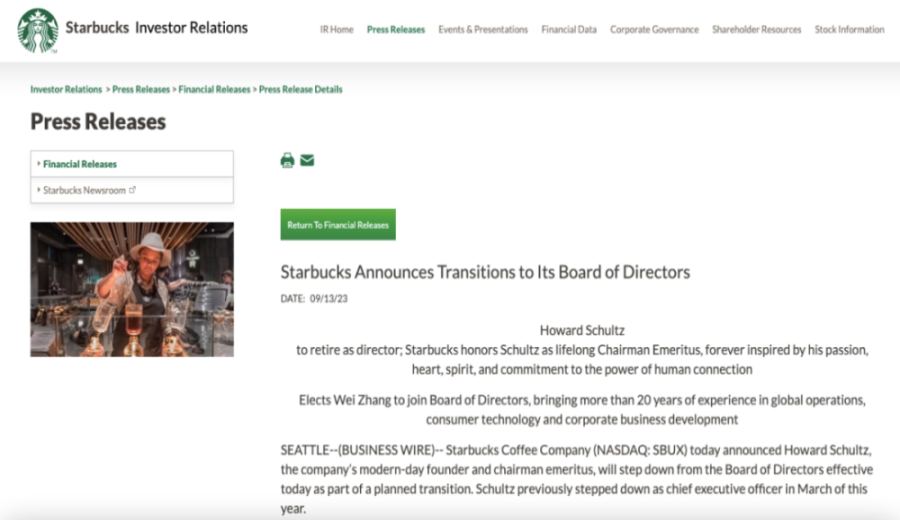
Introduction:Starbucks recently announced that its founder Howard Schultz has officially stepped down from the board of directors, ending his influential era spanning over four decades. Taking his place on the board is Zhang Wei, who previously held a senior position at Alibaba Pictures, with her appointment expected to take effect on October 1. This personnel change not only marks a generational shift in Starbucks’ leadership but is also seen by outsiders as a significant signal of the brand’s deeper commitment to the Chinese market. Learn about Schultz’s legendary journey and how Zhang Wei’s background may influence Starbucks’ future strategy.
Starbucks has recently revealed major personnel news: Howard Schultz, the brand’s founder and former executive chairman, has officially announced his resignation from the board, bringing an end to his decades-long profound impact on the brand. At the same time, Zhang Wei, former president of Alibaba Pictures, has been elected as the new board member, with the appointment set to officially take effect on October 1.
In a public statement, Schultz said: “I have indescribable gratitude for Starbucks’ millions of partners and customers.” He reflected on his 41 years with the company, rising from the grassroots level and personally witnessing Starbucks’ transformation from a small coffee bean retailer into a global coffee chain giant. He further noted that although he will be stepping down from the board, he will continue to support the company and the new generation of management as honorary chairman, and will always remain a loyal fan of Starbucks products.
Schultz revealed that in the future, he will devote more time and energy to family life, and will run the Schultz Family Foundation with his wife Sheri, dedicated to promoting social innovation, creating job opportunities, and helping more people achieve their life goals.
Looking back at Starbucks’ development, in the 1970s, the brand was just a small enterprise focused on wholesale coffee beans. It wasn’t until Schultz joined in the 1980s and proposed transforming coffee shops into a “third place” in people’s lives—a space for relaxation and socializing outside of home and the office—that the brand found a new direction for growth. Between 1987 and 1992, the number of Starbucks stores quickly expanded from the original 9 to over 160, with annual sales climbing to $57 million, gradually establishing itself as a national coffee chain brand and successfully going public on NASDAQ in 1992.
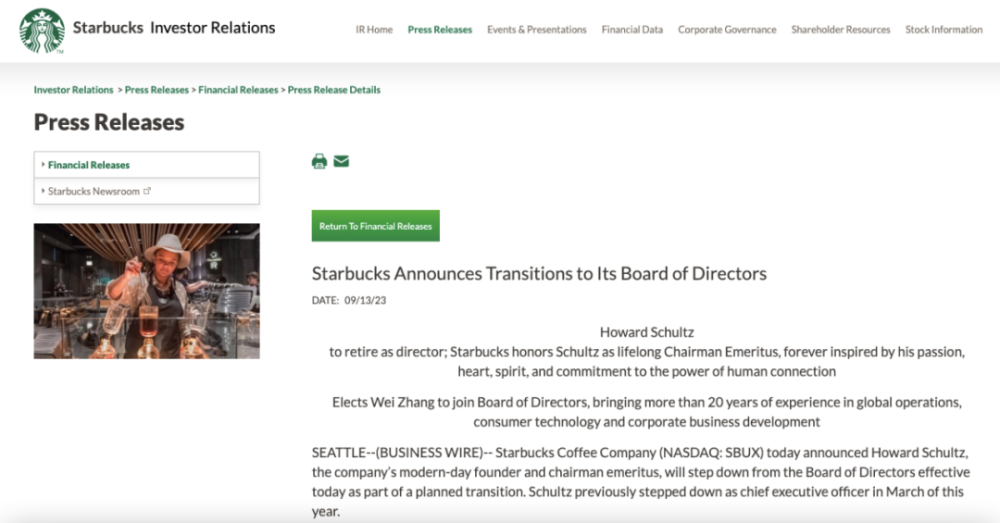
Today, Starbucks has grown into the world’s largest coffee chain brand, with over 36,000 stores globally, including more than 6,500 locations in the Chinese market. Over the years, Schultz has served as Starbucks CEO three times: from 1986 to 2000, from 2008 to 2017, and he returned to the role again in 2022 until officially stepping down in March of this year.
Although Schultz himself has not publicly explained the specific reasons for stepping down from the board, Starbucks has stated that this is part of the company’s planned leadership transition. The 70-year-old Schultz will be awarded the honorary title of “Lifetime Honorary Chairman” in recognition of his long-term outstanding contributions to the brand.
Zhang Wei, who is taking Schultz’s place on the board, brings a wealth of international corporate and media strategy experience. Before joining Alibaba Pictures, she worked for multinational giants such as News Corporation, CNBC, Bain & Company, and General Electric, possessing diverse and solid business expertise. Currently, she also serves on the board of the renowned American luxury brand Ralph Lauren. Notably, Zhang Wei once hosted the CCTV talk show “Dialogue” in her early career, conducting in-depth interviews with multiple international business leaders including Masayoshi Son and Kai-Fu Lee.
The industry generally believes that Zhang Wei’s appointment signals Starbucks’ high level of emphasis on the Chinese market. An analysis by CNN pointed out that Zhang Wei’s experience and network in the Chinese market will help Starbucks achieve greater breakthroughs in the world’s second-largest market.
In fact, Starbucks’ current CEO Laxman Narasimhan emphasized during his visit to China in May this year that the brand plans to open up to 9,000 stores in the Chinese market by 2025 and will continue to increase investment in China. He further pointed out that the Chinese coffee consumption market still has huge growth potential and is expected to surpass the United States in the future to become Starbucks’ largest global market.
For consumers, such a high-level leadership change not only represents possible adjustments in brand strategy but also suggests that more locally tailored products and services may be introduced in the Chinese market in the future. For coffee enthusiasts, in addition to keeping an eye on brand developments, it’s also worth delving into the flavor profiles of various coffee beans, optimal extraction parameters, and pour over techniques to enhance their tasting experience.
The above content is compiled by CoffeeHunters, a coffee news website.


