








Introduction:In recent years, WBC champions have frequently chosen Colombia’s Sidra, bringing this enigmatic coffee variety into the spotlight. What exactly is Sidra? What are its genetic lineage, cultivation characteristics, cupping flavors, and optimal brewing methods? This article takes you deep into the history, plant traits, and extraction essentials of Sidra. Whether you’re a coffee enthusiast or an advanced brewing aficionado, you’ll gain practical insights.
If you’ve been following the coffee scene, you’ve likely heard the name “Sidra” repeatedly over the past two years. This Colombian coffee variety has rapidly risen to prominence in the specialty coffee world, thanks to the favor of two World Barista Championship (WBC) winners. In 2019, South Korean competitor Jooyeon Jeon claimed the title with a Sidra lot from Colombia’s La Palma y El Tucan’s Palmira & Tucan estate, while in 2023, Australian champion Anthony Douglas triumphed with an anaerobically fermented Sidra from Finca El Diviso. Once considered an experimental field variety, Sidra has now become a staple on the championship stage.

The name “Sidra” is actually a transliteration of the Spanish word “Sidra,” sometimes also written as Sydra, and has even been mistakenly referred to as Bourbon Sidra. Semantically, Sidra means “apple juice” or “cider,” which seems to hint at its potential for bright, fruity aromas. The industry generally speculates that Sidra is a cross between Typica and Red Bourbon, which is why it often exhibits sweet tonalities similar to Bourbon along with the clarity and structure typical of Typica in cupping.
However, according to genetic analysis by the World Coffee Research Center (WCR), Sidra’s genetic makeup is actually closer to native Ethiopian landraces rather than a simple Typica-Bourbon hybrid. Some research suggests that Sidra originated in the Nestlé Coffee Breeding Center in Pichincha, northern Ecuador, where attempts were made to cross Ethiopian landraces with the locally prevalent Typica and Bourbon. Later, when the project was discontinued, many experimental varieties—including Sidra—were left to propagate on their own in the fields and gradually spread elsewhere.
Mr. Han Huai-zong also mentioned in his book “The Fourth Wave of Specialty Coffee” that subsequent genetic analyses revealed that commercially available Sidra can be divided into at least two major types: slender-bean and round-bean. Among them, the slender-bean Sidra contains almost no Typica genetics and is more similar to Geisha or other Ethiopian landraces; the round-bean Sidra is believed to be a hybrid of Typica and Geisha. These findings suggest that Sidra’s “lineage” is actually quite complex and not yet fully clarified.
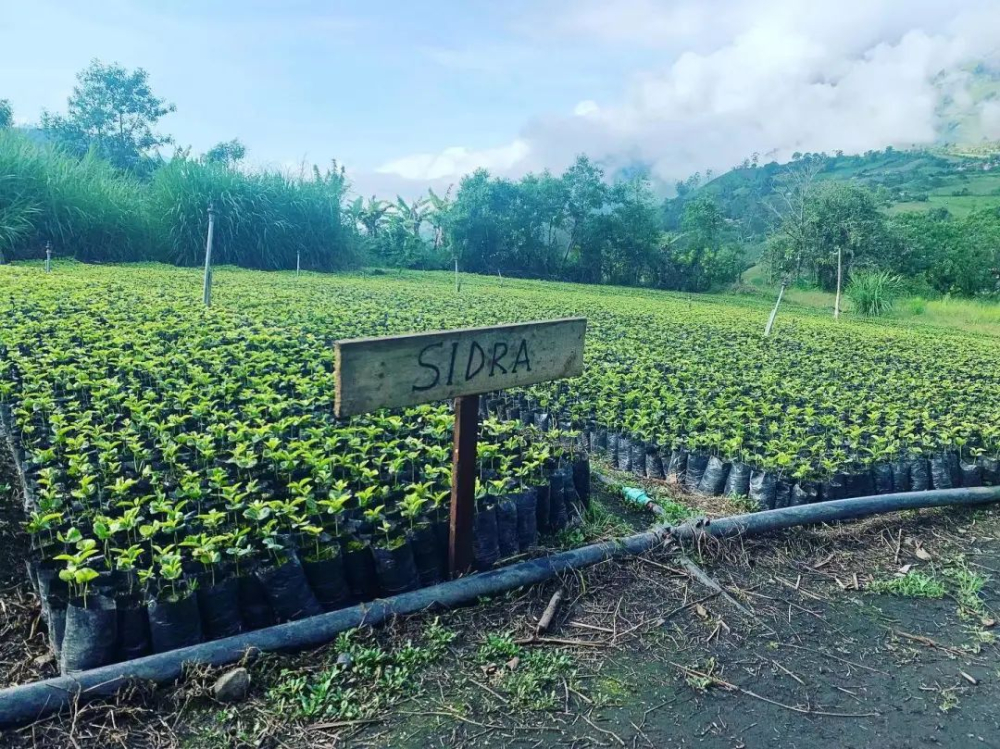
Currently, the main growing regions of Sidra are concentrated in Colombia and Ecuador. In the first-ever Ecuador COE (Cup of Excellence) competition in 2021, Sidra varieties secured the 2nd, 5th, 6th, 8th, 16th, 20th, and 21st places, delivering an outstanding performance. In Colombia, renowned farms such as La Palma y El Tucan and Finca El Diviso continue to cultivate and release high-quality Sidra lots, making it a popular choice in both competitions and the specialty market. Beyond these two countries, a few other regions also grow small quantities of Sidra for experimental purposes.
Sidra plants typically grow at altitudes of 1650–1800 meters, with mature plants reaching up to 4 meters in height and requiring moderate shade. This variety demonstrates certain resistance to common pests and diseases but is still susceptible to leaf rust and coffee berry disease, so disease management is essential during cultivation. Its leaves are long and narrow, with the typical five-petal flower morphology, and it yields abundantly. The fruits are larger and more rounded than those of most Arabica varieties. The green beans have an elongated shape, quite similar to Geisha.
In terms of cupping, high-quality slender-bean Sidra (especially washed processing) often exhibits complex aromas of brown sugar, citrus, honey, and berries, paired with delicate floral notes, closely resembling the impression given by Ethiopian landraces. Han Huai-zong also wrote in his book, “Its sweetness and floral nuances are very similar to those of Yirgacheffe or Geisha.” During an actual cupping of an anaerobic natural Sidra from Finca El Diviso, distinct layers of passion fruit, citrus, grape, and honey were evident; as the temperature dropped slightly, the acidity became as bright as orange juice, accompanied by mild spicy sensations, with a cocoa-like sweet and rich finish that left a deep impression.

In brewing performance, a Sidra from a Colombian Finca El Diviso, whether cold brewed, ice pour over, or hot pour over, consistently showcases intense fruitiness and high sweetness, along with pleasant herbal notes. The overall mouthfeel is round and smooth, with minimal bitterness. For varieties with prominent floral and fruity profiles, medium-light roasting is recommended to enhance aroma and fruit acidity.
Roasters recommend using water at 90–91°C for pour over to avoid extracting excessive bitterness due to high temperature, while still fully highlighting its cocoa and fruit characteristics. The specific brewing parameters are as follows: use a V60 filter, water temperature controlled at 90–91°C, grind size roughly equivalent to granulated sugar (about 80% passing through a standard #20 sieve), coffee-to-water ratio of 1:15, and a coffee dose of 15 grams.
Specific steps: After placing the coffee grounds in the V60, pour hot water equal to twice the coffee weight (approximately 30 grams) for a 30-second bloom to allow the grounds to fully expand; then pour water in small streams, moving from the center outward in circles. When the total water volume reaches 125 grams, perform the first pour break. Once the water level drops to the middle of the filter, continue pouring until reaching 225 grams to complete the extraction. The total brew time should be kept around 2 minutes. These parameters help balance acidity, sweetness, and flavor layers, making it ideal for coffee lovers who enjoy fruity and floral notes.

The above content is compiled by CoffeeHunters, a coffee news website.


