








Introduction:Recently, Luckin Coffee has sparked heated discussion after employees were reportedly required to repeatedly copy down customer complaints as punishment. Some staff claimed they had been made to write out negative reviews, order notes, or quality control checklists dozens or even hundreds of times, with reports of employees breaking down in tears due to the stress. What was the original intention behind this so-called “copying punishment” system? Is it reasonable or appropriate? This article delves into the full story of the incident, exploring how Luckin balances high-quality service with employee labor rights, and offers practical insights for both consumers and industry professionals.
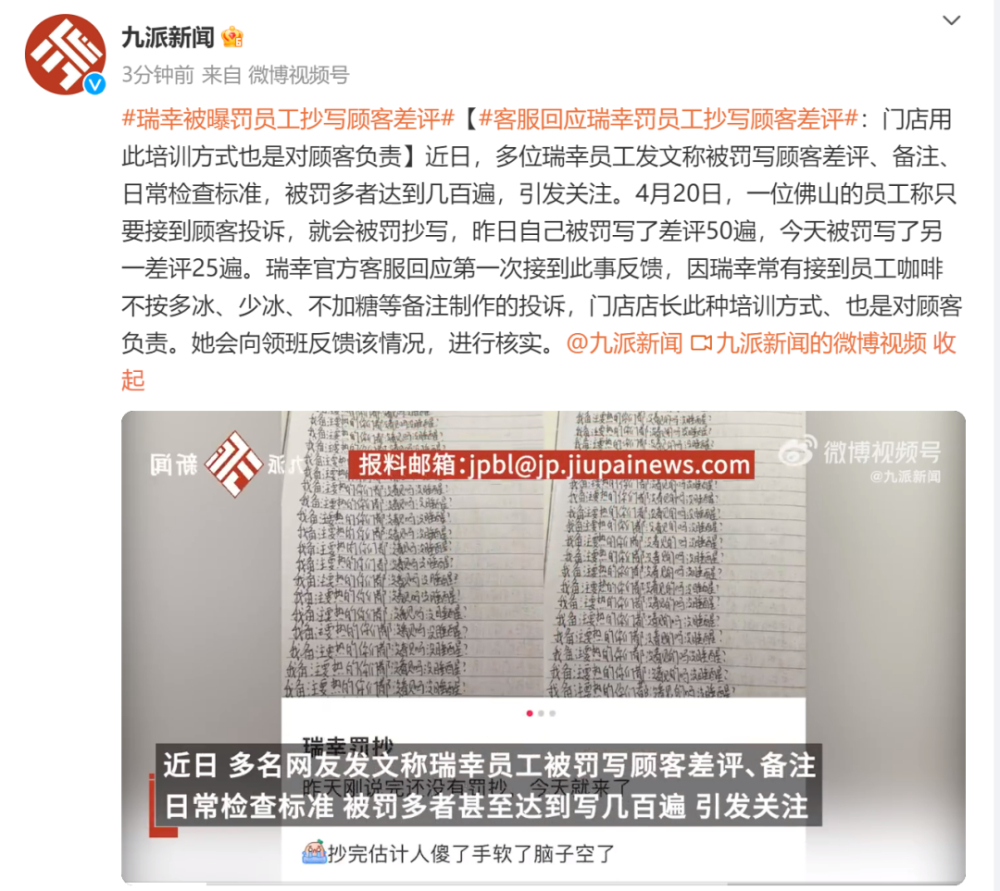
Luckin Coffee has recently come under intense public scrutiny over its practice of “copying down customer complaints.” According to media reports, numerous Luckin employees have shared their experiences on social media platforms, stating that when a store receives a customer complaint, the involved staff members are required to repeatedly write out the content of the complaint, order remarks, or quality control standards—anywhere from dozens to hundreds of times. There have even been reports of employees crying under the pressure of such copying tasks.
In response to the incident, Luckin’s official customer service explained that the measure is intended to reinforce employees’ attention to customer remarks and improve order accuracy. The customer service team further clarified that, in the past, the company received numerous complaints from customers—for example, incorrect adjustments to ice levels or sugar content, or failure to notice requests such as no ice or cup holders. As a result, stores adopted the copying method to remind employees to pay closer attention to order details, thereby providing more thoughtful service.
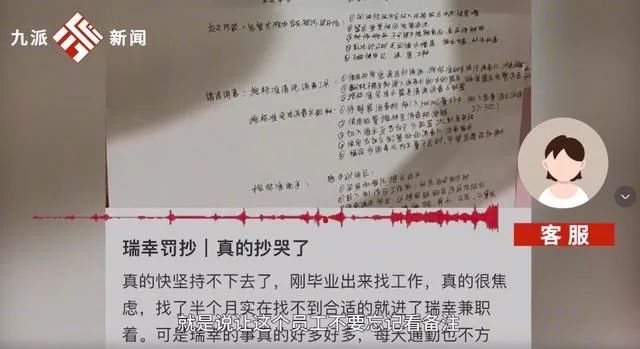
In fact, this so-called “copying punishment” system has not been newly implemented. On social media platforms such as Xiaohongshu (Little Red Book), discussions about it date back as early as August of last year. Employees revealed that they had been required to copy content as many as one thousand times, leaving many netizens exclaiming, “It’s like going back to school days.” From the leaked copying content, it mostly includes common customer complaints, such as: “I noted I wanted it hot, didn’t you see? Are you not awake?” “The jasmine tea has no sugar—it’s completely undrinkable,” “I ordered no ice, why did it arrive with lots of ice?” and “Less ice with a cup holder,” among other specific order requests.
Public opinion on this management measure is sharply divided. Some netizens question whether the copying punishment truly helps improve service quality or if it is merely a formality. They also raise concerns about potential labor rights issues, arguing that employees already face high-intensity workloads and that such measures only add to their psychological burden. Other netizens, however, assert that if employees fail to prepare drinks according to customer requests, they should bear the corresponding responsibility. They view the copying task as a reasonable warning measure, stating, “It’s better than being fined,” and questioning, “With frequent complaints about incorrect orders, shouldn’t there be some form of discipline?”
Notably, in addition to copying down negative reviews, some netizens have shared that certain stores also administer online quizzes on new product recipes. Failure to meet the passing score may also result in copying punishments, indicating that Luckin employs multiple layers of control mechanisms for quality assurance and service standards.
The discussion sparked by this incident focuses not only on customer experience and service quality but also touches on issues related to the working environment and mental health of employees. How to ensure that every cup of coffee meets customer expectations while safeguarding the basic rights and morale of employees has become an important challenge for major coffee chains like Luckin.
For consumers, understanding the importance of order remarks and how stores handle special requests can enhance the purchasing experience. For industry professionals, reflecting on how to balance high service standards with humanized management also holds valuable lessons. Whether Luckin will propose more comprehensive solutions in the future is certainly worth continued attention.
The above content is compiled by CoffeeHunters, a coffee news website.


