








Introduction:Did you know that in Italy, some people add lemon to their espresso? Espresso Romano (Roman Espresso) is a classic drink full of regional character. This article will take you through its historical origins, explore how it emerged as a response to poor-quality coffee during wartime, and through practical testing of different roast levels, show you how lemon affects the flavor profile of espresso. We also provide practical advice for coffee enthusiasts eager to try this unique combination.
What kind of taste experience arises when the bright acidity of lemon meets the rich, slightly smoky bitterness of espresso? In Italy, this combination isn’t a creative whim but a historically rooted drinking tradition — Espresso Romano, also known as Roman Espresso. Behind this drink lies a story of wartime and economic hardship, showcasing the ingenuity of the people, and it is still enjoyed in certain parts of Italy to this day.

When it comes to coffee with pronounced acidity, many people think of words like “bright,” “refreshing,” or “bursting with fruitiness.” These sensations are often closely associated with citric acid. When evaluating fruity, acidic coffees, lemon is commonly used as a reference point for citrus flavors. Whenever a coffee displays a fresh, lemon-like acidity, it tends to make the mouth water and feel lively on the palate.
But in the world of coffee, directly adding highly acidic lemon to espresso is quite an unusual practice. Especially in Italy, the birthplace of espresso, locals actually put fresh lemon slices or juice into a freshly brewed shot of espresso and drink it together. However, it’s important to note that this is completely different from the “lemon coffee” commonly seen in Hong Kong cha chaan tengs.
Going back to the early 20th century, Italy not only invented the modern espresso machine but also popularized the use of the moka pot, making espresso an everyday beverage for the general public. But at that time, coffee flavors were predominantly dark roasted, emphasizing intense, heavy roasty aromas, and even noticeable burnt bitterness. Then came the First and Second World Wars. Coffee bean imports to Italy became difficult, and the post-war economic depression meant many people could only access low-quality beans or turned to instant coffee.
Against this backdrop, residents in southern Italy discovered that their abundant local lemons might help improve the unpleasantly bitter and harsh coffee. They began experimenting by adding fresh lemon juice or slices to their espresso, and unexpectedly found that the acidity of the lemon effectively neutralized the bitterness of the coffee. Not only did it improve the overall drinkability, but it also brought a hint of fresh aroma, making the coffee much easier to enjoy.
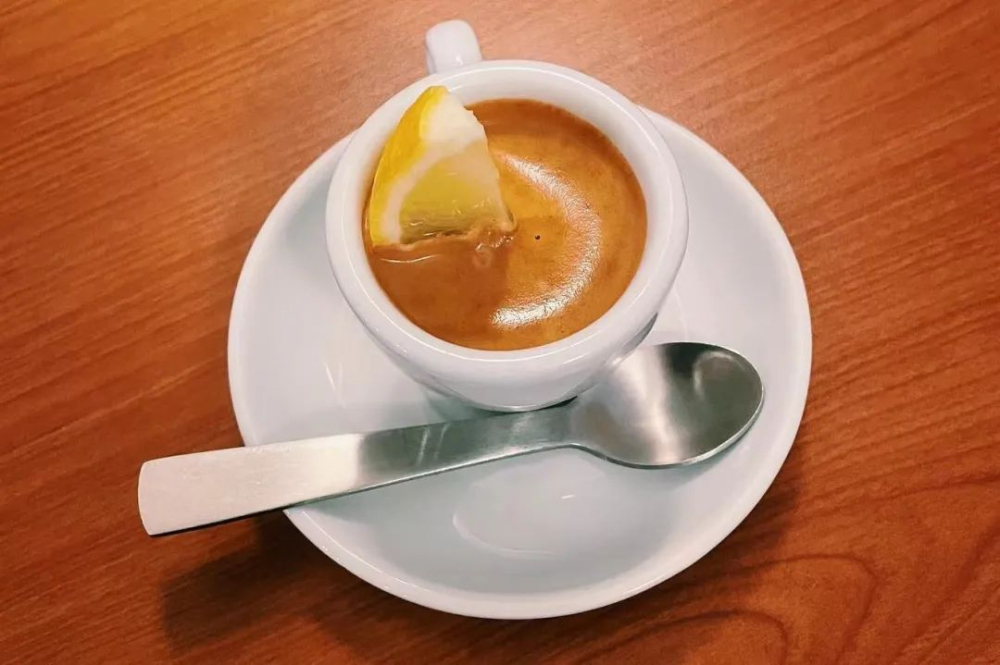
To this day, in places like Naples, Capri, and Sicily in Italy, this method of pairing lemon with espresso can still be found. Locals may call it caffè canarino or caffè all’imone, while internationally it is most commonly referred to as Espresso Romano (Roman Espresso).
In preparation, Roman Espresso is typically made by placing one or two fresh lemon slices in the cup, or directly squeezing in lemon juice, then pouring in a freshly brewed shot of espresso. Sometimes a teaspoon of sugar is also added and stirred in. Some cafes in certain regions even add a dash of liquor, turning this coffee into a locally flavored cocktail-style drink.
In reality, coffee beans of different roast levels produce vastly different flavor reactions when paired with lemon. There have been practical tests showing that using a medium-light roasted blend with pronounced berry acidity (for example, a blend containing Ethiopian sun-dried red cherry), when lemon juice is added, not only does it fail to enhance the flavor as expected, but it actually makes the green, astringent notes more pronounced. The aftertaste also leaves an uncomfortable dryness, negatively affecting the overall drinking experience.
On the other hand, when switching to a medium-dark roasted bean with a primarily bitter-sweet profile — such as coffee beans from Brazil’s Queen Estate, using 20 grams of coffee grounds to extract 35 milliliters of espresso over approximately 28 seconds — this coffee naturally has hazelnut and caramel aromas. It has a rich body with moderate bitterness and a sugarcane-like finish. After adding a few drops of lemon juice, the originally strong bitterness is noticeably softened, while a gentle citrus aroma emerges. The overall profile becomes more balanced and layered.
Based on the overall test results, if you’d like to try replicating this contrast-rich Roman Espresso at home, it is recommended to start with a medium-dark roasted coffee bean. This roast level naturally reduces the intense bitterness of the espresso while creating a better contrast with the fresh acidity of the lemon, resulting in a more harmonious and interesting overall flavor.
Although Roman Espresso may not become a mainstream choice for the mass market, its existence perfectly showcases the flexibility and creativity of Italian coffee culture. While preserving traditional techniques, it is also willing to adapt based on local conditions and needs — an essential part of the espresso spirit. Perhaps in the future, with more bold experiments by baristas, we’ll get to see even more innovative coffee drinks that break the mold.
The above content is compiled by CoffeeHunters, a coffee news website.


