







Introduction:Tims Coffee, a brand under the Canadian national coffee chain Tim Hortons, has officially launched its Chinese brand name ‘Tims天好咖啡’ recently. This marks the first time the brand has adopted a localized Chinese name since entering the Chinese market, demonstrating its commitment to deeply cultivating the Chinese consumer market. From the opening of its first store in Shanghai in 2019, to listing on the NASDAQ in 2022, and now adjusting its store target to surpass 2,750 outlets by 2026—how is Tims China carving out growth opportunities amidst fierce competition from industry giants such as Starbucks and Luckin? This article takes you through the brand’s development trajectory and market strategy.
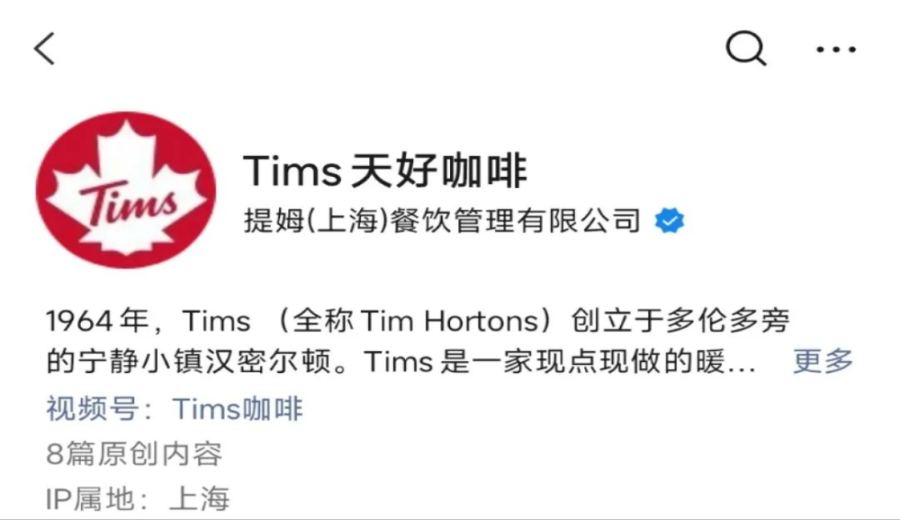
Tims Coffee, the operating entity of the renowned Canadian coffee chain Tim Hortons in the Chinese market, has recently officially changed the name of its official WeChat account to ‘Tims天好咖啡’. This move signifies the brand’s first official adoption of a Chinese name in the Chinese market. According to relevant media reports, the renaming is primarily aimed at strengthening the brand’s localized image, further aligning with the needs of Chinese consumers, and preparing for future expansion into lower-tier cities, including second- and third-tier markets. The official announcement of this brand strategy adjustment is expected to be made by the end of this month or early next month.
The Tim Hortons brand originated in 1964, when legendary Canadian hockey player Tim Horton opened the first restaurant in the small town of Hamilton, Ontario. Over the years, it has become a nationally recognized representative of coffee and light meals in Canada, selling over 2 billion cups of coffee globally each year. In 2018, bullish on the potential of China’s coffee market, the brand’s parent company RBI, together with Cartesian Capital, established Tims China. In February 2019, the first store was opened in Shanghai, marking the official entry into the Chinese market, where the brand was commonly referred to by the simple and memorable Chinese nickname ‘Tims’.
In terms of financial strategy, Tims China has actively sought strategic investment since its inception. In May 2020, it received over RMB 100 million in funding from Tencent, followed in February 2021 by Sequoia China leading the investment round with additional backing from Tencent, providing strong impetus for the brand’s expansion. On September 29, 2022, Tims China successfully went public on the NASDAQ in the United States through a SPAC (Special Purpose Acquisition Company) model, stepping into the international capital market.
In terms of product strategy, Tims China not only offers a variety of classic coffee beverages but also provides popular hot food options such as bagels and sandwiches to meet diverse dining needs. In terms of pricing, its main products are priced between RMB 15 and RMB 30, successfully differentiating itself from major competitors such as Starbucks and Luckin, and attracting value-conscious consumer groups.
According to Tims China’s first earnings report after going public, in the three months ending September 30, 2022, total revenue reached RMB 306 million, a year-on-year increase of 67.9%; although the net loss was RMB 195 million, the adjusted net loss narrowed to RMB 87.5 million, with a loss margin of 28.6%, indicating that while rapidly expanding, the brand is gradually optimizing its financial structure.
In terms of store expansion, Tims China has demonstrated an aggressive and proactive stance, opening 46 new stores in the third quarter of 2022 alone—roughly one new store every two days on average. According to statistics from third-party platforms, as of early December 2022, the total number of Tims China outlets had reached 520. Looking back at the brand’s initial entry into the Chinese market, it had set a long-term goal of opening 1,500 stores within ten years. However, with positive market feedback, the brand announced a strategy adjustment in August 2021, raising the target to 2,750 stores by 2026.
Tims China’s Chief Executive Officer, Lu Yongchen, once stated: ‘Our confidence in increasing the number of stores comes from the enormous consumption potential of the Chinese market. For example, in the Shanghai area, even when the number of stores reached about 200, we still observed significant room for growth and customer demand, with actual operational performance exceeding expectations.’ These remarks highlight the brand’s high expectations for the Chinese market, especially the consumption power in cities below the second tier.
Looking at the various strategic adjustments Tims China has made—from brand naming, funding, product deployment to store expansion—it not only demonstrates its long-term commitment to the Chinese market but also reveals the brand’s clear direction in seeking to carve out market share and deepen penetration in lower-tier markets through differentiated positioning and flexible strategies in the highly competitive coffee industry. The renaming to ‘Tims天好咖啡’ is undoubtedly an important step in the brand’s localization strategy, and its future development is worth continued attention.
The above content is compiled by CoffeeHunters, a coffee news website.


