







Introduction:The Italian century-old coffee brand Lavazza recently announced its plan to fully acquire the French online coffee retailer MaxiCoffee. This move not only strengthens its foothold in the French market but also reveals the brand’s strategic ambition in the e-commerce sector. As the largest online platform for coffee beans and equipment in France, MaxiCoffee boasts an extensive product range and physical retail locations. How will it collaborate and grow alongside Lavazza? This article takes an in-depth look at the background of the deal, the strengths of both parties, and the next steps in Lavazza’s global expansion.
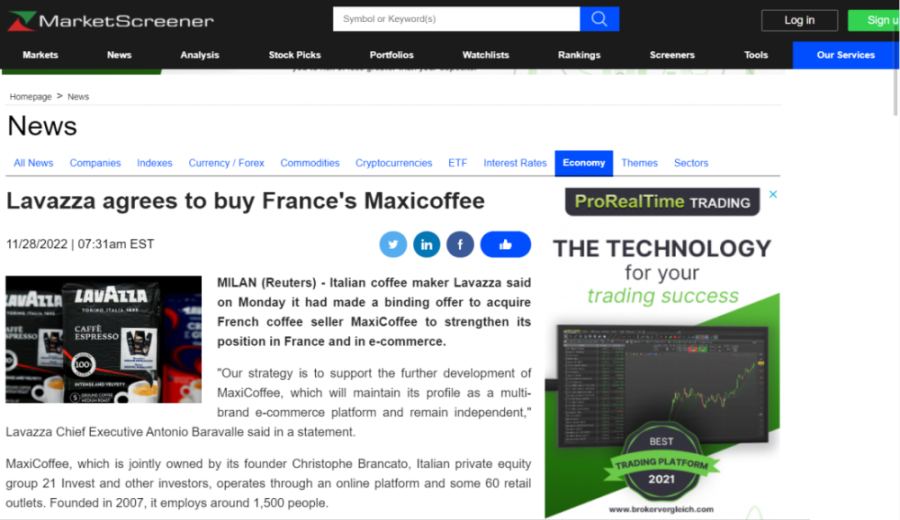
The renowned Italian coffee brand Lavazza has recently made a full acquisition offer to the French online coffee retailer MaxiCoffee, aiming to further solidify its position in the French market and expand its influence in the e-commerce channel. Although specific financial details have not been disclosed, this acquisition is seen as a significant step in Lavazza’s international expansion strategy.
Founded in 1895 by Luigi Lavazza in Turin, Italy, Lavazza has a history of over 120 years. The brand is renowned for its high-quality espresso and markets its products in more than 80 countries and regions, with a market share of approximately 45%. In addition to classic espresso, Lavazza also offers a diverse selection including Italian-style snacks, ice cream, and juices, providing customers with a one-stop experience.
In 2020, Lavazza partnered with Yum China to establish a joint venture, officially entering the Chinese market. Its first overseas flagship store was located in Shanghai, featuring a design dominated by blue, white, and gold tones, along with elements such as marble, brass, and glass mirrors, creating a simple yet premium Italian ambiance. Many customers noted that stepping into a Lavazza store is not just about tasting coffee, but immersing oneself in an Italian art space. With its high-quality coffee and immersive experience, Lavazza rapidly expanded in the Chinese market, opening 78 stores in just over two years, and setting a goal to reach 1,000 stores by 2025.
The target of this acquisition, MaxiCoffee, was established in 2007 and is a leading online platform for coffee beans and equipment in France. The platform offers over 350 brands and more than 8,000 products, with 60 physical sales locations across France. The product range covers various brewing tools, including semi-automatic and fully automatic espresso machines, pour over kettles, and moka pots. As for coffee beans, they range from classic Italian blends and specialty pour over beans to unique flavored beans and green beans, catering to the needs of consumers at different levels.
The Lavazza Group stated that this acquisition aims to provide consumers with a more convenient and diverse shopping experience through MaxiCoffee’s e-commerce platform, further strengthening its competitiveness in the e-commerce market. MaxiCoffee also noted that choosing to partner with Lavazza was due to its over-a-century-long coffee expertise and global leadership in innovation, with Lavazza having become a symbol of the espresso spirit.
Lavazza CEO Antonio Baravalle emphasized in a statement: “Acquiring MaxiCoffee is an important part of our international development strategy. We will maintain the independence of its multi-brand e-commerce platform and will not alter its successful business model. Instead, we will support its continued growth through international resources and development plans.”
After the transaction is completed, MaxiCoffee’s shares will be jointly held by its founder Christophe Brancato, the Italian private equity group 21 Invest, and other minority shareholders, maintaining its existing operational structure.
In fact, Lavazza’s acquisition spree started some time ago. As early as 2015, the brand acquired the French coffee brand Carte Noire for €800 million. In recent years, it has successively acquired Mars Drinks’ coffee business, the French brand ESP, Denmark’s Merrild, Canada’s Kicking Horse Coffee, and Australia’s Blue Pod Coffee, demonstrating its determination in global expansion.
Despite Lavazza’s strong performance in the global market, how to continue innovating, enhancing the customer experience, and striking a balance between e-commerce and physical channels remains a key challenge for its future development in the highly competitive coffee industry.
The above content is compiled by CoffeeHunters, a coffee news website.


