







Introduction:The well-known Chinese affordable tea beverage brand Mixue has recently accelerated its overseas expansion, first entering South Korea and then setting its sights on Tokyo’s Omotesando district to open its first store in Japan. Starting from Vietnam, it has gradually expanded to multiple Southeast Asian countries and now has over a thousand overseas stores worldwide. This article provides an in-depth analysis of Mixue’s internationalization strategy, exploring how it has managed to stand out in the highly competitive Asian new-style tea beverage market, and observing its potential impact on local beverage shops and specialty coffee brands.
The Chinese ready-to-drink beverage chain brand Mixue has once again caught the market’s attention as it accelerates its overseas expansion. Following the opening of its first store in Seoul, South Korea, the brand officially announced its entry into the Japanese market, with its first location set in the renowned fashion and shopping landmark — Omotesando in Tokyo. This move not only demonstrates its determination in its internationalization strategy but also marks the continued expansion of the brand’s presence in Asia’s tea beverage landscape.
Mixue’s overseas expansion journey can be traced back as early as four years ago. In 2018, the brand opened its first overseas store in Hanoi, Vietnam, under the English name “MIXUE.” It is reported that at the time, the store sold nearly 1,400 cups in a single day, showing extremely high market acceptance. Subsequently, the brand successively entered major Southeast Asian markets such as Indonesia, Malaysia, and Singapore. As of June this year, the total number of its global overseas stores has exceeded 1,000.
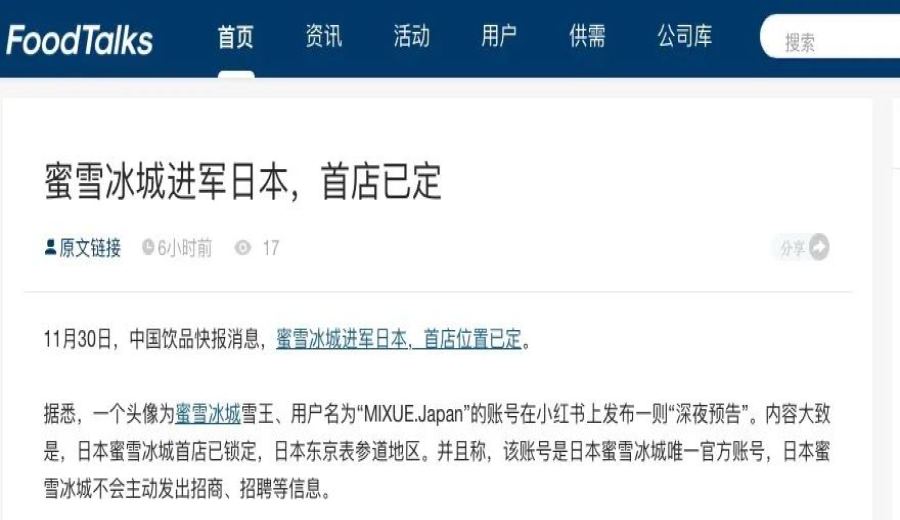
It is worth noting that this is not Mixue’s first attempt to enter the Japanese market, but the official confirmation of its landing in Tokyo’s Omotesando, along with the release of a “late-night announcement” through its official social media account “MIXUE.Japan,” shows the brand’s emphasis and confidence in the Japanese market. The account specifically emphasizes that it is the only official channel for the Japanese market and states that there are currently no franchising or recruitment plans. Although the specific opening date has not yet been announced, it has already sparked considerable discussion and anticipation online.
From the announcement images released by the official social media, the brand mascot “Snow King” can be seen wearing a “hachimaki,” a traditional Japanese festive headband made of a long strip of cotton cloth that symbolizes encouragement and fighting spirit. This also shows that Mixue pays attention to integrating local cultural elements when expanding overseas, delivering a positive brand image. Such detailed touches help the brand establish a friendly and down-to-earth impression in the local market.
Before entering Japan, Mixue had entered the South Korean market earlier this year. Its first store is located near Seoul National University, and one of its flagship products, “lemonade,” is priced at around 2,000 Korean won, approximately 10 RMB. Although this price is slightly higher than its pricing in China, it remains relatively affordable in the South Korean tea beverage market. It has successfully attracted a large number of consumers, with reports even suggesting that the high foot traffic has impacted nearby competing bubble tea shops.
According to Chinese students in South Korea, Mixue has become extremely popular since its opening, with many customers reporting long queues at the stores. Its popularity seems to have had a certain impact on other nearby beverage shops, and some neighboring bubble tea shops have even chosen to cease operations. This phenomenon also reflects the high level of competition among affordable tea beverages in the Asian market and the sensitivity of consumers to cost-effectiveness.
As the Chinese brand with the largest number of physical stores for ready-to-drink beverages, Mixue has reached a total of 22,276 global stores according to the latest statistics, demonstrating an extremely strong market coverage capability. The brand has long adopted a business model of “direct-operated stores as the guide, with franchised stores as the main body.” In addition to its main tea beverage brand “Mixue,” it also owns a freshly ground coffee brand “Xingyun Ka” and a freshly made ice cream brand “Jilatu,” forming a diversified product matrix.
Faced with a gradually saturating domestic market, the brand’s founder Zhang Hongfu had long foreseen the direction of international development, hoping to find new growth momentum through overseas expansion. From Southeast Asia to Japan and South Korea, each step of Mixue’s expansion has undergone market research and strategic adjustments, reflecting its caution and ambition in its global layout.
Overall, Mixue’s expansion in the Asian market is not only an important milestone in the brand’s own development but also introduces new competitive variables to the new-style tea beverage industry as a whole. For consumers, more diverse and affordable options are undoubtedly a great benefit; for other tea beverage brands and specialty coffee shops, however, it means they need to rethink how to carve out their competitive advantages in terms of price, product differentiation, and customer experience.
The above content is compiled by CoffeeHunters, a coffee news website.


