







Introduction:How did Luckin Coffee, once embroiled in allegations of financial fraud, stage an incredible comeback to become a market darling? This article delves into the reasons behind Snow Lake Capital’s shift from short-selling to bullishness, analyzing how Luckin turned itself around through internal restructuring and precise market strategies to achieve rapid revenue growth and emerge as a leader in China’s coffee market.
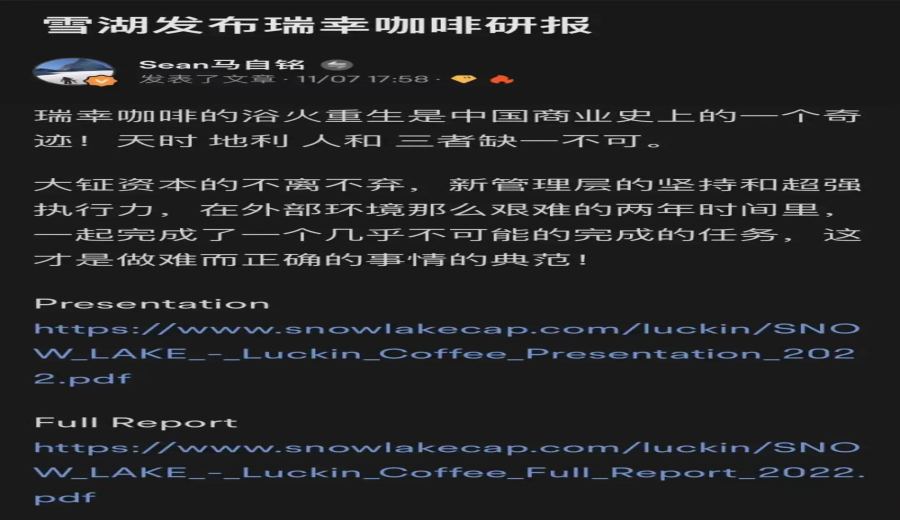
Snow Lake Capital, once seen as a key player behind the Luckin Coffee financial scandal, has now dramatically reversed its stance. Its founder, David H. Ma, publicly described Luckin’s “rise from the ashes” as one of the greatest miracles in Chinese business history. He has invested in a minority stake in the company, betting on a significant future rise in its valuation. This article will guide you through the full process of Snow Lake Capital’s dramatic reversal, while also reviewing in detail Luckin’s journey from financial crisis, delisting, restructuring, to resurgence, and deeply analyzing the two key reasons why Ma is optimistic about Luckin.
In early 2020, Luckin Coffee—founded and taken public by Charles Lu—was hit by a major financial fraud scandal and subsequently faced delisting. At the time, the market widely suspected that Snow Lake Capital was the behind-the-scenes force behind the anonymous report that exposed Luckin’s issues. Although Snow Lake had commissioned a consulting firm to investigate Luckin’s business model and tried to uncover potential problems, Ma himself never directly admitted to being involved in or leading the controversial anonymous report.
Subsequently, Luckin’s major investor, Centurium Capital, along with the new management team, quickly removed the old Lu faction and undertook a comprehensive restructuring of the company. This bold reform proved highly effective. According to public financial reports, Luckin’s revenue in 2021 grew nearly 100% year-on-year, reaching RMB 7.965 billion, and in the first half of 2022, revenue increased by approximately 80% year-on-year to RMB 5.7 billion, demonstrating astonishing recovery capabilities.
Earlier this year, Snow Lake Capital conducted an online survey covering over 100,000 Luckin consumers, and based on this, produced an 81-page bullish analysis report. Ma emphasized that during the writing process, there was no communication with Luckin’s official team, and the judgment was made independently based solely on market data. He estimated that if Luckin can maintain its current growth momentum, its net profit could climb to RMB 2.8 billion by 2024, with a corresponding price-to-earnings ratio of 35, comparable to the then valuation of Starbucks’ China business.
This shift in stance also reflects Snow Lake Capital’s high regard for Luckin’s new management. The restructuring led by Centurium Capital has focused the new team on solidifying the business foundation and improving profitability, rather than blindly pursuing store expansion or gimmicks like so-called “new retail.” They place greater emphasis on single-store efficiency and product structure optimization, a business direction that has clearly resonated with the market.
In an interview with The Wall Street Journal, Ma revealed that Snow Lake Capital has taken a minority stake in Luckin, accounting for about 15% of its total managed assets (the exact amount undisclosed), and plans to hold it long-term, provided Luckin can steadily maintain its growth momentum. He is also optimistic about Luckin’s potential future return to the U.S. capital markets, which would further enhance its global brand value and financing capabilities.
There are two core logics behind Snow Lake Capital’s shift to optimism. First, the pandemic has changed consumer habits around coffee, with more customers opting for takeout or delivery, significantly reducing the demand for in-store space. Compared to Starbucks, which emphasizes the “third space,” Luckin’s primarily pick-up store model—designed for quick transactions—is better suited to this consumption trend, earning it market favor.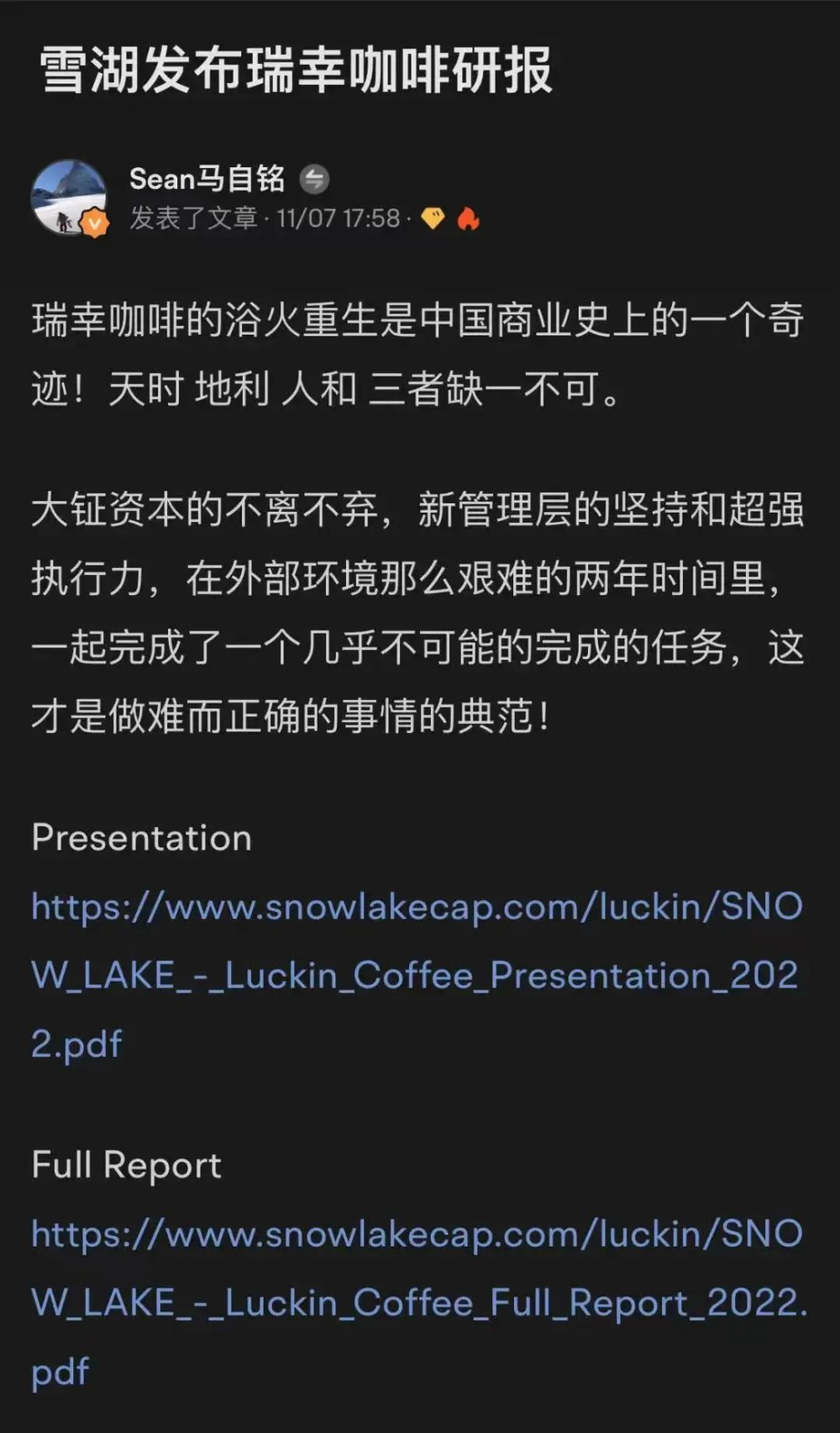
Secondly, Luckin has a keen understanding of consumer demand in the Chinese market. The brand continuously launches innovative coffee beverages and meets the taste preferences of different demographic groups through rapid product iteration. At the same time, its widespread adoption of a franchise model has effectively helped the brand penetrate lower-tier cities in China, capturing market opportunities with affordable pricing and an efficient supply chain.
Over the past two years, Luckin has not only successfully regained investor confidence but also won consumer support with solid product quality and market strategy. From financial crisis to its current position as a market leader, Luckin’s turnaround is a classic case study of Chinese corporate transformation and rebirth.
The above content is compiled by CoffeeHunters, a coffee news website.


