







Introduction:Heytea recently announced the opening of its franchise program, with franchise partnership fees capped at 500,000 RMB and a focus on small storefronts under 50 square meters, targeting non-tier-one city markets. This strategy not only helps reduce expansion costs but also paves the way for the brand to penetrate lower-tier markets. This article delves into the core conditions of Heytea’s franchise model, its market strategy, as well as the challenges and opportunities for new tea beverage brands in third- and fourth-tier cities.
Shortly after closing the last store of its budget sub-brand “Hey Tea Junior,” Heytea swiftly announced its franchise plan on November 3, 2023. This franchise model sets an upper limit of 500,000 RMB for the franchise partnership fee, which is comparable to the initial investment of most industry brands, while emphasizing that store sizes must be kept within 50 square meters, falling under the category of compact, small-format stores.
According to official information, Heytea will leverage the brand resources, product R&D, and supply chain management expertise accumulated over the past decade to roll out tailor-made franchise solutions for non-tier-one cities. In addition to brand authorization, partners will receive comprehensive support covering product standards, quality control, food safety, operational processes, staff training, and logistics.
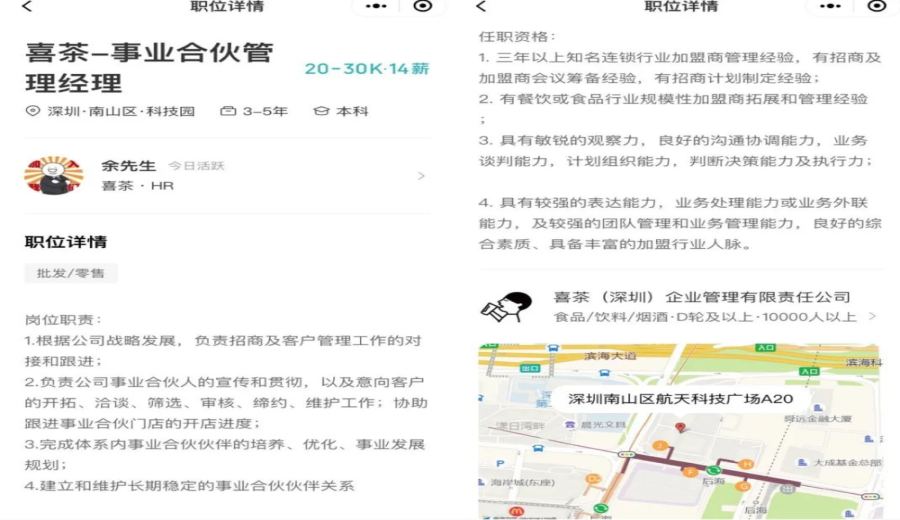
Notably, Heytea has posted a job listing for a “Franchise Partnership Management Manager” on recruitment platforms. This role is primarily responsible for advancing franchise recruitment, maintaining client relationships, and managing the progress of franchise openings. The position requires candidates to have over three years of experience in managing franchises for well-known chain brands, highlighting the brand’s emphasis on and standardization of franchise expansion.
Industry observers note that Heytea has long adhered to a direct-operated model, which ensured consistent product quality and brand image but limited its expansion speed. The shift to franchising is now seen not only as a way to accelerate market penetration but also as a key strategy to alleviate financial pressure and seek new growth trajectories.
Looking at the brand’s development trajectory, Heytea originated in Jiangmen, Guangdong in 2012 under the original name “Royaltea.” Due to trademark issues, it was renamed “Heytea” in 2016 and expanded to Beijing in 2017, marking the beginning of its nationwide presence. Over the years, the brand has consistently used genuine ingredients—including real milk, real fruit, real tea, and real sugar—to establish a positioning of “high-quality yet affordable” beverages.
As of now, Heytea operates over 800 stores in nearly 70 cities globally, with store counts exceeding 100 in first-tier cities such as Shanghai and Shenzhen. However, compared to brands that primarily rely on franchising, its expansion pace remains relatively conservative. For example, Mixue Ice Cream & Tea has over 20,000 global stores, while brands like Guming, Shiyi Tea Fairy Grass, and Cha Bai Dao have reached 6,600, 6,500, and 5,800 stores respectively.
To further capture the lower-tier market, Heytea has taken frequent actions recently, including adjusting product prices, introducing transparent fresh-fruit peeling windows, collaborating with popular IPs such as Fujiwara Hiroshi, Dream of Splendor, Genshin Impact, and Legend of Zhen Huan for co-branded marketing, and closing its previously budget-oriented sub-brand “Hey Tea Junior.” Among these, the across-the-board price adjustment in February this year increased the proportion of products priced under 19 RMB to 80%, successfully attracting more price-sensitive consumers.
Taking IP collaborations as an example, the special drink launched by Heytea in partnership with the TV drama “Dream of Splendor” sold over 300,000 cups on its first day, with some individual stores reporting peak daily sales of around 1,000 cups. The co-branded product with “Legend of Zhen Huan” garnered significant attention due to its first-time collaboration, quickly selling out and demonstrating strong brand synergy effects.
However, franchise expansion also comes with challenges. While it can rapidly increase the number of stores, ensuring that each franchise maintains a consistent brand image and product quality is a challenge Heytea must address. Additionally, for partners, beyond the initial capital investment, subsequent operational management, staff training, and quality control execution will directly impact store performance.
Whether Heytea can successfully break through in the highly competitive and fragmented third- and fourth-tier city markets through this franchise strategy remains to be seen. Meanwhile, whether Nayuki, another new tea beverage brand that insists on direct operation, will follow suit and open up franchising has also become a focal point of industry attention.
The above content is compiled by CoffeeHunters, a coffee news website.


