







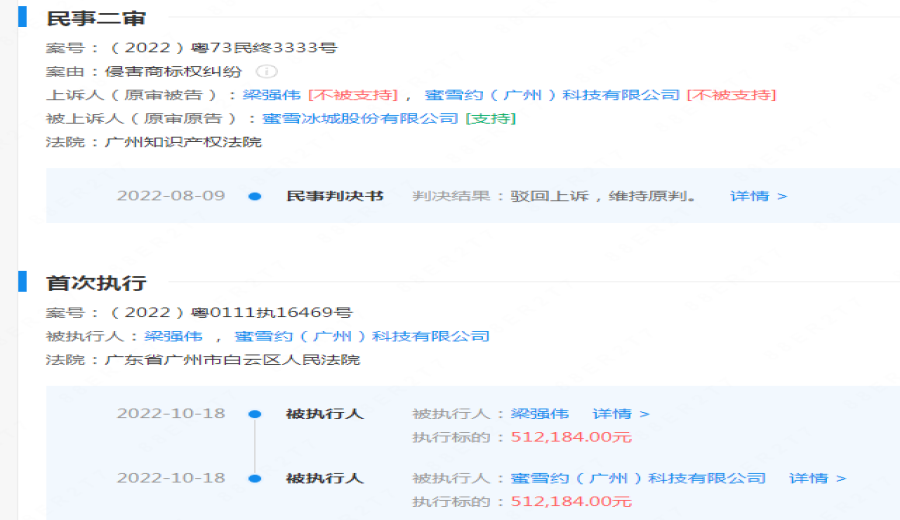
Introduction:The new tea beverage market is booming, and cases of brand trademarks being maliciously imitated are emerging one after another. The infringement lawsuit between Mixue Ice Cream & Tea and Mixueyue has reached its final verdict, with the latter ordered to pay over 510,000 yuan in compensation. This article delves into the details of the case, exploring how leading brands can build legal defenses through comprehensive trademark registrations, and provides practical advice for tea beverage businesses to guard against trademark risks.
The competition in the tea beverage industry is fierce, and well-known brands have become a “gold mine” in the eyes of counterfeiters. From Heytea to Cha Yan Yue Se, imitation brands use similar trademarks and store designs to divert customers, even affecting consumers’ trust in the quality of the authentic products. This time, it’s the turn of Mixue Ice Cream & Tea, which has over 20,000 stores globally, to take legal action — a milk tea brand named “Mixueyue” was found by the court to have committed infringement due to its highly similar trademark text and visual design, and was ordered to pay512,184 yuanin compensation, with its appeal being rejected.
Mixue Ice Cream & Tea started in Zhengzhou in 1997 and rapidly expanded thanks to its affordable ice cream and tea beverages. It now has over22,276 storesglobally, covering all 31 provincial-level administrative regions in China and expanding into overseas markets such as Vietnam and Indonesia. In 2022, its application for an A-share IPO was accepted by the China Securities Regulatory Commission, signaling the brand’s move toward the capital market. In contrast, the involved party, Mixueyue (Guangzhou) Technology Co., Ltd., was established in 2019 with a registered capital of just 200,000 yuan. Its business scope included a mix of educational consulting and food sales, and it has since been deregistered.
The focus of the case was that Mixueyue’s trademark design was extremely similar to Mixue Ice Cream & Tea’s “Snow King” image and the combination of the word “Mixue.” The court determined that there was a clear intent to ride on the brand’s coattails, not only infringing on the trademark rights but also likely causing consumer confusion. Notably, Mixue Ice Cream & Tea had implemented a defensive trademark strategy early in its rise, registering over2,161 trademark applicationswith the China Trademark Office, of which 1,517 have been successfully approved, including full-category registrations for multiple key terms such as the core brand name.
Defensive trademarks refer to the practice where companies register their well-known trademarks in related or unrelated categories outside their main business operations. For example, a food brand might also register the same trademark in categories such as clothing or electronics. While this may face the risk of cancellation for “non-use for three consecutive years,” it effectively prevents others from free-riding on similar trademarks. Mixue Ice Cream & Tea’s registration of identifiers like “Mixue” and “Snow King” in categories such as coffee, catering equipment, and even stationery is a typical example.
Industry experts point out that common trademark risks for tea beverage brands include: 1. Imitating the main brand’s visual identity with similar fonts and color schemes; 2. Using regional variant names (such as “XX Mixue”) to avoid direct infringement claims; 3. Expanding stores on a large scale without registering for commercial franchise filings. Consumers find it difficult to distinguish between authentic stores and counterfeit ones, ultimately damaging the brand’s reputation.
For tea beverage businesses looking to expand their markets, the following measures are recommended: First and foremost, complete full-category registrations of core trademarks and prioritize the protection of high-risk categories (such as catering services, retail, and packaging design); secondly, establish a trademark monitoring system to regularly check for abnormal applications in the market; thirdly, retain unique design elements of the brand (such as mascot shapes or exclusive cup designs) to increase the difficulty of imitation. Additionally, even if there are no immediate plans to enter overseas markets, it is advisable to proactively register trademark rights in major export markets to avoid legal disputes caused by trademark squatting.
This court ruling once again confirms that in an environment of increasingly strict intellectual property protection, a systematic trademark strategy has become the cornerstone of a brand’s long-term operation. In addition to focusing on product R&D and store expansion, tea beverage startups must also incorporate legal defenses into their overall business planning to ensure their market position is not eroded.
The above content is compiled by CoffeeHunters, a coffee news website.


