







Introduction:Have you ever felt puzzled when, while enjoying a latte at a café, your bill suddenly includes an extra 6% value-added tax (VAT) and 10% service charge? Recently, a consumer in Chengdu sparked controversy after discovering unclear breakdowns on their receipt. While tax and market supervision authorities responded that “complying with tax laws is compliant,” the consumer questioned the transparency of clearly marked pricing. This article delves into the details of the incident, explores the boundaries of compliant tax labeling, and offers practical advice to help consumers protect their rights.
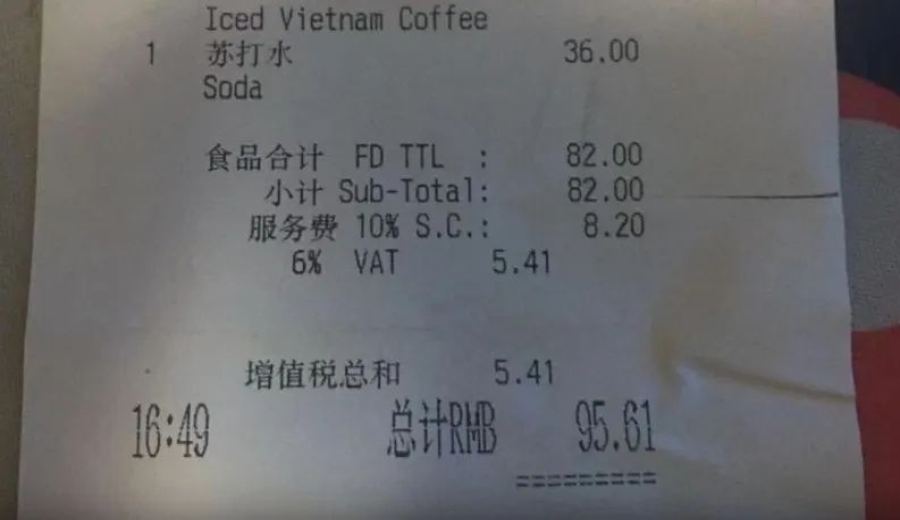
Recently, a resident of Chengdu dined at a café where, in addition to the cost of the drink itself, the receipt also included a 10% service charge and a 6% VAT, bringing the total from the original 82 yuan up to 95.61 yuan. The consumer mentioned that although there was extremely small print indicating these fees beneath the price list, the signage was too inconspicuous. The staff did not proactively explain these charges during ordering, and it was only at checkout that the customer realized there were additional fees.
According to the “Regulations on Clearly Marked Pricing and Price Fraud” implemented on July 1, 2022, businesses are prohibited from using misleading language, text, or images when marking prices for goods or services. They also cannot deliberately downplay price conditions unfavorable to consumers to avoid misleading transactions. In this case, although the business did provide some form of labeling, the small font size and lack of proactive reminders led to consumer doubts about “clear and actual pricing.”
The consumer, surnamed Yin, stated: “If you say it’s non-compliant, they did have labels; but if you talk about clear and actual pricing, I feel it wasn’t really achieved.” She believes that the composition of the costs should be clearly communicated before consumption, rather than being passively discovered at checkout. The overall process made her feel as though she was being forced to accept these fees, even raising suspicions of potential price fraud.
After the incident, Ms. Yin filed a complaint with the relevant local authorities, hoping that the appropriate units would intervene in the investigation and request the business to improve its price labeling method by clearly listing the actual amount to be paid, enabling consumers to be fully informed before ordering.
On October 10, the Tax Bureau of Jinjiang District, Chengdu, responded by pointing out that some businesses in the area do adopt similar charging methods. As long as businesses pay taxes in accordance with the law, their practices are considered compliant. Consumers who have concerns can request invoices from the businesses as proof. Some cafés indicate the product price on the menu and separately list the VAT amount below.
The Jinjiang District Market Supervision Administration stated that, upon investigation, although the café’s menu did contain relevant fee prompts, the font size was too small and not easily noticeable. The market supervision department can suggest that the business make improvements, but under current regulations, it cannot directly penalize or mandate changes to the labeling method.
In response to the consumer’s concerns, the café involved stated that the matter has been assigned to a specific person for handling and will be relayed to the relevant supervisor. However, as of press time, no formal reply has been issued.
Currently in China, price and industry regulatory authorities have not yet explicitly regulated whether product labels must separate price and tax amounts. Therefore, as long as businesses pay taxes in accordance with the law, even if taxes and product prices are listed separately, it is still within the legal scope. In practice, some businesses directly include taxes in the marked price, so what consumers see is the total price; others choose to list taxes separately, so that customers pay them together at checkout.
This method of price labeling can sometimes make consumers feel a lack of transparency, especially when there is no prior notice. It’s similar to how, when purchasing high-priced items, additional shipping fees often cause more frustration than the item itself. With the improvement of the taxation system, the separate listing of taxes may become more common in the future, but businesses should also provide sufficient information before consumption to safeguard consumers’ right to know.
Industry insiders recommend that, before ordering or making a purchase, consumers might as well proactively ask whether the price includes service fees or taxes, and pay attention to the fine print on menus. If unclear labeling or post-purchase revelations of extra fees are found, consumers can raise the issue with the business or make suggestions to the relevant authorities to promote a more transparent consumption environment.
The above content is compiled by CoffeeHunters, a coffee news website.


