







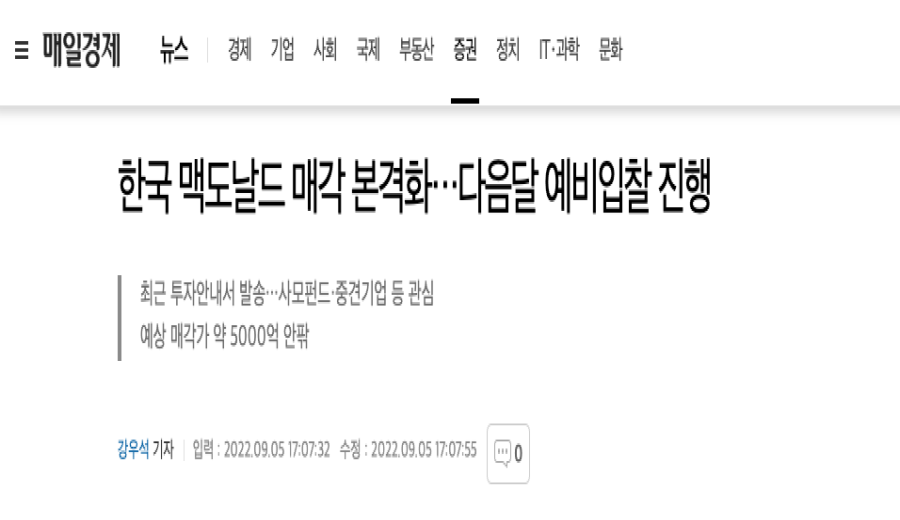
Introduction:Faced with rising labor costs in South Korea and intense competition from delivery platforms, McDonald's has once again initiated the process of selling its business in the country. The American fast-food giant is putting up for sale 100% equity and operational rights of its South Korean subsidiary, valued at approximately 500 billion KRW (about NT$11.2 billion), with the first round of bidding expected to take place in October. This article analyzes the main reasons behind McDonald's continuous losses in South Korea, as well as the potential types of buyers and highlights of the store assets involved in this sale.
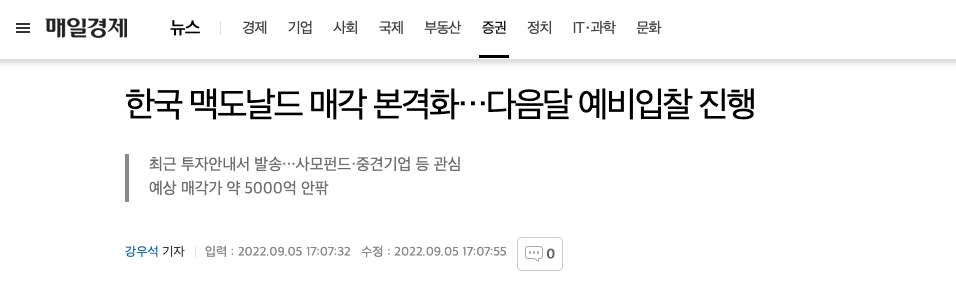
Amid continuously rising labor costs in the South Korean market and increasingly fierce competition in the delivery service sector, the international fast-food brand McDonald's has decided to seek a new owner for its South Korean operations once again. According to local South Korean media reports, the U.S.-based food group has sent out transaction notices to more than ten potential buyers, planning to sell all the shares and local operating rights of McDonald's South Korea held by McDonald's Singapore Investments, with an overall valuation of about 500 billion KRW (approximately NT$11.2 billion). The preliminary bidding process is expected to begin in October.
This marks the second time McDonald's has attempted to sell its South Korean business. As early as 2016, the brand had engaged in negotiations with Maeil Dairies, a major South Korean dairy company, and the international private equity firm Carlyle Group. However, the deal ultimately fell through at that time due to high asking prices and disagreements on other terms. Now, McDonald's is once again putting its South Korean market on the table, hoping to find a new investor capable of taking on the operational challenges.
The subject of this transaction is the 100% equity in McDonald's South Korea held by McDonald's Singapore Investments, along with the brand’s full operating rights in the country. As one of McDonald's important markets in Asia, South Korea has long ranked first in the number of outlets within the fast-food industry, giving it a significant market share advantage. It is worth noting that many medium-sized enterprises interested in entering the food and beverage or restaurant sectors have begun to evaluate the possibility of participating in this bidding, particularly because most of these outlets are located in high-traffic commercial areas, with the real estate asset value attached to them seen as a major selling point.
Although McDonald's has an extensive network of outlets in the South Korean market, its local operations have faced severe financial pressure in recent years. Financial reports for 2021 show that McDonald's South Korea incurred an operating loss of 27.7 billion KRW and a net loss that widened to 34.9 billion KRW, with annual sales amounting to 867.8 billion KRW. Analysis points out that this wave of operational difficulties mainly stems from continuously rising delivery service costs, coupled with increasing labor wages and raw material prices, leading to a significant decline in overall profitability.
To alleviate the pressure of soaring costs, McDonald's South Korea has adjusted its prices twice within just six months. The most recent adjustment was announced on August 19, when the brand declared a price increase for 68 items, including beverages and desserts, with an average increase of 4.8%. This marks another price adjustment following the previous one, showing that its management team is attempting to balance rising expenses through pricing strategies.
Market observers indicate that the current sale process of McDonald's South Korean operations is expected to attract interest from South Korean domestic private equity funds, medium-sized enterprises, and even some multinational investment institutions. Despite facing consecutive years of losses, the brand’s outlet locations and established customer base in the South Korean market are still considered to hold certain appeal. In addition, with intensified competition among delivery platforms, optimizing delivery costs and improving single-store operational efficiency will be key issues that the new buyer must address.
The above content is compiled by CoffeeHunters, a coffee news website.


