







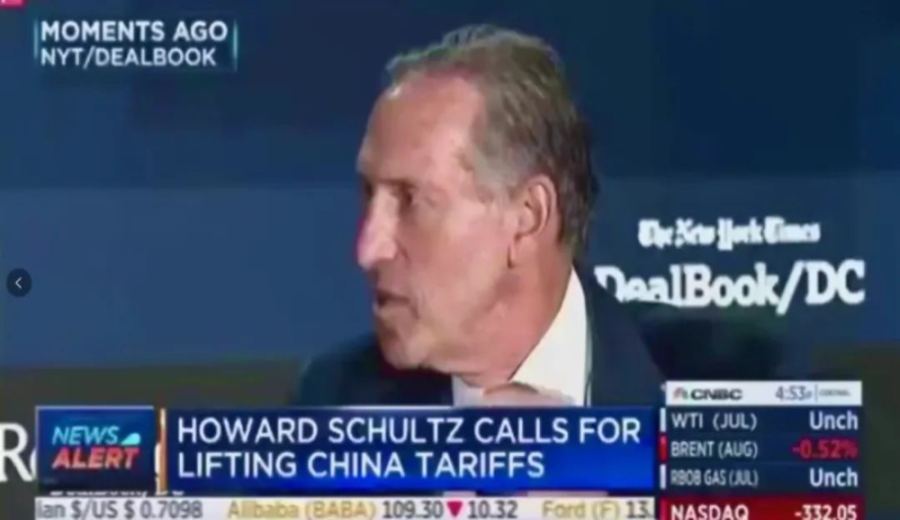
Introduction:Howard Schultz, Starbucks' interim CEO, recently shared significant insights on U.S.-China relations and proposed that removing high tariffs could help alleviate inflation and consumer pressure. At the same time, he is actively driving internal management restructuring at Starbucks, including halting stock buybacks, adjusting employee policies, addressing union challenges, and planning to select a new CEO from outside the company. This article details Schultz’s reform directions and strategies to help readers better understand the decision-making behind the brand.
Starbucks interim CEO Howard Schultz recently stated in public that the ongoing tensions between China and the United States are not beneficial to either side, and improving bilateral relations would have a positive impact on the global market. He pointed out that removing the tariffs on Chinese goods, which amount to$360 billion, would not only ease the economic burden on American consumers but also be an important step in alleviating global inflation.
Schultz has long been committed to promoting friendly exchanges between China and the United States. Last year, he even received a reply from Chinese President Xi Jinping, who acknowledged his and Starbucks’ contributions to fostering bilateral trade and relations. He emphasized that China and the United States should establish a “positive and constructive cooperative relationship” in order to create a win-win situation.
As a globally renowned coffee chain, Starbucks had, as of April this year, more than84 countries and regionswith over34,600 storesglobally, including5,700 stores in the Chinese market, making it not only Starbucks’ largest overseas market but also its second-largest globally — a position of great significance.
However, with such a vast operational scale, Starbucks is facing multiple challenges, including global supply chain fluctuations, rising raw material costs, and issues related to employee salaries and mental health. In April this year, Howard Schultz returned to take on the role of interim CEO again, aiming to stabilize the company’s financial and management conditions.
Looking back at the pandemic period, Starbucks faced dissatisfaction among employees in multiple locations due to staff shortages, heavy workloads, and inadequate pay, which led to the rise of union movements. Employees demanded direct dialogue with the company, further complicating management. In addition, inflationary pressures and rising raw material prices plunged Starbucks into multiple dilemmas involving operations, finance, and personnel.
To stabilize the situation, on his first day back, Howard announcedthe halt of the stock buyback programand plans to redirect the funds originally allocated for this purpose into employee benefits and daily store operations, hoping to enhance employee satisfaction and loyalty.
Faced with union movements around the world, Howard did not choose a hardline suppression approach but instead adopted a softer strategy. On one hand, he explained to employees that, according to federal law, Starbucks cannot unilaterally adjust the salaries and benefits of union members; on the other hand, he encouraged employees to carefully consider their future direction and seek mutually acceptable solutions.
Howard emphasized that as interim CEO, he will not stay in the role long-term. In a recent interview, he said: “For the long-term development of the company, we need to strengthen experience and expertise on multiple levels, and that is our current focus.”
He pointed out that some of Starbucks’ current problems stem from its internal structure and management approach. Therefore, in the two months since his return, he has asked several senior executives to leave, making room for new talent. In May this year, Starbucks announced that the head of human resources and two vice presidents responsible for public affairs and public policy would be leaving, two of whom had served the company for over15 years.
In addition, the pandemic has accelerated changes in consumer behavior. Howard admitted: “No CEO can fully predict these rapid changes. Starbucks must re-examine its operating model to adapt to market demands.” For this reason, he is actively seeking a suitable external CEO candidate, hoping to bring in new management thinking.
However, this move has also raised questions from some investors and former management about whether Howard can truly “let go.” In response, Schultz said that he is excited by the diversity and quality of the current candidate pool, and his only concern is whether the new CEO can lead Starbucks to success. He expects to finalize the candidate this fall, and if all goes well, he will formally step down as interim CEO after the first-quarter earnings report next year, though he will remain on the board to continue providing guidance to the brand.
The above content is compiled by CoffeeHunters, a coffee news website.


