







Introduction:Freeze-dried coffee has become a new favorite in the market in recent years, but do you know the fundamental difference between it and traditional instant coffee? This article delves into the two core production processes—spray drying and freeze drying—to help you understand how freeze-drying technology preserves more coffee flavors. It also explores how upgraded raw materials and innovative packaging have helped this category stand out.
Freeze-dried coffee has emerged as a standout in the coffee market in recent years, yet many consumers still don’t fully understand how it truly differs from traditional instant coffee. From a process perspective, we can trace the development of instant coffee and focus on the two main production methods—spray drying and freeze drying—to explain why freeze-dried coffee delivers better flavor and how it is gradually changing the public’s perception of instant coffee. Additionally, improvements in raw materials and innovations in packaging design are also key factors behind the popularity of freeze-dried coffee.
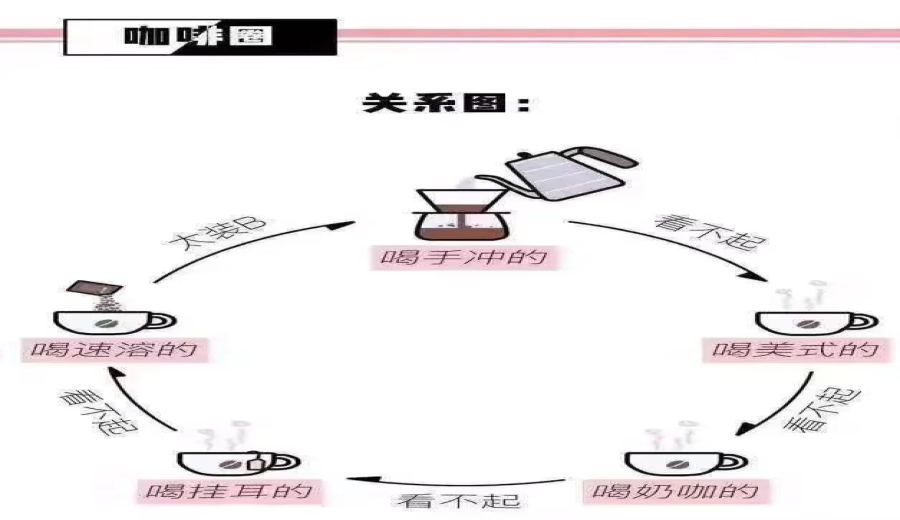
Freeze-dried coffee isn’t a new concept; in fact, it still falls under the category of instant coffee. Although many coffee enthusiasts often place instant coffee at the bottom of the so-called “coffee snobbery hierarchy,” this classification more reflects market trends than an absolute assessment of quality.
To understand the characteristics of freeze-dried coffee, we first need to revisit the origins and production principles of instant coffee. It is generally believed that instant coffee was first developed in 1901 by the team of Japanese chemist Sartori Kato, who was living in the United States. They used vacuum drying technology to convert coffee solution into powder form.

In 1937, Nestlé introduced the “spray drying method,” which later became the mainstream production method for instant coffee. This technique is a hot drying process: first, the soluble substances in roasted coffee beans are extracted into water—essentially large-scale industrial “brewing” of coffee—then the coffee liquid is atomized into tiny droplets through nozzles and sent into a high-temperature drying chamber. The rapid evaporation of moisture results in powdered instant coffee.
This process is relatively low-cost, which is why it has long dominated the instant coffee market. However, the high-temperature treatment destroys most of the flavor compounds in coffee, resulting in a product that often has a noticeable bitter taste. Such products are commonly found in “two-in-one” or “three-in-one” instant drinks, as well as affordable “instant black coffee,” typically appearing as fine powder.
In contrast, freeze-drying is a more expensive process, though its history is equally long. Although freeze-dried coffee has only gained widespread attention in the past two years, the technology has existed for decades. Its basic process also begins with hot water extraction, but the extraction concentration is higher—about 65%—and the texture is closer to thick chocolate sauce rather than typical coffee liquid.
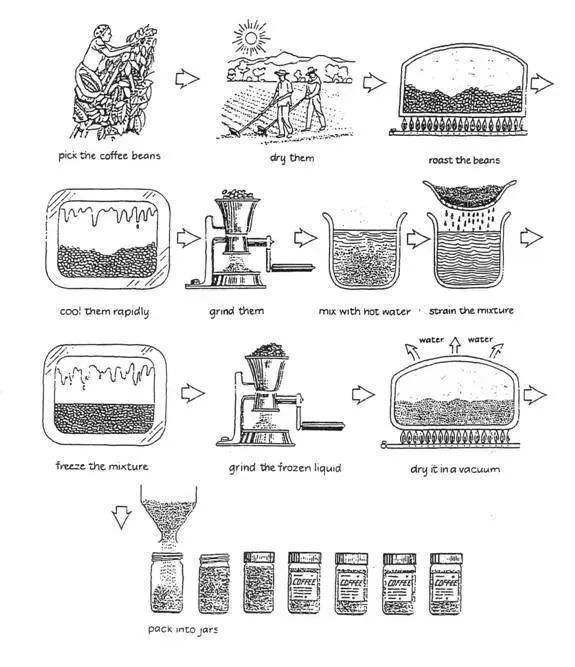
Next, the highly concentrated extract is cooled to -5°C to solidify it into a paste, then placed in an extremely low-temperature environment of -40°C to -50°C to completely freeze it. The frozen material is then crushed into small particles measuring 2 to 3 millimeters—this explains why commercially available freeze-dried coffee powder often appears in small chunk-like forms.
Finally, these frozen particles are placed in a vacuum drying chamber and heated. In the vacuum environment, the moisture sublimates directly without liquefying, ultimately yielding freeze-dried coffee that retains more of the original flavors.
Products such as Nestlé’s freeze-dried instant coffee powder and UCC’s 114 and 117 lines are all produced using this method. Although freeze drying is more costly, it preserves the original aroma and taste of coffee more intact, hence the relatively higher price.
Overall, traditional instant coffee is often seen as being at the bottom of the “snobbery hierarchy” mainly due to the flavor shortcomings caused by its raw material selection and production limitations. The long-standing market impression has also made it difficult to associate the term “instant” with “tasty.” However, through the technological upgrade represented by “freeze-dried coffee,” instant coffee has successfully reinvented itself.
As the industry places greater emphasis on flavor performance, instant coffee continues to evolve. Early products mostly used Robusta beans, but now some brands emphasize the use of 100% Arabica beans. Freeze-drying technology has also continued to improve—from initially requiring hot water extraction, to now featuring cold-brew freeze-drying methods that more effectively lock in the delicate flavors of coffee.
In terms of product appearance, the 2 to 3 millimeter particle size is no longer the only common form; some freeze-dried coffee products are now made into shiny crystalline powders. Packaging designs have also become more diverse, featuring many clever and fun single-serve small cans. These innovations clearly differentiate freeze-dried coffee from traditional instant coffee and are gradually helping it shed its previous negative image.

The above content is compiled by CoffeeHunters, a coffee news website.


