







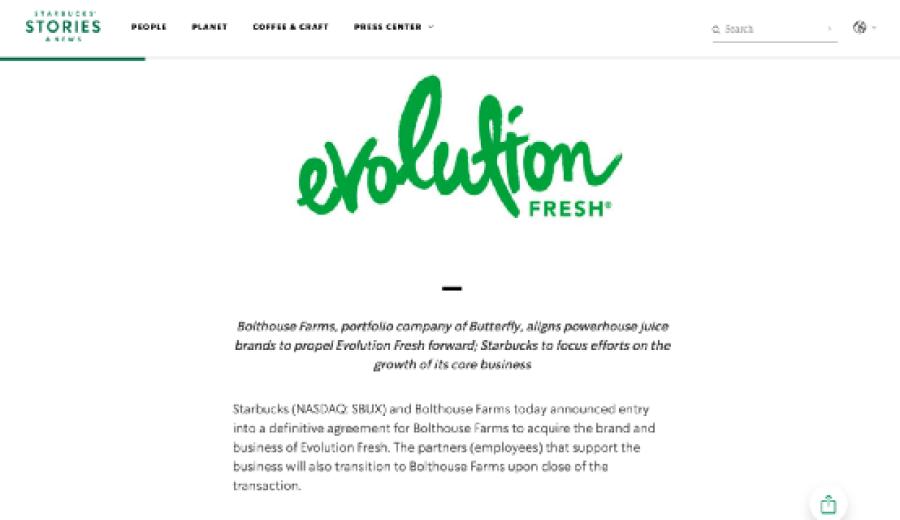
Introduction:Starbucks recently announced the sale of its juice brand Evolution Fresh to Bolthouse Farms, marking a strategic refocus on its core coffee business. This article analyzes the background of the deal, explores how Starbucks—under the return of its founder Howard Schultz—is optimizing its U.S. market presence, addressing unionization challenges in stores, and takes you through the rise and fall of Evolution Fresh from high-profile acquisition to quiet exit.
When people think of Starbucks, many first think of classic milk-based coffees like lattes and cappuccinos. Yet, this global coffee chain once ventured into juices with its own cold-pressed juice brand, Evolution Fresh. Now, Starbucks has officially announced the sale of Evolution Fresh to Bolthouse Farms, a company specializing in refrigerated beverages, further narrowing its brand portfolio to concentrate on deepening and expanding its core coffee operations.
According to reports, the deal was first revealed by The Wall Street Journal on May 24, Eastern Time, with both Starbucks and Bolthouse Farms having signed a definitive agreement. Bolthouse stated that it will retain all nearly 300 existing employees of Evolution Fresh following the deal’s completion, which is expected later this year. Starbucks emphasized that the financial impact of the transaction is relatively limited, with a greater focus on clarifying its long-term brand strategy.
In terms of market performance, Bolthouse currently accounts for about a quarter of the U.S. refrigerated beverage market and has a solid consumer base. According to IRI statistics, aside from Whole Foods and Starbucks’ own stores, Evolution Fresh’s juice products hold only about 2% of the U.S. refrigerated beverage market share in other retail channels, indicating limited room for independent growth.
Looking back at the trajectory of Evolution Fresh, its origins trace back to 2011. At the time, Howard Schultz had returned to Starbucks for his second stint as CEO and acquired the brand for around $30 million, hoping to tap into the approximately $1.6 billion premium juice and health food market. Subsequently, Starbucks opened some Evolution Fresh-branded juice bars in select cities, attempting to establish new outposts for healthy drinks. However, as Kevin Johnson took over as CEO in 2017, the juice business was gradually sidelined, eventually limited to bottled organic cold-pressed juices sold within Starbucks stores.
In 2022, Kevin Johnson stepped down, and Schultz returned to the helm once again. Since then, he has actively pushed for Starbucks to refocus on its core coffee business, especially optimizing operations in the U.S. market. For example, in April of this year, Starbucks announced the cancellation of a multibillion-dollar stock buyback plan, redirecting funds to support store upgrades and employee benefits in the U.S.; then on May 23, it also announced a full withdrawal from the Russian market, closing over 130 local stores and paying employees about six months’ salary as compensation.
Meanwhile, the trend toward unionization among Starbucks stores in the U.S. continues to intensify, with more partners (the term Starbucks uses for its employees) demanding improved working conditions and benefits. Evolution Fresh, as a brand less connected to the core coffee business, became a target for adjustment in this context. By selling it to the juice specialist Bolthouse, Starbucks not only streamlines its brand matrix but also helps ease internal tensions, injecting new vitality and focus into store operations.
A spokesperson for Bolthouse Farms expressed high expectations for the acquisition, stating that the brand has great potential, particularly with ample room for development in the premium beverage market. They praised the product quality and brand philosophy of Evolution Fresh, and pledged to continue and expand its influence in the natural, cold-pressed juice category.
In summary, Starbucks’ decision to divest Evolution Fresh reflects both a strategy of brand focus and a proactive response to market changes and internal challenges. For consumers, while Evolution Fresh products may no longer be commonly found in Starbucks stores, it also signifies Starbucks’ renewed commitment to enhancing coffee quality and customer experience, further solidifying its leadership position in the global coffee market.
The above content is compiled by CoffeeHunters, a coffee news website.


