







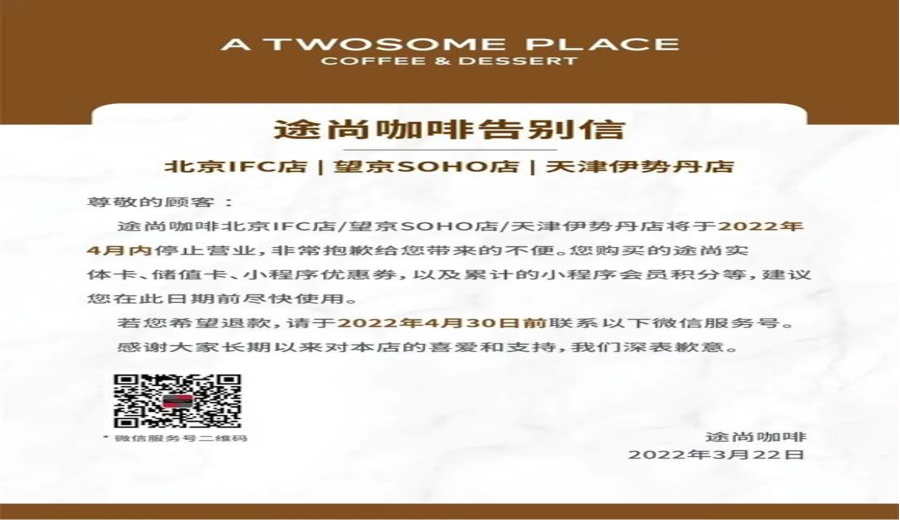
Introduction:The South Korean chain coffee brand TWOSOME+ COFFEE has announced that it will completely withdraw from the Chinese market in April, with its last three stores — located in Beijing, Tianjin, and other locations — gradually ceasing operations. Once boasting 36 stores across China in 2017, TWOSOME+ struggled to compete in the fierce market due to insufficient product differentiation and declining brand appeal. This article delves into the reasons behind its exit and explores the current challenges and transformation directions of the Chinese coffee market.
Competition in the Chinese coffee market has reached a fever pitch, and yet another foreign brand has chosen to exit quietly. The well-known South Korean coffee chain "TWOSOME+ COFFEE" recently announced that it will close its last three remaining stores in China in April, officially withdrawing from the market. This South Korean coffee brand, established in 2002 and entering the Chinese market in 2010, once expanded to 36 stores by 2017 but ultimately had to end its presence in China due to a lack of distinctive products and declining brand visibility.
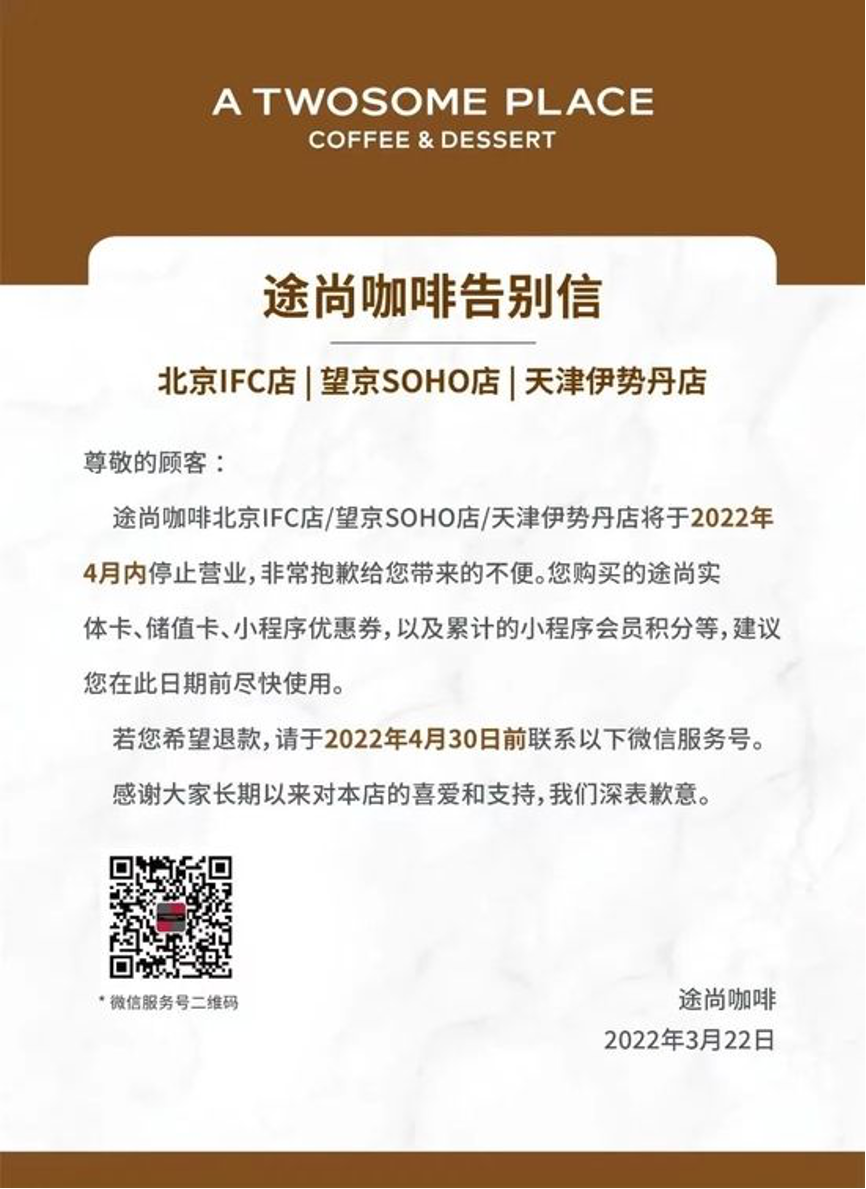
It is understood that TWOSOME+'s final locations include Beijing IFC (International Finance Centre), Wangjing SOHO, and Tianjin Isetan. All three stores will cease operations completely by the end of April. According to Beijing media reports, customers can process refunds for membership cards, redeem coupons, and use accumulated points before April 30 to ensure their rights and interests are protected. Store staff also confirmed that this closure marks the brand’s formal exit from the Chinese market.
TWOSOME+ was founded in 2002 and is part of the large South Korean food and beverage group CJ Foodville. It was later acquired by the investment firm Anchor Equity Partners and eventually purchased by the U.S. private equity fund Carlyle Group for approximately 800 billion KRW (equivalent to 4.3 billion RMB). In 2010, the brand first entered the Chinese market and opened its first global flagship store in Shanghai in 2014, demonstrating its ambition for the Chinese market. 2017 was the brand’s peak year, when it had 36 stores across major Chinese cities.
However, after 2019, although the brand briefly expanded by opening five new stores in Beijing and Tianjin — including prime locations such as Wangjing SOHO, Oriental Plaza, and COFCO Plaza — it failed to effectively increase its market share. After the pandemic, the Chinese coffee market experienced explosive growth, with consumers demanding higher quality and more diverse flavors, intensifying market competition. In addition to international chains, local specialty coffee shops, convenience store coffee, and tea beverage brands all joined the fray, leading to a wide array of consumer choices and clear market segmentation.
Additionally, the recent waning of the "Korean Wave" in China has indirectly affected the overall appeal of Korean brands. As a premium-positioned South Korean coffee brand, TWOSOME+ failed to adjust its strategy in time, resulting in a continuous decline in brand popularity — another major reason why it struggled to maintain a foothold in China.
An in-depth analysis of the reasons for its exit reveals that insufficient product differentiation is one of the key factors. Compared to currently popular specialty coffee brands, TWOSOME+’s product line is relatively limited, and its signature drinks lack distinctive features that can satisfy the new generation of consumers’ pursuit of "pour over coffee," "specialty processed beans," or "precise extraction parameters." Moreover, the brand has not kept up with market trends in terms of coffee bean selection, roasting profiles, and beverage innovation, making it difficult to stand out among numerous competitors.
Store environment is another weakness. Many popular coffee brands today, such as %Arabica, attract consumers with minimalist wood-style designs, large glass windows, and clean spatial aesthetics. Even themed cafes — such as those with camping, photography, or animal themes — offer unique customer experiences. In contrast, TWOSOME+’s store designs are more traditional, and its spatial ambiance and decor styles fail to create differentiated appeal, making it less likely to be a top choice for consumers.
TWOSOME+’s exit is not an isolated case. In recent years, several foreign and domestic brands have chosen to leave due to their inability to adapt to market changes. To survive in the Chinese coffee market, brands must deeply understand the preferences of the new generation of coffee enthusiasts, and demonstrate clear differentiation and high-quality standards in everything from product innovation and flavor presentation to the overall consumer experience. For example, brands that focus on "specialty coffee bean recommendations," "origin flavor descriptions," and "precise extraction techniques" often gain greater market recognition.
For coffee brands still fighting for a place in the Chinese market, how to adjust strategies according to consumer needs, strengthen brand positioning, and enhance customer loyalty will be key to future sustainable growth. The case of TWOSOME+ serves as a reminder to the industry that relying solely on past brand prestige and expansion speed is no longer sufficient to navigate today’s rapidly evolving market environment.
The above content is compiled by CoffeeHunters, a coffee news website.


