







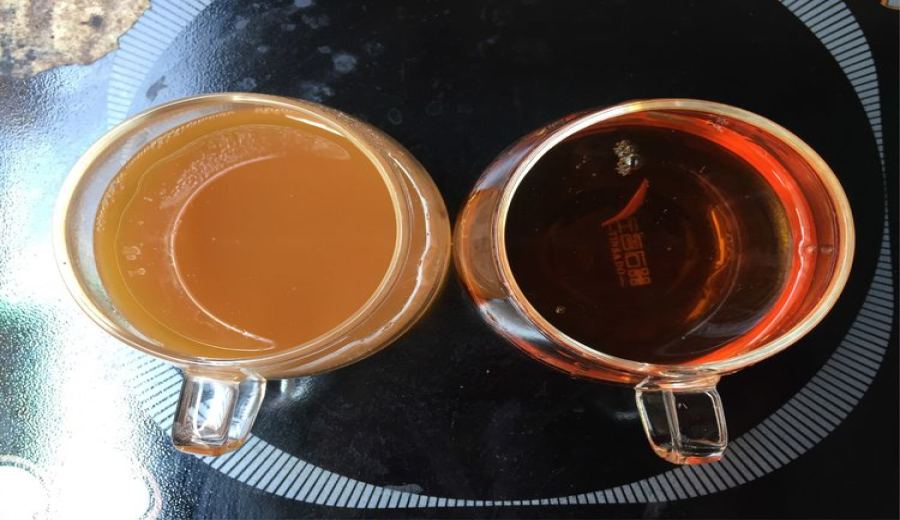
Introduction:Have you ever noticed that after brewing Yinghong No. 9 black tea, the tea liquor becomes cloudy as it cools down, or even forms sediment at the bottom of the cup? In fact, this phenomenon, known as "cold brew haze" or "tea cream," is a natural reaction of the compounds in black tea at lower temperatures. Rather than diminishing flavor, it can actually be a sign of high quality. This article delves into the science behind cold brew haze, its relationship with temperature, and how this characteristic can help assess a tea’s freshness and strength.
When brewing Yinghong No. 9 black tea, many people may have experienced this: the freshly brewed tea is bright and clear, but if left to sit or cool down, a yellowish, mud-like cloudiness gradually appears, settling at the bottom and proving hard to clean. However, when hot water is added, the sediment quickly dissolves, and the tea becomes clear again. This common yet curious phenomenon is what we call “cold brew haze,” also known as “tea cream.”
The formation of cold brew haze is mainly related to three key components in black tea: theaflavins, thearubigins, and caffeine. At high temperatures (around 100°C), these substances remain in a free state, allowing them to dissolve evenly in the tea liquor and resulting in a clear appearance. However, as the tea cools, these compounds begin to interact and form complex complexes—what we observe as the cloudy haze.
These complexes exhibit colloidal properties. Over time and with decreasing temperature, the colloidal particles grow larger and aggregate, leading to the formation of a milky suspension in the tea. The color typically ranges from orange-yellow to brown, depending slightly on the fermentation level of the tea. This transition from clear to cloudy is what we refer to as the cold brew haze phenomenon.
It's worth noting that during the tea production process, polyphenols in the leaves are partially converted into theaflavins, thearubigins, and theabrownins through fermentation. Among these, theaflavins and thearubigins not only influence the color of the tea liquor but also play a significant role in the formation of cold brew haze. Caffeine, with its slightly bitter taste and chemical stability, also participates in this complexation reaction.
When brewed with hot water, these components remain dispersed. But once the tea cools and molecular activity slows, they begin to adhere to each other, forming tiny colloidal particles visible to the naked eye. This is why the tea gradually becomes cloudy at room temperature or upon cooling, sometimes even developing a sediment layer at the bottom.
So, does cold brew haze mean the tea is of poor quality? Actually, quite the opposite. In the experience of drinking black tea,cold brew haze is often considered an indicator of higher freshness and strength.When black tea contains abundant theaflavins and thearubigins, these substances are more likely to form complexes upon cooling, making the cold brew haze more pronounced. Therefore, if you find that a cup of Yinghong No. 9 shows significant cold brew haze as it cools, it usually means the tea is rich in internal compounds and relatively high in quality.
However, the degree of cold brew haze visibility is also influenced by brewing conditions. For example, using water that is too cool, steeping for too long, or using too much tea leaf can accelerate the release of compounds in the tea, further affecting the degree of cloudiness upon cooling. Therefore, if you want to observe whether a black tea exhibits cold brew haze, it is recommended to brew it using standard pour over or teapot methods, with water temperature controlled between 90°C and 95°C, and then observe the changes in the tea liquor as it cools at room temperature.
In short, the next time you brew Yinghong No. 9 and notice cloudiness after the tea cools, don’t worry that the tea leaves are spoiled—in fact, you can view it as a reference point for tea quality. By observing the presence and degree of cold brew haze, you’ll gain deeper insight into the tea’s internal composition and overall performance, further enhancing your tea tasting experience.
The above content is compiled by CoffeeHunters, a coffee news website.


