







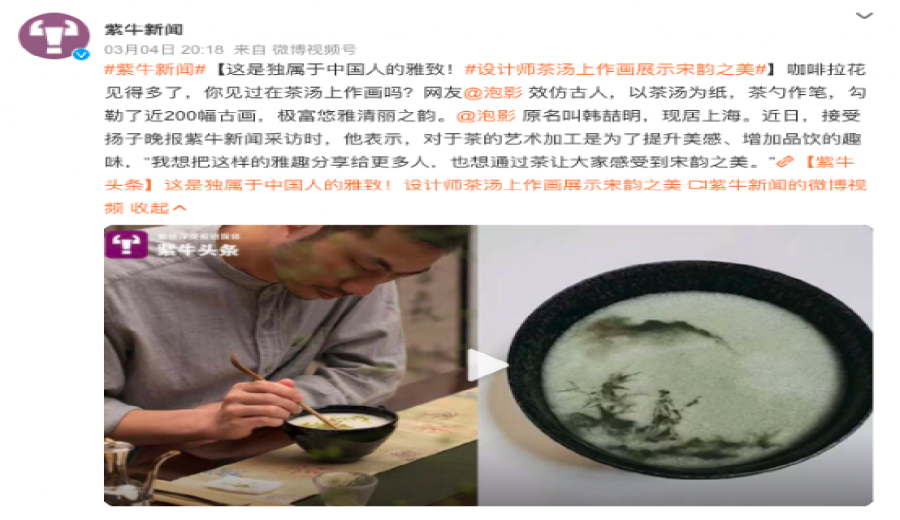
Introduction:Did you know? As early as a thousand years ago during the Song Dynasty, ancient Chinese people were painting intricate designs on the surface of tea soup. This art, known as "tea foam art" (茶百戲), can be considered the Eastern counterpart to coffee latte art. This article will delve into the complete process of Song Dynasty tea whisking (點茶), explore the historical origins and techniques of tea foam art, compare the differences between modern adaptations and traditional methods, and take you on a journey to appreciate this remarkable craft that blends tea artistry with painting.
Coffee latte art is a common visual treat in modern cafés, but did you know? You can also create stunning patterns on the surface of tea soup. Among the tea culture of the Song Dynasty, there was a remarkable skill called "tea foam art," which involved drawing designs on the frothy layer of tea. This ancient technique has recently garnered renewed attention thanks to the creative work of a Shanghai-based designer.
This designer, Han Zheming, made it to the Weibo hot search with his exquisite skill of painting traditional Chinese ink paintings on tea soup. He combines the traditional Song Dynasty tea whisking craftsmanship with modern artistic creation—using specially processed white tea powder, he achieves a fine and uniform layer of tea foam through seven precise pours and whisking motions, then uses tea paste as "paint" to sketch classical paintings on the tea foam.
The process of making tea foam is highly meticulous. First, the tea leaves are ground into extremely fine tea powder, thenseven pours of waterare performed: the first pour turns the tea powder into a paste, while the following six require continuous whisking with a tea whisk (茶筅) to form a thick and even foam layer. This technique not only gives the tea soup rich visual layers but also a more delicate flavor.
It’s worth noting that during the "tea competitions" (鬥茶) popular in the Northern and Southern Song periods, one of the judging criteria was the endurance of the tea foam—a technical term referred to as "biting the cup" (咬盞). This was not just a way of drinking tea, but evolved into a form of competitive art.
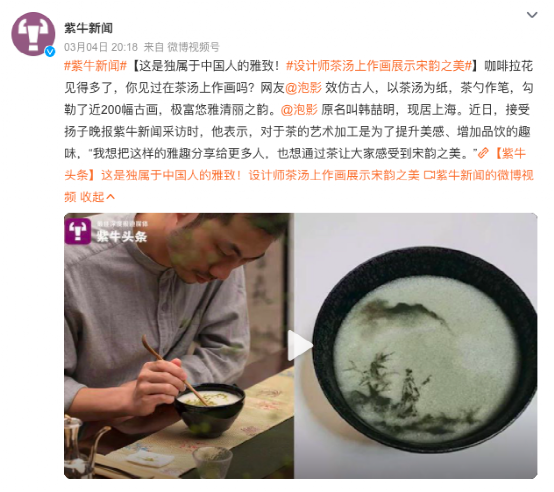
The timing for creating tea foam art is extremely critical, as the foam naturally dissipates over time. Therefore, creators must complete their artwork withinjust a few minutes,with the entire process from whisking the tea to painting needing to be completed within ten minutes. Over the course of six years, Han Zheming has created nearly 200 pieces, including classic works such as “Plum Blossom and Sparrow” by Emperor Huizong of the Northern Song (趙佶) and “Distant View of Cloudy Peaks” by Ma Yuan of the Southern Song (馬遠).
There are significant differences between traditional tea foam art and its modern adaptations. According to ancient texts, the original method involved using clear water or tea soup as the medium, manipulating a tea spoon to "pour water and move the scoop" (下湯運匕)—using water as ink to draw patterns on the tea foam. Modern adaptations use tea paste as paint, which produces a more vivid visual effect but no longer follows the method precisely as in antiquity.
Additionally, the full tea whisking ceremony traditionally concludes with the step of "dividing the tea" (分茶), where the prepared tea soup is evenly poured into each teacup to ensure consistent foam texture in every serving. This detail is often overlooked in modern adaptations but was a crucial element of ancient tea ceremonial culture.
This ancient tea art technique not only showcases the Song literati's pursuit of perfection in tea culture but also offers modern people a new way to experience tea culture. When you sip a cup of tea, you might also sense the aesthetics, perseverance, and innovation cherished by tea lovers a thousand years ago.
The above content is compiled by CoffeeHunters, a coffee news website.


