








Introduction:Blue Bottle Coffee is accelerating its expansion in mainland China. Following the opening of its first store in Shanghai, the second location will be set up on West Nanjing Road, currently under renovation. Earlier this year, the brand registered a new company in Beijing, signaling its intention to expand into the northern China market. Facing intense competition in the coffee industry, how will Blue Bottle differentiate itself with its premium, specialty positioning? This article analyzes its store planning, market strategy, and future challenges.
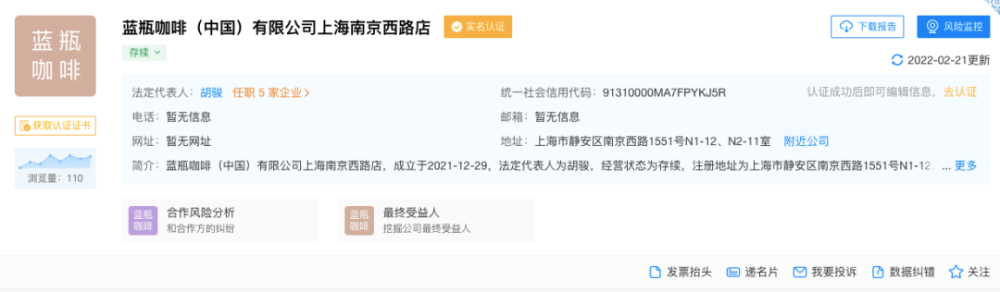
The pace of Blue Bottle Coffee’s expansion in mainland China has clearly accelerated. After the debut of its first store in Shanghai, the second location has been confirmed at West Nanjing Road, with renovation work already underway. Observations on-site show that the storefront area has been fenced off, and interior construction is in progress. According to registration data, this new store was officially registered on December 29 last year, with the address being Room N1-12 & N2-11, No. 1551 West Nanjing Road, Jing’an District, Shanghai — approximately 1.5 kilometers away from the renowned Starbucks Reserve Roastery Shanghai.

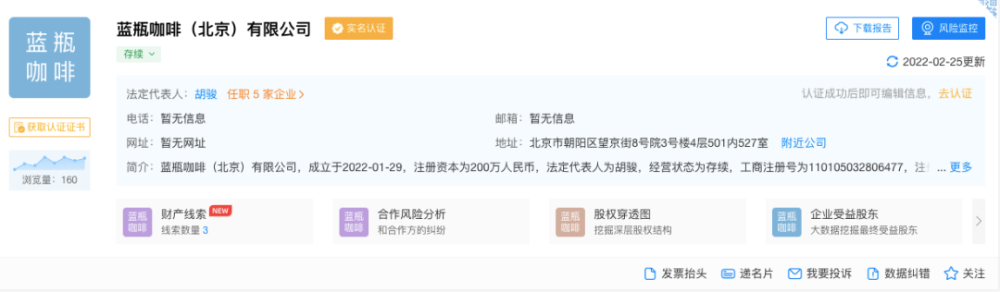
As early as last year, there were market rumors that Blue Bottle Coffee planned to open 10 stores in Shanghai. The two confirmed locations so far are the Chang’an Road Yutong store (the first store) and the West Nanjing Road store (the second store). According to information from the Tianyancha platform, apart from these two outlets, no other registrations have been recorded. Notably, on January 29 this year, Blue Bottle Coffee registered a limited company in Beijing, prompting speculation: has the brand included the northern China market in its short-term development plans?
Although the news of new openings is exciting, consumers should remain realistic. Blue Bottle Coffee’s entry into the Chinese market comes with considerable challenges. Its product pricing is relatively high, while the domestic coffee market has become highly competitive — with options ranging from chain brands to independent cafes. In a direct price comparison, Blue Bottle’s market entry at this time does not offer a competitive advantage.
However, with its unique product experience and strong brand recognition, the brand still has the potential to attract specific consumer groups. Its focus on a minimalist, niche approach combined with specialty coffee, along with distinctive brand symbols and widely shared brand stories, has successfully garnered a following among customers seeking differentiation. Market analysts point out that Chinese consumers’ understanding of coffee culture is still evolving — many initially encountered coffee through domestic brands such as Luckin and Manner. As the market matures, demand for premium specialty coffee is expected to gradually increase.
CITIC Securities Research Department predicts that the share of the premium specialty coffee market is around 25%–30%, and existing independent specialty coffee shops and brands have not yet fully met the demand in this segment. Against this backdrop, Blue Bottle Coffee, which adheres to a quality-oriented approach, is likely to carve out a niche and accelerate its expansion.
Judging from the performance of its first store, Blue Bottle Coffee’s pricing strategy has not significantly affected consumer decisions — many customers place more value on its brand. Market feedback indicates that the brand delivers consistent product quality, with no major customer attrition reported, so the issue of “high pricing” has not become a major point of contention. This strategy to some extent shows that Blue Bottle is avoiding the “price war” stirred up by domestic brands and does not primarily view local competitors as its main rivals.
The above content is compiled by CoffeeHunters, a coffee news website.


