







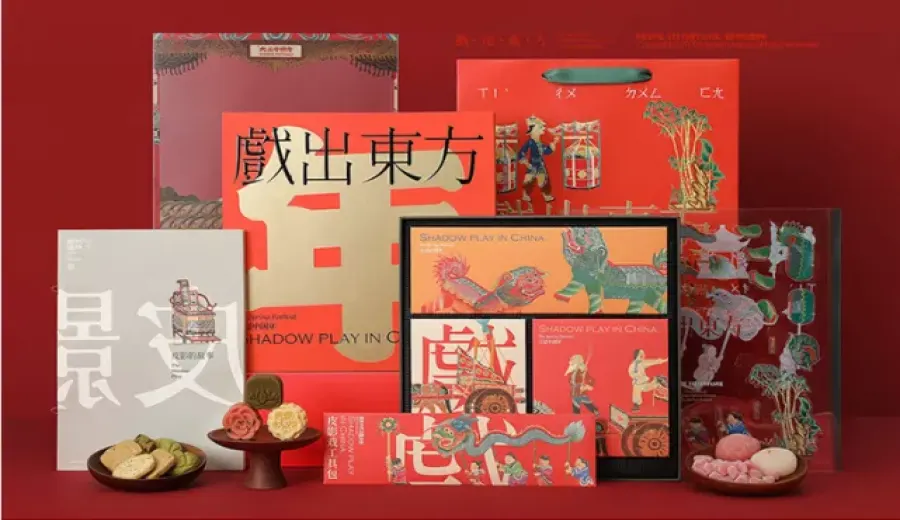
Introduction:Lunar New Year is a key opportunity for brands to showcase their creative takes on Chinese cultural trends. This year, Starbucks collaborated with calligrapher Zhu Jingyi to release Spring Festival couplets, but the writing style and content sparked widespread online criticism. This article delves into the marketing logic behind the "guochao" (Chinese cultural trend) movement, explores how international brands can balance respect for traditional culture with innovative expression, and offers practical advice for choosing guochao-style coffee merchandise.
In recent years, the "guochao" trend has swept across various industries, with traditional patterns and fonts being reimagined and integrated into modern designs, becoming a popular direction for brand marketing. Lunar New Year is a crucial time for brands to showcase their "guochao" creativity. This year, Starbucks partnered with calligrapher Zhu Jingyi to launch Spring Festival couplets, attempting to reinterpret traditional Lunar New Year elements in a trendy way. However, the writing style and content expression drew extensive online skepticism. This is not Starbucks' first foray into "guochao"—from the "Three Good Star Youth" campaign in 2020 to the 2022 Lunar New Year series, its strategy has gradually intensified.
For Chinese consumers, Spring Festival couplets are not just decorations but cultural carriers carrying wishes for good fortune. This controversy prompts reflection: How can international brands appropriately use "guochao" elements to showcase innovation while still respecting tradition?
Starbucks is no stranger to leveraging "guochao." In 2020, it launched the "Three Good Star Youth" series as a "test run" to observe consumer reactions to foreign brands using "guochao." Since then, Starbucks has released several guochao-inspired merchandise items, but without aggressive promotion. It wasn’t until the 2022 Lunar New Year series that Starbucks officially made "guochao" a central theme, significantly increasing its promotional and contextual efforts compared to previous years.
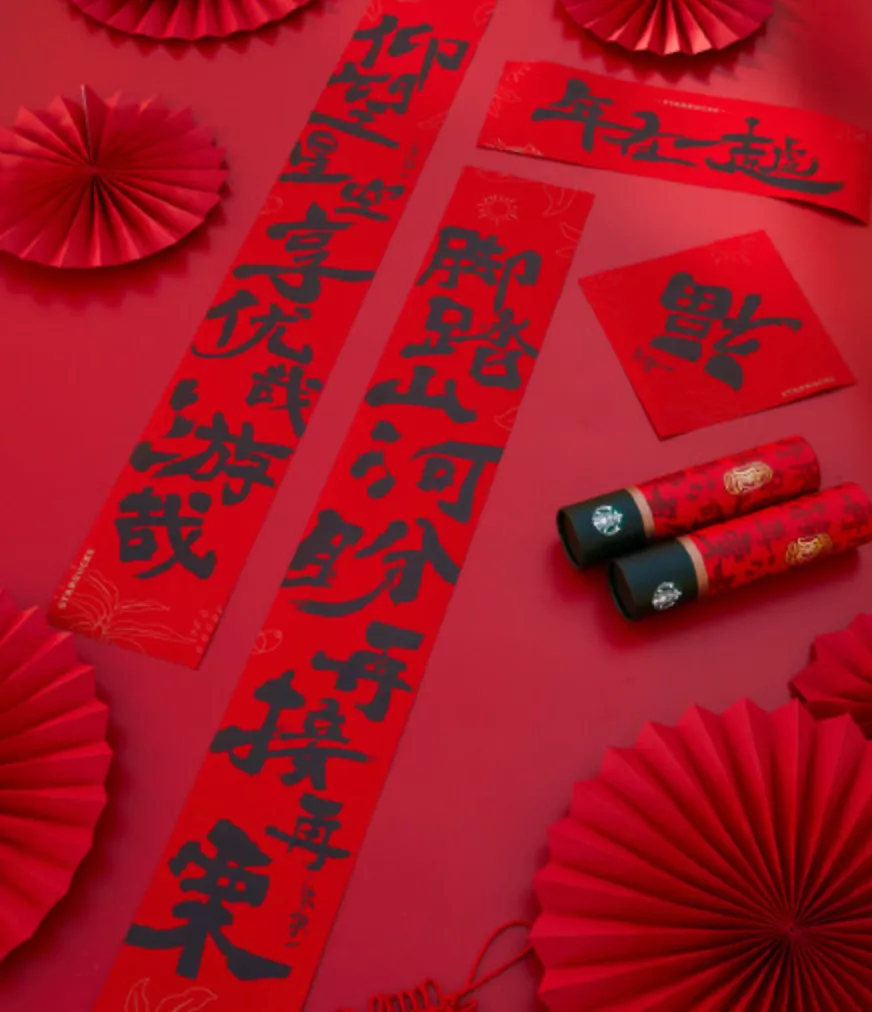
This year, to further integrate imported coffee into the traditional Chinese Lunar New Year setting, Starbucks not only introduced festive-themed pastries, "New Year-flavored" beverages, and zodiac-themed merchandise but also collaborated with trendy calligrapher Zhu Jingyi to launch "guochao" calligraphy Spring Festival couplets. These couplets play on the homophone "nian zai yi qi" (together for the year), conveying the message that no matter where you are or how you celebrate, Starbucks will "stick with you."
For this collaboration, Starbucks teamed up with Zhu Jingyi, dubbed the "mudslide" of the calligraphy world, creating two sets of couplets. Their defining features? They disregard "tonal harmony and rhyme" and aren’t bound by "traditional calligraphy." Starbucks explained that this design isn’t confined to tradition, making it more fun—a new interpretation of Spring Festival couplet text and a fresh form of calligraphic art.
Artist Zhu Jingyi is often referred to as the "madman" of the calligraphy world. His calligraphic works feature text content akin to jokes—varied, whimsical, and completely devoid of rhyme. His writing style bears some resemblance to that of Tsang Tsou-choi, who called himself the "King of Kowloon" in Hong Kong and was known for his street graffiti—unrestricted to paper, writing wherever he pleased, with uneven and asymmetrical fonts, and content that could be anything he wanted, all to highlight his uniqueness.
However, this style has also faced criticism. Some argue it’s an attempt to forcibly blend foreign "street graffiti" culture into traditional Chinese culture under the guise of "new-style calligraphic art," constituting a form of "cultural invasion." Regarding Zhu Jingyi’s style, many netizens bluntly stated that he lacks reverence for traditional culture and is unworthy of being called a "calligrapher."
The Spring Festival couplets released by Starbucks this year sparked heated online discussions, with criticism primarily centered on their "lack of calligraphic beauty and deep disrespect for traditional Chinese culture." Netizens pointed out that while couplets written on white paper, walls, or other surfaces might be seen as art, when written on traditional couplet paper, they appear incongruous. Additionally, the couplet content—such as "Gaze at the stars, enjoy a leisurely life; stand on the mountains, look forward to pressing on" and "Whether chatting or busy, I love sticking close; no matter how hectic, find moments of ease"—was not only convoluted but also lacked the traditional blessing meanings of Spring Festival couplets.
In fact, as an important part of traditional Chinese culture, Spring Festival couplets have strict standards for both their writing and content. Professionals note that a proper couplet must not only feature balanced antithesis and tonal harmony but also convey auspicious meanings. While Starbucks attempted to reinterpret traditional elements with a trendy style, it clearly failed to strike the right balance in both writing technique and content creation.
This controversy also serves as a reminder to international brands to exercise greater caution when using guochao elements. Innovation is important, but respect and understanding of traditional culture are equally indispensable. For consumers, when selecting guochao-style coffee merchandise, it’s advisable to focus on whether the product design genuinely integrates cultural meaning, rather than merely pursuing visual novelty.
The above content is compiled by CoffeeHunters, a coffee news website.


