







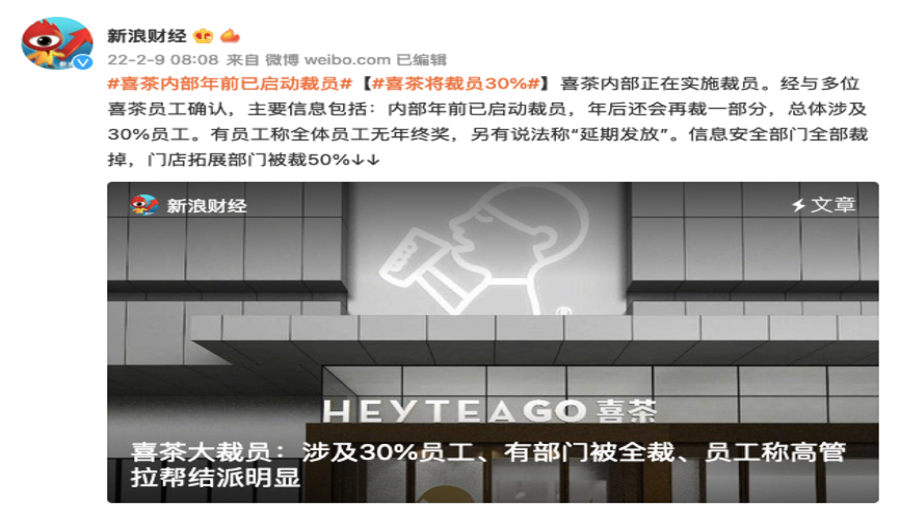
Introduction:The new-style tea brand HEYTEA recently made headlines with reports of layoffs, drawing attention to its operational status and the competitive landscape of the industry. Although the company officially responded that it was merely normal personnel optimization, the slowdown in growth, deceleration in store expansion, and price reduction strategy all reflect the broader issues of severe market homogenization and cooling capital enthusiasm. This article delves into HEYTEA’s operational adjustments since 2021 and the real challenges facing the new-style tea market.
The new-style tea brand HEYTEA has recently been embroiled in a layoff controversy, with online rumors suggesting that around 30% of its employees were cut internally, sparking widespread market discussion. In response to the rumors, HEYTEA quickly clarified that the reports were untrue, stating that it only conducted normal personnel structure adjustments based on year-end evaluations, with no large-scale layoffs taking place.
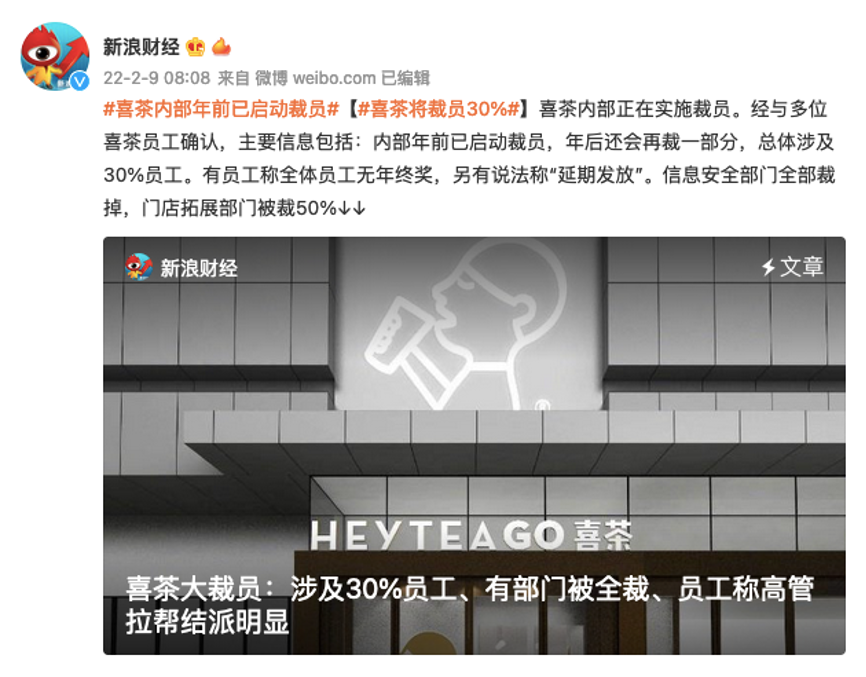
According to an earlier report by Sina Finance, an internal employee of HEYTEA revealed that some staff had already been laid off before the Spring Festival, with further layoffs expected after the holiday, totaling around 30%. Some employees also noted that year-end bonuses were not issued as scheduled and might be delayed; among these, the Information Security Department was reportedly disbanded entirely, while the Store Expansion Department saw a layoff rate as high as 50%. Although affected employees could apply for internal transfers—for example, from technical to business roles—the scale of the personnel changes was still hard to overlook.
HEYTEA’s official statement pointed out that the small number of personnel adjustments before the New Year were purely part of normal optimization measures based on year-end performance. It also emphasized that all employees’ year-end bonuses were distributed in full before the Spring Festival according to individual performance, with no instances of arrears or non-payment.
In fact, the new-style tea market has long entered a highly competitive red-ocean phase. Brands are not only rapidly following trends in products—such as yellow-skinned and yuzu drinks that became wildly popular the previous year, almost becoming a must-have item for every brand—but are also frequently adjusting their business strategies. Those able to go public are busy preparing for IPOs, while those with capital are accelerating fundraising, yet the overall issue of product homogenization is becoming increasingly serious.
Take HEYTEA as an example. As a representative of premium tea beverages, its primary customer base consists of urban white-collar workers and young consumers, with stores mostly located in popular commercial districts where rents and operating costs remain high, resulting in relatively expensive product pricing. However, unlike many brands that have chosen to raise prices, HEYTEA, amid a market atmosphere leaning conservative,has adopted a price reduction strategy, with some products even dropping to a minimum price of 9 yuan, approaching the price range of mid-tier tea drinks.
Nevertheless, this move has drawn skepticism from many consumers. Some customers have reported that the so-called price cuts are actually “a reduction in price but an increase in cost,” with some drinks showing signs of “cutting corners”—items that were previously offered for free, such as toppings, now come at an additional charge, making the discounts feel insincere. Industry insiders speculate that this strategy may be a short-term move to boost market share, aiming to squeeze the survival space of mid-to-low-price tea beverage brands.
Looking back at 2021, HEYTEA’s operational performance also fell short of expectations. The pace of store expansion slowed significantly, only surpassing 800 stores by the third quarter, with the vast majority concentrated in first- and second-tier cities. Additionally, since July of last year, both its per-store sales efficiency and average revenue have shown a downward trend. Some netizens on social platforms have also pointed out internal management chaos within the brand, with even rumors of executive infighting and other negative news.
It is worth noting that although the new-style tea market has long been favored by capital, attracting substantial investment, the early 2022 announcement by Nayuki that it expects to post an annual loss of over 100 million yuan, coupled with the layoff news from HEYTEA, raises the question: is this once rapidly growing market now facing a wave of reshuffling and adjustment?
The above content is compiled by CoffeeHunters, a coffee news website.


