







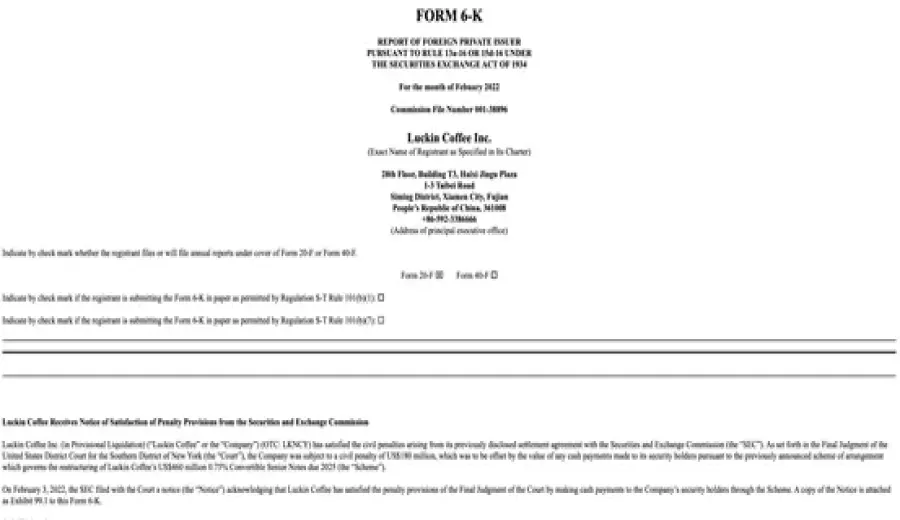
Introduction:Luckin Coffee paid $187.5 million to settle with the U.S. Securities and Exchange Commission (SEC) over its financial fraud case — an amount equivalent to the profit from selling tens of millions of cups of coffee. From the Muddy Waters short-seller report exposing $2.2 billion in fabricated transactions, to the Nasdaq delisting, how did Luckin fall from a capital market myth to rock bottom? What impact did Lu Zhengyao’s role have on investor confidence? With Centurium Capital acquiring equity and Lu Zhengyao completely exiting, can Luckin make a comeback in 2022? This article provides an in-depth analysis of the full scope of the incident and its future direction.
Luckin Coffee reached an $187.5 million settlement agreement with the U.S. Securities and Exchange Commission (SEC). This massive fine reflects the strict requirements of the U.S. capital market regarding financial transparency. Calculated based on the pre-price-increase average price of around 15 to 16 RMB per cup at that time, this amount would require selling approximately 75 million cups just to offset — not including production and operational costs.
If we further consider the common 3.8-fold discount at the time, where a latte was actually sold for only 5 to 6 RMB, it would take nearly 200 million cups sold to “break even” on the fine. Of course, Luckin could not possibly cover this huge sum solely through coffee sales revenue, which also shows the profound impact the incident had on its financial structure.
This settlement can be seen as an important step for Luckin to pave the way back to the capital markets. Although the company had previously denied plans to relist in the U.S., failing to resolve the dispute with the SEC would not only prevent the resumption of stock trading but could also lead to ongoing legal proceedings. The settlement helps maintain the company’s credibility in international capital markets and preserves possibilities for future financing and expansion.
The spark for the incident can be traced back to January 2020, when the well-known Chinese short-seller Muddy Waters released an 89-page investigative report accusing Luckin of attracting customers with heavy subsidies and falsifying financial statements to cover up actual operational losses. The report mobilized 92 full-time and 1,200 part-time investigators, collecting over 25,000 receipts, pointing out serious misreporting by Luckin in key metrics such as order volume, average spending per customer, and advertising expenses.
The report revealed that Luckin exaggerated sales figures to create the illusion of high growth, leading investors to misjudge the sustainability of its business model. In reality, most of the invested funds ultimately turned into low-priced coffee, rather than genuine corporate profits.
In response to the allegations, Luckin initially issued a statement on February 3, 2020, denying the fraud, calling the Muddy Waters report baseless and misleading. However, just over two months later, on April 2, Luckin pre-announced the results of its internal investigation before the U.S. market opened, admitting that since the second quarter of 2019, the company’s Chief Operating Officer (COO) and his team had been involved in fabricating transactions, amounting to 2.2 billion RMB.
This news shocked the market and led to Luckin’s official delisting from the Nasdaq exchange on June 29, 2020. From rapid expansion to a financial scandal, Luckin’s “coffee myth” quickly collapsed, and investor confidence plummeted accordingly.
Behind this incident, the role of founder Lu Zhengyao cannot be ignored. Through the successful IPO of UCAR, he accumulated extensive capital market experience and connections, and later propelled Luckin to expand rapidly using a similar model — relying on heavy subsidies and aggressive store openings to seize market share. However, this business model, which was highly dependent on capital infusion and lacked substantive profit support, ultimately proved unsustainable.
The year 2022 became a pivotal year for Luckin’s transformation. On January 27, Centurium Capital announced that the buyer consortium it led had completed the acquisition of shares from some of Luckin’s shareholders. This confirmed, in terms of equity structure, that Lu Zhengyao and the former management team had fully exited the company’s operations. This change brings an opportunity for Luckin to reposition and adjust its strategy, and has the market looking forward to whether it can return to a path of growth with more stable steps.
The above content is compiled by CoffeeHunters, a coffee news website.


