







Introduction:After Heytea’s classic bestseller, the Juicy Bayberry series, made a comeback, its affiliated company was fined 450,000 RMB by the Baoshan District Market Supervision Administration of Shanghai for false advertising regarding ingredients used in its drinks. This incident not only drew public attention to the issue of integrity in the beverage industry but also exposed common pitfalls in ingredient labeling and advertising compliance within the new-style tea drink sector. This article walks you through the full sequence of events, analyzes the involved aspects and regulatory basis, helping you navigate through the information fog when making purchasing decisions.
Heytea’s popular product, the “Juicy Bayberry” series, made a high-profile return to the market after a period of absence. Unexpectedly, its affiliated company, Shanghai Xichuang Yu Cha Catering Management Co., Ltd., was fined 450,000 RMB by the Baoshan District Market Supervision Administration of Shanghai for significant discrepancies between its advertised content and the actual product. This penalty stemmed from a consumer complaint filed half a year prior. After a thorough investigation, it was found that the product in question was suspected of false advertising regarding key information such as the origin of ingredients, contents, and advertising claims.
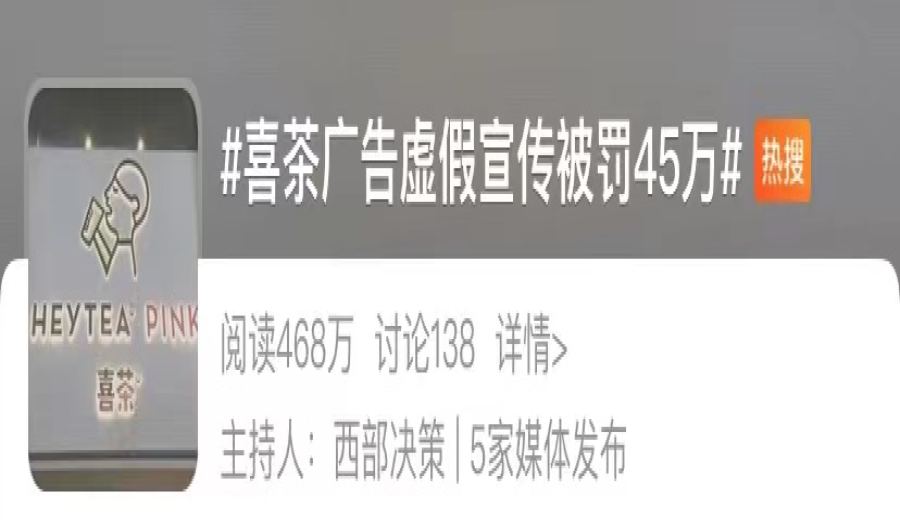
This penalty decision quickly sparked heated discussions on social media platforms. The Weibo topic “#Heytea Fined 450,000 RMB for False Advertising#,” led by West Decision, even surged to the top of the hot search rankings, becoming a focal point of discussion among netizens. Many people expressed doubts about the promotional tactics used in the beverage industry, and it also prompted the public to re-examine whether new-style catering brands can truly balance product quality and information transparency in market competition.
According to the official document number Hu Shi Jian Bao Chu [2021] No. 132021001052, the Baoshan District Market Supervision Bureau received a complaint on June 2, 2021, reporting that the advertisement for fresh fruits such as bayberries displayed at the Lu Xiang Road branch of Shanghai Xichuang Yu Cha Catering Management Co., Ltd., was suspected of violating regulations. After preliminary verification, the complaint was largely substantiated, leading to further investigation.
In fact, the core products at the center of this controversy were the once best-selling “Juicy Bayberry” — which achieved over 3.5 million cups sold in just 72 days — and Heytea’s first-ever fruit sorbet cone series, the “Iceberg Bayberry Cone.” Both drinks used bayberries as their main ingredient. At the time, Heytea emphasized in its official announcement that the variety of bayberries used had been fully upgraded to “in-season Dongkui bayberries,” which were not only larger and juicier, but also claimed to be carefully selected from Shiping in Yunnan and Xianju in Zhejiang. They were described as having “large size, small pits, tightly packed and plump flesh, with intense flavor,” thereby creating an image of a premium product.
However, on June 4, 2021, the Baoshan District Market Supervision Bureau officially launched an investigation into the company’s alleged act of publishing false advertisements. The investigation team gathered evidence on-site, interviewed key responsible persons, and collected relevant supporting materials. Ultimately, it was confirmed that the information claimed by Shanghai Xichuang Yu Cha Catering Management Co., Ltd. regarding the origin of ingredients, contents, and product-related promises significantly deviated from the actual situation, constituting a violation as stipulated in Article 28 of China’s Advertising Law, which prohibits “using advertisements to make false claims about goods or services, deceiving or misleading consumers.”
After comprehensively evaluating the relevant evidence and the extent of impact, the Baoshan District Market Supervision Bureau officially issued the penalty decision on December 16, 2021, with the announcement date clearly recorded as December 7, 2021. This decision was not only a ruling on a single incident but also sent a clear signal of strict market regulation.
After the announcement of this penalty, online public opinion reacted strongly. Some netizens felt the 450,000 RMB fine was too lenient, commenting, “Only 450,000? Are you looking down on Heytea?” Others expressed disappointment with the overall promotional practices in the beverage market, bluntly stating, “This isn’t unique to one brand; you’ll find the same issue everywhere if you look.” Some even criticized, “Forty-five thousand is just a formality—it doesn’t have any real deterrent effect, and similar incidents will definitely happen again in the future.”
Notably, in May of this year, Heytea relaunched the Juicy Bayberry series, achieving impressive sales of nearly 120,000 cups on the first day. As early as April, the brand had already teased the product’s comeback, detailing the challenges of ingredient selection and production processes in an attempt to strengthen consumer trust in product quality. However, after the exposure of this advertising violation, many loyal customers who had previously supported the product began to question the brand’s integrity.
In the current trend of increasingly refined processes in new-style catering, evaluating a brand’s overall strength involves not only supply chain management, human resource allocation, and product innovation speed, but more importantly, the ability to adhere to the fundamental principle of “using genuine ingredients.” When making purchases, consumers should not only focus on flavor and taste but also pay closer attention to the authenticity and transparency of product information in order to make truly informed consumption decisions.
The above content is compiled by CoffeeHunters, a coffee news website.


